
LONDON: Britain on Monday recommended tougher social distancing measures to curb the coronavirus outbreak, including household isolation, home-working and an end to mass gatherings.
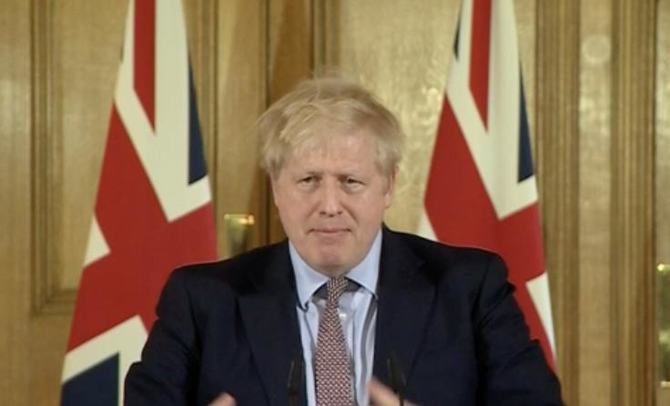
Prime Minister Boris Johnson said more stringent restrictions were needed as more cases were detected, to slow infection rates and protect the elderly and most vulnerable in society.
In a three-pronged approach, the first recommendation is for all household members to stay at home for 14 days if anyone displays symptoms of the disease — a persistent new cough or fever.
The second advises an end to close social contact to protect people aged 70 and over, pregnant women and those with underlying health conditions.
The third recommends an end to mass gatherings — such as sporting — events from Tuesday, despite the risk of transmission among large crowds being “relatively low,” he added.
“Now is the time for everyone to stop non-essential contact with others and non-essential travel,” Johnson said at the first of his planned daily news conferences on the outbreak.
“We need people to start working from home where they possibly can. You should avoid pubs, clubs, theaters and other such social venues,” he added.
Johnson, flanked by chief scientific adviser Patrick Vallance and chief medical officer for England Chris Whitty, said the UK was “approaching the fast growth part of the upward curve.”
He acknowledged the disruption it would cause but said it was important to act at the right time, and promised even tougher measures in the coming days.
That includes isolating people with the most serious health conditions from social contact for 12 weeks to ensure “maximum protection coincides with the peak of the disease.”
The prime minister added that the government was asking for “very substantial change in the way we want people to lead their lives,” adding it was “unprecedented” in peacetime.
Vallance suggested the 12-week period “may be a little longer.”
Britain’s approach contrasts sharply with that of other countries, particularly its nearest neighbors on mainland Europe, many which have sealed borders and closed schools.
But Johnson stood firm, again resisting calls for schools to be closed, assessing that “on balance it’s much better if we can keep schools open.”
Britain, which had 1,543 confirmed cases as of 9:00 am (0900 GMT) on Monday, with 35 deaths, is currently only testing people who have been taken to hospital suffering from severe symptoms.
Whitty said more than 44,000 people have been tested so far and expected testing to be increased in the coming weeks.
Last week, Vallance suggested between 5,000 and 10,000 people may have COVID-19 without knowing it.
But on Monday he declined to give an estimate, saying only “the epidemic is expected to double every five days.”
“The absolutely key thing is testing, ramping up our ability to test... who has had the disease rather than who has got it,” he told reporters.
“How many people have had it and been asymptomatic, that is the biggest unknown worldwide.”
He said restrictions will remain in place for some time.
“We stressed right from the beginning, it’s going to be a marathon not a sprint.”