HAMMAMET, TUNISIA: Ammar Jouini had been optimistic about this year, hoping that after Tunisia’s tourism sector finally recovered from years of pain caused by militant attacks in 2015, his souvenir business might also be looking up.
But with the coronavirus devastating holiday bookings, he is thinking of shutting up his shop in the popular beach resort of Hammamet and seeking new work for the season. “I have to wait three or four days to sell only one piece. My costs are much higher than my income. It seems the difficulties will return again,” he said.
Tunisia had been gearing up for a season of record visitor numbers that politicians hoped would make up for gloom elsewhere in the economy. But last week Prime Minister Elyes Fakhfakh said forecast economic growth had fallen to 1 percent from 2.7 percent, citing the virus.
In another blow to the tourist trade, Tunisia has announced it will require everyone arriving from abroad to self-isolate for two weeks.
Tourism accounts for nearly a tenth of Tunisia’s economy, is its second-biggest employer after agriculture and provides an important source of foreign currency.
The crash that followed the 2015 attacks caused gross domestic product (GDP) growth to slow to 0.5 percent that year from an expected 3 percent. It contributed to a sharp fall in the value of Tunisia’s currency the following year and ongoing economic troubles.
Tunisia agreed to a loan program in 2016 with the International Monetary Fund but it expires in April and the new government, agreed in February after months of wrangling, is now trying to negotiate a replacement.
Jouini’s shop is far from the only business facing hard times in Hammamet, where resorts stretch along the sandy beach each side of the pretty walled city and its fort.
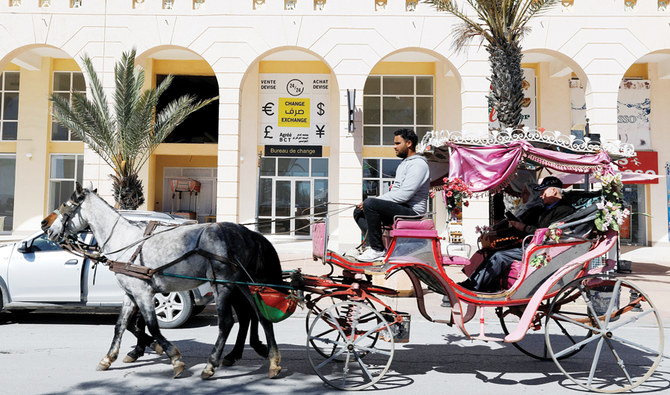
While Jouini spoke, other souvenir sellers played football in the street, their shops empty. Nearby, Ramadan Jlassi sat with his horse-drawn carriage, waiting for customers.
He does not earn more than 10 dinars ($3.50) a day and has three sons, he said. “It is hard to buy the basics for my family,” he said.
Canceled reservations
Tunisia has confirmed 13 cases of the coronavirus.
Spring bookings at the Hasdrubal hotel, one of the smartest in town, stand at 15 percent, a quarter of the usual level in March, said general manager Samir Ncir.
“There is stagnation. Many reservations were canceled,” he said. The hotel is not yet planning to lay off staff though it may delay signing up seasonal workers, hoping that the epidemic will pass and tourists will return in
the summer.
“We expect the pattern to return at the end of May and the beginning of June. But we may have to put off signing contracts with casual workers in the summer,” he said.
But for Jouini, who has two children, the outlook is not good. “It will be complicated for me and my family because this is our only income,” he said.

Tunisian beach resorts face up to coronavirus blight
https://arab.news/grz5x
Tunisian beach resorts face up to coronavirus blight
- Tunisia has confirmed 13 cases of the coronavirus
Saudi Maaden reports 156% profit surge to $2bn on strong commodity prices, record production
RIYADH: Saudi mining and metals company Maaden has reported a 156 percent jump in its net profit attributable to shareholders for 2025, driven by higher commodity prices, record production volumes, and a one-off bargain purchase gain.
The state-backed giant posted a net profit of SR7.35 billion ($1.95 billion) for the full year 2025, an increase from SR2.87 billion in the previous year. The firm’s revenue surged by 19 percent to SR38.58 billion, up from SR32.55 billion in 2024.
This comes as Saudi Arabia steps up efforts to expand its mining sector as a pillar of economic diversification, encouraging international participation and private investment to unlock the Kingdom’s estimated $2.5 trillion in untapped mineral resources under Vision 2030.
In a statement on Tadawul, the company said: “Performance was led by record phosphate production, near record aluminum production, an increase in all three of Maaden’s main output commodity prices.”
The performance was also fueled by a 60 percent increase in gross profit, which reached SR14.79 billion. In its annual results announcement, Maaden attributed the top-line growth to “higher commodity market prices for phosphate, aluminum and gold business units,” as well as increased sales volumes in its phosphate and aluminum segments. This was partially offset by slightly lower sales volume in the gold unit.
Maaden’s CEO, Bob Wilt, hailed 2025 as a transformative year for the company, marked by strategic growth and operational excellence. “This was a great year for Maaden’s strategic growth. We delivered strong financial results and sustained operational excellence across the business,” he said in a statement.
“This was driven by growth in production across all businesses, including record-breaking DAP (di-ammonium phosphatevolumes), disciplined cost control across and a clear commitment to our role as a cornerstone of the Saudi economy,” Wilt added.
Profitability was further bolstered by an increased share of net profit from joint ventures and an associate. This included a one-off bargain purchase gain of SR768 million related to Maaden’s investment in Aluminium Bahrain B.S.C. The company also benefited from lower finance costs.
The fourth quarter of 2025 was strong, with Maaden swinging to a net profit of SR1.67 billion, compared to a loss of SR106 million in the same period of the prior year. Quarterly revenue rose 7 percent to SR10.64 billion.
The firm achieved record production of di-ammonium phosphate, reaching 6.72 million tonnes for the year, a 9 percent increase. Aluminum production remained near-record levels, while the company added a net 7.8 million ounces to its reportable gold mineral resources through discovery and resource development.
The phosphate division saw sales jump 17 percent to SR20.77 billion, with the earnings before interest, taxes, depreciation, and amortization margin expanding to 47 percent. The aluminum business reported a 9 percent increase in sales to SR10.99 billion, with EBITDA more than doubling in the fourth quarter.
Looking ahead, Wilt emphasized that the pace of growth will accelerate as the company advances key initiatives, including the Phosphate 3 Phase 1 and Ar Rjum projects, which remain on budget and schedule. Maaden has also secured a gas supply for its future Phosphate 4 project.
“This pace of growth will only accelerate. Not only as we advance projects and increase the scale of our exploration program, but as we continue to grow production and implement technology that will further modernize, streamline and unlock value,” Wilt added.
Earnings per share for the year rose sharply to SR1.91, up from SR0.78 in 2024. Total shareholders’ equity increased by 18.7 percent to SR61.59 billion.


