Syria death toll 384,000 after nine years of war

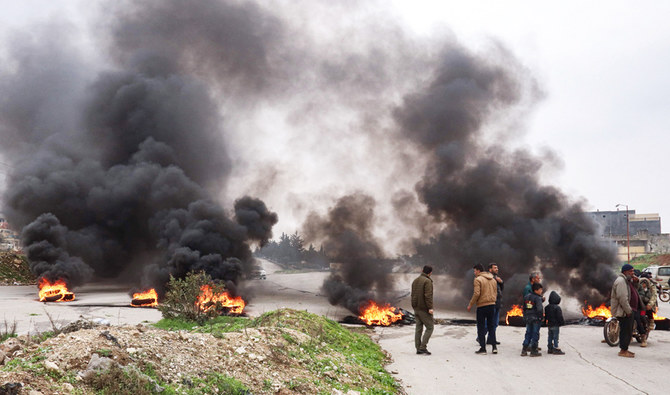
Civilians cut off a section of a highway near the Syrian town of Ariha in Idlib on Saturday, protesting the passage of Russian patrols along the road. (AFP)
Short Url
Updated 15 March 2020
Follow

Syria death toll 384,000 after nine years of war

  • The latest death toll includes about 22,000 children and 13,000 women

BEIRUT: At least 384,000 people have died in Syria, including more than 116,000 civilians, since the war began in March 2011, the Syrian Observatory for Human Rights said on Saturday.
Sparked by deadly repression of peaceful pro-democracy protests, the conflict has drawn in outside powers in a complex war involving opposition factions, militant groups and foreign interests.
As the war enters its 10th year, the regime of Bashar Assad now controls more than 70 percent of Syrian territory, thanks to the military support of its allies Russia, Iran and Lebanese militant group Hezbollah.
The conflict is the “worst manmade disaster since World War II,” the UN human rights chief declared in 2017.
The war has destroyed the economy and caused more than 11 million Syrians to flee their homes.
According to the Observatory, which relies on a network of sources in Syria, the latest death toll includes about 22,000 children and 13,000 women.
At least 129,476 regime soldiers, allied forces and militiamen have died, according to the Britain-based war monitor, including 1,697 members of Hezbollah.
Nearly 57,000 opposition figures have died, as well as 13,624 members of the Kurdish-led Syrian Democratic Forces, which spearheaded the US-backed campaign against Daesh, the Observatory said.
The Observatory tallied 67,296 deaths among militants loyal to Daesh or to Hayat Tahrir Al-Sham, an alliance led by a former Al-Qaeda affiliate that dominates the last opposition enclave in the Idlib region in the northwest.

FASTFACTS

• The war has destroyed the economy and caused more than 11 million Syrians to flee their homes.

• The latest death toll includes about 22,000 children and 13,000 women.

The death toll included 421 unidentified victims.
After recent regime advances, Idlib province is the last battleground between regime forces, and the militants and their allies.
Damascus launched an offensive to take the region in December, causing close to 1 million people to flee, according to the UN, before Ankara and Moscow negotiated a cease-fire earlier this month.
NGOs continue to denounce human rights abuses by the Syrian regime, including lethal chemical attacks, torture and arbitrary arrest.
Tens of thousands of people have been subject to forced disappearances by the government or a myriad of armed groups, NGOs report.
The war has destroyed infrastructure and crucial sectors of the economy including the oil industry.


Turkiye asks Britain’s MI6 to step up protection of Syria’s Sharaa, sources say 

Updated 8 sec ago
Follow

Turkiye asks Britain’s MI6 to step up protection of Syria’s Sharaa, sources say 

  • A Turkish source said that MIT appealed to MI6 for more support after one such incident last month
  • A senior Syrian security source said the request came after a “high-risk assassination plot”

ISTANBUL/DAMASCUS/LONDON: Turkiye’s intelligence agency asked its British counterpart MI6 last month to take a larger role in protecting Syrian President Ahmed Al-Sharaa after recent assassination plots, according to five people familiar with the matter.
The request highlights efforts by foreign allies to shore up a country still shaken by sporadic violence 15 months after the overthrow of president Bashar Assad, with the US-Israeli war on Iran now rattling the wider region.
Those allies see Sharaa as crucial to preventing a relapse into sectarian fighting or civil war, after 14 years of civil conflict drove millions of refugees abroad and allowed Daesh to control swathes of Syria.
The militants last month stepped up attacks on military and security personnel across Syria and declared Sharaa, a former rebel, their “number one foe.”
It was unclear what specifically Turkiye’s National Intelligence Organization, or MIT, had asked of MI6, or what new role, if ⁠any, MI6 ⁠had taken up.

ANXIETY RISES IN SYRIA OVER DAESH
Turkiye, Britain and the US last year threw their backing behind Sharaa to try to reunite and rebuild his country of 26 million. London and Washington have scrapped most sanctions on Syria and on Hayat Tahrir Al-Sham (HTS), the Islamist group he once led.
The sources who spoke to Reuters requested anonymity owing to the sensitivity of the matter.
MIT, the Turkish foreign ministry, Britain’s foreign office and Syria’s defense and interior ministries did not respond to requests for comment.
The sources, including Syrian and foreign officials, all cited rising anxiety over a series ⁠of reported Daesh plots to kill Sharaa.
A Turkish source said that MIT, which has played a key role in helping the new government to establish itself, appealed to MI6 for more support after one such incident last month. A senior Syrian security source said the request came after a “high-risk assassination plot”, adding that MIT, MI6 and Syrian authorities were constantly sharing intelligence.
Details of the plot were unclear. A separate Western intelligence source briefed on the matter believed Turkiye wanted to introduce a Western presence in Damascus to provide something of a buffer between the agencies of Turkiye and Israel, currently at loggerheads.

REPORTED ASSASSINATION ATTEMPTS AGAINST SHARAA Last year, Sharaa and two senior cabinet ministers were targeted by Daesh in five foiled assassination attempts, according to the UN Office of Counter-Terrorism. In November, Reuters reported that Syrian authorities had foiled two of the attempts.
Describing Sharaa as a “watchdog” of the global anti-Daesh coalition, ⁠the group mounted six attacks ⁠on Syrian authorities last month in what it called a “new phase.”
On Thursday, Damascus openly acknowledged for the first time that it coordinates with MIT, saying they had cooperated to foil an Daesh attack in the capital.
Turkish security sources said MIT had identified a team of three preparing remote bomb attacks, enabling Syrian counterparts to prevent an “imminent assault.”
A US diplomat briefed on the matter said MIT’s request to MI6 had been prompted by the Daesh resurgence.
The Western intelligence source said the two agencies could intensify joint planning and technical operations, but that no decision had been made on whether to send British personnel to Damascus. A Syrian security source said a physical British presence would be “highly risky.”
They said MI6 had been discussed at a meeting in Damascus on February 26 between a delegation headed by Britain’s special envoy for Syria, Ann Snow, and Syria’s deputy interior minister, Major General Abdulqader Tahan.
Sharaa was a commander of Al Qaeda’s Nusra Front in Syria before cutting ties with the group in 2016, then led a coalition of Islamist rebel factions in late 2024 to topple Assad.