Pakistan passes child abuse law in view of Zainab Ansari case

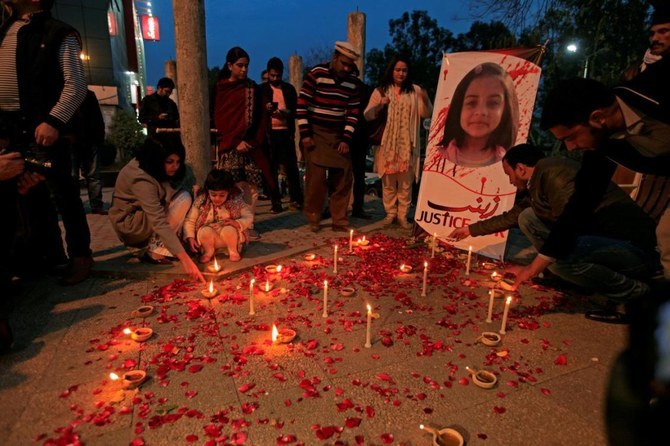
Members of Civil Society light candles and earthen lamps to condemn the rape and murder of 7-year-old girl Zainab Ansari in Kasur, during a candlelight vigil in Islamabad, Pakistan January 11, 2018. (Reuters)
Short Url
Updated 12 March 2020
Follow

Pakistan passes child abuse law in view of Zainab Ansari case

  • 7-year-old girl was brutally raped and murdered in Kasur district of Punjab province
  • First national child abuse law brings life imprisonment for child abusers

ISLAMABAD: Pakistan’s parliament passed a new law against child abuse on Wednesday, two years after the rape and murder of a 7-year-old girl that shocked the country.
Pakistan’s first national child abuse law will introduce a penalty of life imprisonment for child abuse, said Pakistan’s Human Rights Minister Shireen Mazari.
It follows the death of Zainab Ansari, whose body was found in a garbage dumpster in Kasur district near the eastern city of Lahore in 2018, sparking large protests and accusations of negligence by authorities.
There had been reports of a number of missing children in the district since 2015 when authorities uncovered what they said was a pedophile ring linked to a prominent local family.
Mazari tweeted that the bill’s passage had been “a long struggle” as she thanked colleagues for helping it clear numerous hurdles.
“Finally, we have emerged today successful, getting the Zainab Alert Bill sailed through the National Assembly with a majority of votes,” she told the Thomson Reuters Foundation by phone.
An amended version of the bill cleared Pakistan’s legislative assembly late on Wednesday after being passed by the upper house earlier this year. It is expected to receive the formal assent of the president in the coming days.
Zainab’s case triggered a debate in Pakistan over whether to teach children how to guard against sex abuse, a taboo subject in the Muslim majority nation.
Nearly 10 cases of child abuse a day are reported in Pakistan, according to Sahil, an organization that works on child protection, with girls disproportionately affected.
The law requires police to register a case within two hours of a child’s parents reporting them missing.
It includes measures to speed up the process, including the establishment of a dedicated helpline and a new agency to issue alerts for a missing child.


Punjab expands Pakistan-India Wagah border arena with museum, partition-themed park

Updated 4 sec ago
Follow

Punjab expands Pakistan-India Wagah border arena with museum, partition-themed park

  • The border crossing, near eastern city of Lahore, is the primary land route between Pakistan and India and one of the most recognizable symbols of their often-tense relations
  • The site is best known for its daily flag-lowering ceremony, a choreographed military ritual performed by border forces from both countries that draws thousands of spectators

ISLAMABAD: Maryam Nawaz, chief minister of Pakistan’s Punjab province, on Thursday inaugurated the newly constructed arena at Wagah border cross between Pakistan and India, which includes a museum and a partition themed park.

The Wagah border crossing, located near the eastern city of Lahore, is the primary land route between Pakistan and India and one of the most recognizable symbols of the often-tense relationship between the two neighbors. It serves as a key point for prisoner exchanges and limited movement of travelers, while remaining tightly regulated due to security considerations.

The site is best known for its daily flag-lowering ceremony, a choreographed military ritual performed by border forces from both countries that draws thousands of spectators. Over the years, the ceremony has evolved into a popular tourist attraction, blending displays of nationalism with public spectacle and making it one of Pakistan’s most visited landmarks, which connects with India’s Attari.

Flanked by military officials, CM Nawaz visited the crossing and inaugurated the new arena, with its seating capacity increased from 7,500 to 25,000 spectators, the state-run Radio Pakistan broadcaster reported. The chief minister also visited the martyrs’ monument and offered her respects.

“In addition to the arena’s expansion, several new constructions have been added at the Joint Check Post Wagah. These new developments include a theme park depicting the partition of the Subcontinent, featuring models of a railway station, military equipment and a Martyrs’ Memorial,” the broadcaster reported.

“A Pakistan Museum has also been established within the arena, showcasing the country’s history and culture from the Freedom Movement to the present day.”

In August 1947, Britain divided the Indian Sub-continent, its former colony, into two countries — Hindu-majority India and Muslim-majority Pakistan.

Excitement over independence was quickly overshadowed by some of the worst bloodletting that left up to 1 million people dead as gangs of Hindus and Muslims slaughtered each other.

Creating two independent nations also tore apart millions of Hindu and Muslim families in one of the world’s largest peacetime migrations, which displaced at least 15 million people.

The fate of Kashmir, then a princely state, was left undecided. The Himalayan territory continues to remain a flashpoint in relations between the neighbors, who have fought multiple wars over it.