

A quarter of Iranian oil rigs idle as US sanctions bite into production

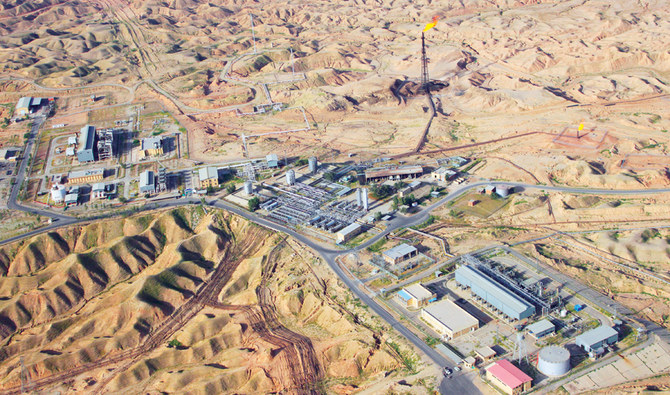
Falling exports have deepened Iran’s recession. (Shutterstock)
Short Url
Updated 11 March 2020
Follow

A quarter of Iranian oil rigs idle as US sanctions bite into production

  • The sharp fall in oil prices in 2020 — due to the impact of the coronavirus epidemic on global demand — will exacerbate the pain for Iran’s economy, which is also dealing with one of the biggest outbreaks of the disease outside China

LONDON: At least a quarter of Iran’s oil rigs are out of action as US sanctions strangle the Islamic Republic’s vital oil industry, according to a Reuters review of financial documents and industry sources, dealing a potentially long-term blow to its oil industry.
The lack of rig activity could damage the OPEC member’s capacity to produce oil from older fields, which require continuous pumping to maintain pressure and output. That would make it difficult for Iran to raise production back to pre-sanction levels if tensions ease with the US.
The US sanctions aim to curtail Tehran’s nuclear ambitions and regional influence. They have forced Iran to slash its oil output by half since early 2018 to less than 2 million barrels per day (bpd) because refineries worldwide have stopped buying its oil.
Plummeting production and exports have deepened a recession in Iran and choked the government of its main source of income. Reduced activity has forced mass layoffs in its oil sector.

FASTFACT

Tehran has slashed oil output by half since 2018.

The sharp fall in oil prices in 2020 — due to the impact of the coronavirus epidemic on global demand — will exacerbate the pain for Iran’s economy, which is also dealing with one of the biggest outbreaks of the disease outside China.
Some of Iran’s oil rigs are out of action because they cannot be repaired. Sanctions have also made it more difficult and expensive for it to buy and import spare parts.Iran relies entirely on imported parts for its rigs, said Mohsen Mihandoust, a director at Iran’s Society of Petroleum Engineers.
 In a decade of work in oil and gas drilling in Iran, Mihandoust has never seen a spare part that was not imported, and most came from the US or Europe.
“We are still dependent on other countries,” he said. “It is like learning to work with a TV remote control, but still having no clue how a television is made.”
Sanctions had driven up the costs of spare parts as much as five-fold, making it not feasible to repair the rigs, he said.
Iran bought dozens of new and second-hand Chinese rigs in the past decade, but the core parts of those were still American, two industry sources said.


Closing Bell: Saudi main market closes the week in red at 10,526 

Updated 25 December 2025
Follow

Closing Bell: Saudi main market closes the week in red at 10,526 

RIYADH: Saudi equities ended Thursday’s session modestly lower, with the Tadawul All Share Index slipping 14.63 points, or 0.14 percent, to close at 10,526.09.    

The MSCI Tadawul 30 Index also declined 3.66 points, or 0.26 percent, to 1,389.66. In contrast, the parallel market outperformed, as Nomu jumped 237.72 points, or 1.02 percent, to close at 23,430.93.  

Market breadth on the main market remained tilted to the downside, with 156 stocks ending lower against 99 gainers.    

Trading activity eased further, with volumes reaching 80.46 million shares and total traded value amounting to SR1.66 billion ($442 million).    

On the movers’ board, Saudi Industrial Export Co. led the gainers, rising 6.6 percent to SR2.10, followed by Consolidated Grunenfelder Saady Holding Co., which advanced 6.43 percent to SR9.60.    

Raoom Trading Co. climbed 4.36 percent to SR61.05, while Astra Industrial Group gained 4.35 percent to close at SR139. Riyadh Cables Group Co. added 3.77 percent to end the session at SR135.00.    

On the downside, Methanol Chemicals Co. topped the losers’ list, falling 5.96 percent to SR7.41.  

Flynas Co. retreated 5.43 percent to SR61.00, while Leejam Sports Co. dropped 5 percent to close at SR100.80.    

Alramz Real Estate Co. slipped 4.64 percent to SR55.50, and Almasane Alkobra Mining Co. declined 4.55 percent to SR84.00.  

On the announcement front, ACWA Power said it has completed the financial close for the Ras Mohaisen First Water Desalination Co., a reverse osmosis desalination project with a capacity of up to 300,000 cubic meters per day, alongside associated potable water storage facilities totaling 600,000 cubic meters in Saudi Arabia’s Western Province.    

The project was financed through a consortium of local and international banks, with total funding of SR2.07 billion and a tenor of up to 29.5 years, while ACWA Power holds an effective 45 percent equity stake.  

Shares of ACWA Power ended the session at SR185.90, up SR0.2, or 0.11 percent.     

Meanwhile, Consolidated Grunenfelder Saady Holding Co. announced the sign-off of a customized solutions project with Saudi Aramco Nabors Drilling Co., valued at SR166.0 million excluding VAT.    

The 24-month contract covers the sale and maintenance of field camp facilities, with the financial impact expected to begin from the first quarter of 2026.