

PM Khan says ready to work with Afghanistan’s Ghani for regional peace 

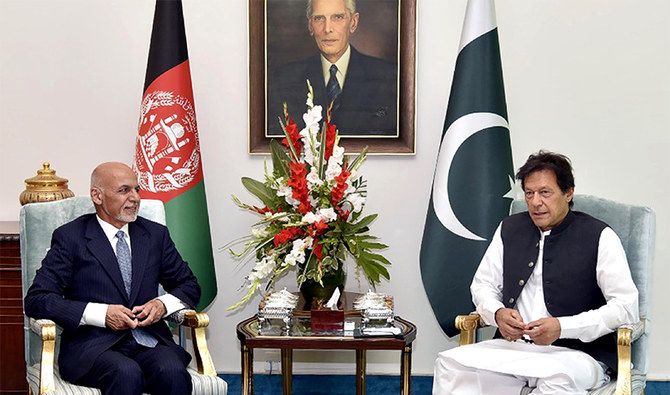
In this handout picture released by Pakistan's Press Information Department (PID) on June 27, 2019, visiting Afghan President Ashraf Ghani (L) talks with Pakistani Prime Minister Imran Khan during a meeting in Islamabad. (AFP)
Short Url
Updated 10 March 2020
Follow

PM Khan says ready to work with Afghanistan’s Ghani for regional peace 

  • Pakistan reaffirmed its support for ‘Afghan-led and Afghan-owned’ peace solution
  • Islamabad expresses hope that Afghan leaders would resolve their differences for the sake of peace

ISLAMABAD: Prime Minister Imran Khan expressed his willingness to work for regional peace with President Ashraf Ghani, following the Afghan leader’s swearing in to a second term on Monday.

“I want to congratulate Afghanistan’s President Ashraf Ghani & look forward to working with him. Pakistan will do everything it possibly can to bring peace and stability in our region,” Khan in said in a Twitter post.

Meanwhile, Pakistan’s Foreign Office reaffirmed in a statement its support for “a peaceful, stable, united, sovereign, democratic and prosperous Afghanistan, at peace with itself and with its neighbors.”

It said that the signing of the US-Taliban peace agreement in Doha on Feb. 29 has created “a historic opportunity for the people of Afghanistan and a pathway to intra-Afghan negotiations.”

Pakistan, the statement read, will “continue to facilitate the Afghan peace and reconciliation process” through a comprehensive and inclusive solution that is “Afghan-led and Afghan-owned.”

“We hope the Afghan leaders would proceed with wisdom and foresight, eschew blame-games, resolve mutual differences, and unite in the supreme interest of their country,” Foreign Office read, as Afghanistan witnessed two oath-takings on Monday, with Ghani’s rival, Abdullah Abdullah, also announcing himself the country’s new ruler.

While Ghani’s ceremony was taking place at the presidential palace in Kabul, Abdullah held a separate one in an adjacent compound

The two leaders have been sharing power — Ghani as president and Abdullah as chief executive — since 2014.

Afghanistan’s electoral commission last month announced that Ghani had won over 50 percent of September’s presidential vote, but Abdullah rejected the result and declared himself the winner.


Pakistan president calls for facilitating trade, business interactions with Iraq

Updated 6 sec ago
Follow

Pakistan president calls for facilitating trade, business interactions with Iraq

  • President Asif Ali Zardari meets Caretaker Iraqi PM Mohammed Shia Al-Sudani in Baghdad
  • Zardari calls for closer cooperation between chambers of commerce of both nations, private sector

ISLAMABAD: President Asif Ali Zardari recently called for facilitating trade and business interactions between Pakistan and Iraq to facilitate cooperation in key sectors of the economy between the two countries, Pakistani state media reported. 

Zardari arrived in Iraq on Saturday for a four-day visit to the country aimed to deepen Pakistan’s bilateral ties with Baghdad. The Pakistani president met Iraqi Caretaker Prime Minister Mohammed Shia Al-Sudani to discuss practical measures to enhance bilateral cooperation, state broadcaster Radio Pakistan reported on Sunday. 

According to the Press Information Department, Pakistan’s exports to Iraq totaled $54.29 million in 2024 while imports from Iraq, primarily petroleum products, amounted to $145.46 million the same year. Analysts have noted that these figures are modest, considering the market sizes and mutual interests of both nations.

“He [Zardari] highlighted priority sectors including information technology, agriculture and food security, construction, pharmaceuticals and medicines,” Radio Pakistan said. 

“The president also stressed the importance of direct banking channels to facilitate trade, business interaction and the movement of pilgrims.”

Every year, thousands of Pakistani pilgrims travel to Iraq to visit some of the most revered shrines in Shia Islam, including the mausoleums of Ali in Najaf and Hussain in Karbala. 

The scale of travel, often involving long stays and cross-border movements, has long posed logistical, security and migration-management challenges for Pakistani authorities and host governments alike.

The president called for improved facilitation for Pakistani pilgrims at immigration points, greater flexibility in emergency travel cases and measures to ease difficulties faced by pilgrims. 

Zardari and Al-Sudani agreed on the importance of maintaining regular high-level exchanges to carry forward bilateral engagement. The Pakistani president spoke of Islamabad’s participation in major trade and health exhibitions in Baghdad, noting these engagements as a step toward sustained business-to-business connectivity.

“He encouraged closer coordination between chambers of commerce and the private sector of both countries through regular exchanges and virtual engagement,” Radio Pakistan said. 

Zardari expressed satisfaction over the steady progress in bilateral defense ties with Iraq, including ongoing training programs and completed defense deliveries.

“He reaffirmed Pakistan’s willingness to further strengthen defense collaboration in line with Iraq’s requirements and evolving security needs,” the state media outlet reported.