

UK’s Labour suspends leading anti-racism campaigner

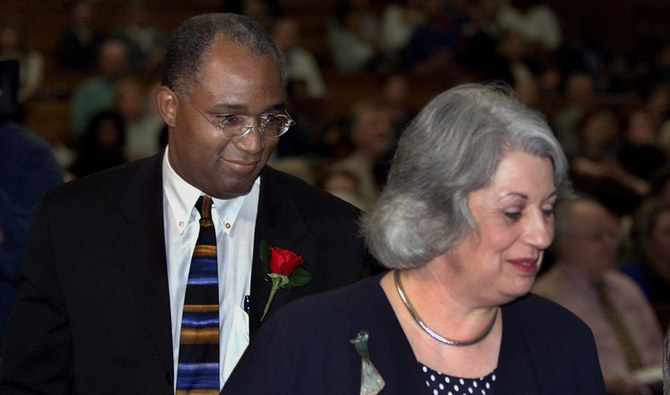
Phillips accused Labour of “shutting down genuine debate.” (File/AFP)
Short Url
Updated 09 March 2020
Follow

UK’s Labour suspends leading anti-racism campaigner

  • Trevor Phillips, ex-chief of Britain’s equalities watchdog, denies accusations of Islamophobia

LONDON: Trevor Phillips, the former head of Britain’s equalities watchdog, has been suspended from the Labour Party following accusations of Islamophobia.

Phillips, who coined the term Islamophobia in the 1990s, is being investigated for public statements he made regarding child sexual abuse involving gangs of South Asian men in towns across the north of England.

The complaint also refers to comments made by him regarding Muslims not wearing poppies — a traditional British symbol for remembering fallen soldiers — during national remembrance events.

He told BBC Radio 4’s Today program on Monday that he had been suspended with immediate effect, and accused Labour of “shutting down genuine debate.”

But Jennie Formby, the party’s general secretary, said the suspension was carried out as a matter of “urgency to protect the party’s reputation.”

Phillips was the founding chairman of the Equality and Human Rights Commission, a government anti-racism watchdog.

Last year, he joined other prominent Labour members who publicly declared they would not be voting for the party in a general election due to concerns over anti-Semitism.

As chairman of the Runnymede Trust — an equalities think tank — in the 1990s, Phillips released a report on Islamophobia and successfully lobbied then-Prime Minister Tony Blair into developing new laws to protect Muslims from discrimination.

England’s first Muslim MP and Labour Party backbencher Khalid Mahmoud reacted to the suspension by saying: “The charges were so outlandish as to bring disrepute on all involved in making them.”

Dr. Rakib Ehsan, a research fellow at the Henry Jackson Society, said: “Trevor Phillips is a leading race equality pioneer who has made insightful contributions on the socially divisive effects of multiculturalism in the UK.

“For the Labour Party to depict him as an anti-Muslim bigot is grossly unfair, and demonstrates Labour’s broader reluctance to discuss problematic attitudes within Britain’s Muslim communities.”

Phillips says he has done nothing to breach the party’s rules.

But Sonia Sodha, a Guardian columnist and chief leader writer for The Observer, tweeted: “All those defending Trevor Phillips as an avowed anti-racism campaigner who can do no wrong should look at his track record of making unfounded claims about Muslims.”

She added: “He made a sensationalist documentary about Muslims in 2016 that claimed that British Muslims were a ‘nation within a nation’ based on a survey that was methodologically unsound and which contradicts better-designed surveys of British Muslims.”

In 2016, Phillips wrote a report titled “Race and Faith: The Deafening Silence,” in which he claimed that “the most sensitive cause of conflict in recent years has been the collision between majority norms and the behaviors of some Muslims groups.”

In the same report, Phillips lamented that only one Muslim wore a poppy at an Islamic conference before Remembrance Sunday.

He added that he later visited an industrial site where many of the workers were Eastern European and African immigrants.

“Poppies were everywhere,” he said. “One group had clearly adapted to the mainstream, the other had not.”


Pakistan Embassy denies role in Kabul visa black market as Afghans turn to agents

Updated 5 sec ago
Follow

Pakistan Embassy denies role in Kabul visa black market as Afghans turn to agents

  • Arab News investigation earlier found how Afghans resort to tour agents, pay up to $1,800 to obtain Pakistani visas
  • Any additional money charged by travel agents is ‘outside the purview’ of the embassy, spokesperson says

KABUL: The Pakistani Embassy in Kabul has rejected reports of knowledge of a black market for Pakistani visas, emphasizing its unwavering commitment to a fair and accessible visa system for Afghans.

An Arab News investigation published last month found Afghans resorting to tour agents and paying exorbitant prices to obtain Pakistani travel documents, with desperate applicants paying between $1,300 and $1,800 for visas that officially cost more than 50 times less.

In a rebuttal shared with Arab News, the Embassy of Pakistan in Kabul said it “has no official agents, intermediaries, or affiliated travel companies authorized to collect money” from visa applicants.

“The embassy’s official visa fee is published transparently and must be paid directly via credit card. We are aware that many applicants lack credit cards and often rely on local agents for assistance with the online payment,” Sayed Khizar Ali, the embassy’s press counsellor, said in a statement to Arab News.

“Our commitment to a transparent, fair, and accessible visa system for our Afghan brothers remains unwavering.”

Multiple travel agencies in Kabul and Nangarhar that earlier confirmed to Arab News that Pakistani visas are traded on the black market have maintained their statements.

“How can it be outside their control when we send applications and they come back approved within three days?” one manager of a travel agency who declined to be named told Arab News this week.

“The embassy stamps the visas. They know where they come from.”

He said his agency has been processing dozens of visas weekly since October, after tensions between Afghanistan and Pakistan rose following a week of deadly clashes at their shared border.

“The travel agencies that are registered with them, we are the only way. If you don’t go through us, you won’t get a visa,” he said.

Despite the embassy’s denial that it does not work through travel agents, public advertisements by several tour agents offering services for “guaranteed” medical and tourist visas can be seen both online and on their storefronts. Though prices are negotiated privately, many openly promise quick turnarounds of just a few days.

The Afghan Ministry of Interior and Ministry of Foreign Affairs did not respond to requests for comment, despite repeated attempts by Arab News.

Pakistan’s visa fee for Afghan nationals is approximately $25, paid through a fully digital online system. But applicants who attempt to follow this channel told Arab News the process often ends in silent rejection after months of waiting.

Asma, an Afghan national who has been trying to join her fiance in Switzerland, had to go through tour agents to obtain her and her father’s Pakistan visas.

“I applied online through the official channel. That was four months ago. I never heard anything back. No response, no explanation — just complete silence,” Asma told Arab News earlier.

The cost to obtain the travel documents was double for her, as her father also had to apply in order to accompany her due to Afghanistan’s strict travel rules for unmarried women.

“We heard from neighbors that some agencies in Kabul could get it done faster … We went there,” she said, adding that they received their visas on WhatsApp three days later — not through official channels but through a cousin’s contact.

One agency employee who agreed to speak anonymously earlier described a system organized around waiting lists and contacts at the Pakistani Embassy and consulates in Kabul, Nangarhar, Kandahar and Mazar-e-Sharif.

“We have lists. Each list works like seats on a plane. When one list is full, we start filling the next. Every day, a list goes out — meaning visas are issued daily,” he said.

“These days, no visa costs less than $1,300 and none exceed $1,800. This rate has been stable for over a month.”

However, the Embassy of Pakistan in Kabul maintained that these reports are “unfounded and most unfortunate.

“Any additional money these private agents may charge applicants is an illegal and unofficial practice that occurs entirely outside the purview and control of the embassy.”