

First Chinese dispatch against locust emergency arrives in Pakistan

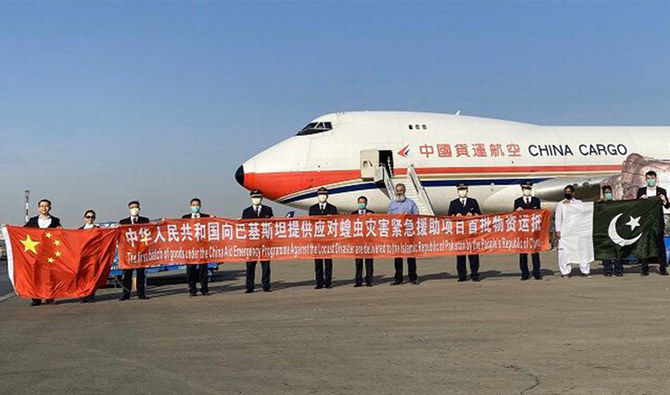
China aids of 50,000 liters of malathion and 14 pesticide sprayers for locust plague prevention & control and 12,000 more coronavirus testing kits arrived in Pakistan on March 9, 2020. (Courtesy: Chinese embassy Pakistan)
Short Url
Updated 10 March 2020
Follow

First Chinese dispatch against locust emergency arrives in Pakistan

  • Chinese experts earlier visited Pakistani provinces worst hit by huge locust swarms
  • The first dispatch carries 50,000 liters of pesticides and 14 air-powered sprayers

ISLAMABAD: First batch of pesticides and other supplies from China arrived in Karachi, on Monday, to help Pakistan deal with its locust emergency.

The consignment include 50,000 liters of pesticides and 14 air-powered high-efficiency remote sprayers, and follows a visit by a Chinese team of experts last month, state run media said.

Pakistan declared a national emergency in February after the food ministry issued a warning that the country was facing its worst locust infestation in two decades.

It led to Pakistan and the FAO (UN’s agency for Food and Agriculture) joining hands on February 25 to tackle the issue.

In a meeting with Federal Minister for National Food Security and Research, Makhdoom Khusro Bakhtiar on Feb 25, FAO representative in Pakistan, Minà Dowlatchahi, discussed the options for chemical and biological control measures and a locust surveillance system introduced by the FAO.

Bakhtiar appreciated the efforts of FAO and “stressed on the need for developing an integrated work plan for controlling the locust without any time lag,” FAO said in a statement.

The emergency pesticide deployment from China is not unwarranted: home-grown cotton – which is being destroyed by the locust attacks – runs Pakistan’s textile industry which is its largest job provider and foreign exchange earner. 

Desert locusts or short-horned grasshoppers, are the oldest migratory pests in the world. They have a high capacity to multiply, form groups, migrate over relatively large distances and, if ecological conditions become favorable, rapidly reproduce.

From the Red Sea coast of Sudan and Eritrea, the locusts first emerged in January this year. By February, they had swarmed Saudi Arabia and Iran before entering Pakistan’s southwestern Balochistan province in March. 

Pakistani authorities estimate that locust attacks have damaged around 80,000 hectares of crop and pastures in Sindh and Balochistan and have also affected areas in Dera Ismail Khan in the Khyber Pakhtunkhwa province.
 
The last major locust infestations in Pakistan were recorded in 1993 and 1997, though the government lacks credible statistics to quantify the damage caused in both instances.


UN torture expert decries Pakistan ex-PM Khan’s detention

Updated 12 December 2025
Follow

UN torture expert decries Pakistan ex-PM Khan’s detention

  • Khan’s party alleges government is holding him in solitary confinement, barring prison visits
  • Pakistan’s government rejects allegations former premier is being denied basic rights in prison

GENEVA: Pakistan’s former prime minister Imran Khan is being held in conditions that could amount to torture and other inhuman or degrading treatment, the United Nations’ special rapporteur on torture warned Friday.

Alice Jill Edwards urged Pakistan to take immediate and effective action to address reports of the 73-year-old’s inhumane and undignified detention conditions.

“I call on Pakistani authorities to ensure that Khan’s conditions of detention fully comply with international norms and standards,” Edwards said in a statement.

“Since his transfer to Adiala Jail in Rawalpindi on September 26, 2023, Imran Khan has reportedly been held for excessive periods in solitary confinement, confined for 23 hours a day in his cell, and with highly restricted access to the outside world,” she said.

“His cell is reportedly under constant camera surveillance.”

Khan an all-rounder who captained Pakistan to victory in the 1992 Cricket World Cup, upended Pakistani politics by becoming the prime minister in 2018.

Edwards said prolonged or indefinite solitary confinement is prohibited under international human rights law and constitutes a form of psychological torture when it lasts longer than 15 days.

“Khan’s solitary confinement should be lifted without delay. Not only is it an unlawful measure, extended isolation can bring about very harmful consequences for his physical and mental health,” she said.

UN special rapporteurs are independent experts mandated by the Human Rights Council. They do not, therefore, speak for the United Nations itself.

Initially a strong backer of the country’s powerful military leadership, Khan was ousted in a no-confidence vote in 2022, and has since been jailed on a slew of corruption charges that he denies.

He has accused the military of orchestrating his downfall and pursuing his Tehreek-e-Insaf (PTI) party and its allies.

Khan’s supporters say he is being denied prison visits from lawyers and family after a fiery social media post this month accusing army leader Field Marshal Asim Munir of persecuting him.

According to information Edwards has received, visits from Khan’s lawyers and relatives are frequently interrupted or ended prematurely, while he is held in a small cell lacking natural light and adequate ventilation.

“Anyone deprived of liberty must be treated with humanity and dignity,” the UN expert said.

“Detention conditions must reflect the individual’s age and health situation, including appropriate sleeping arrangements, climatic protection, adequate space, lighting, heating, and ventilation.”

Edwards has raised Khan’s situation with the Pakistani government.