Lebanon said to be on verge of debt default

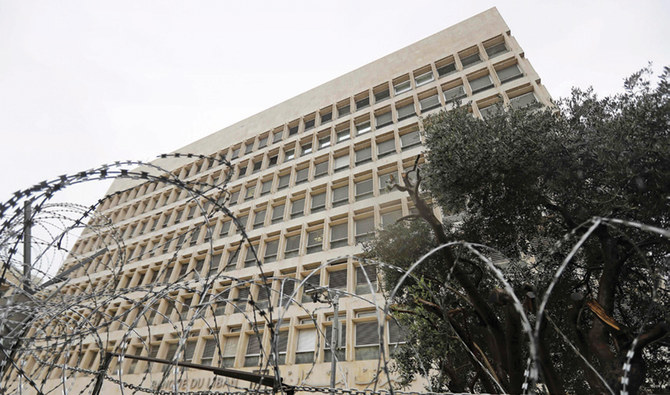
Barbed wire blocks the vicinity of Lebanon’s central bank building in the capital Beirut. (AFP)
Short Url
Updated 07 March 2020
Follow

Lebanon said to be on verge of debt default

  • Prime Minister Hassan Diab will announce Lebanon’s decision on the Eurobonds after meetings on Saturday

BEIRUT: Lebanon will announce on Saturday it cannot make upcoming dollar bond payments and wants to restructure $31 billion of foreign currency debt, unless a late deal with creditors avoids a default.

Debt default would mark a new phase in a financial crisis which has hammered Lebanon’s economy since October, slicing 40 percent off the value of the currency and leading banks to deny access to deposits.

Prime Minister Hassan Diab will announce Lebanon’s decision on the Eurobonds after meetings on Saturday, two days before the state is due to pay back holders of a $1.2 billion Eurobond due on March 9.

“Lebanon is heading toward announcing it will halt payment, or its incapacity to pay the Eurobonds and the interest,” a senior political source told Reuters.

“The Lebanese government will do all it can to reorganize its relations with its debtors and to open the door for negotiations,” the source said. “When we talk about restructuring, we are talking about all the (Eurobond) debt of $31 billion.”

Parliament Speaker Nabih Berri, an ally of the powerful Hezbollah group, said on Wednesday a majority of lawmakers backed not paying back the debt.

The senior source told Reuters last-minute contacts continued, but expressed doubt a breakthrough was possible. A second source said efforts had aimed to avoid a disorderly default but there was little hope of a deal.

“They are trying but I don’t think there’s any hope,” echoed a third source close to the government.

Lebanon still has the option of invoking a seven-day grace period on the March 9 bond, which would allow the country more time for talks.

The March Eurobond dipped 1.7 cents to 57 cents on the dollar on Friday. That followed three consecutive trading sessions of strong gains on hopes of avoiding a default. The bond is trading at more than half the level of some longer-dated dollar issues.



From barrels to bytes: How AI is powering Saudi Arabia’s industrial transformation

Updated 9 sec ago
Follow

From barrels to bytes: How AI is powering Saudi Arabia’s industrial transformation

  • Inside the Kingdom’s drive to merge energy expertise with digital intelligence

RIYADH: Artificial intelligence is moving beyond concept to become a cornerstone of Saudi Arabia’s energy sector, reshaping how oil, gas, and power systems are managed and optimized.

Industry giants like Saudi Aramco are embedding smart systems into their operations to boost efficiency, reliability, and sustainability—key pillars in the Kingdom’s efforts to modernize its industrial base and diversify its economy.

According to the International Energy Agency, oil and gas companies were among the first to adopt digital technologies. The agency estimates that applying AI to power plant operations and maintenance could save up to $110 billion annually by 2035 through reduced fuel consumption and maintenance costs.

For Saudi Arabia, this technological momentum offers both a blueprint and an opportunity. Under Vision 2030, integrating data and intelligent automation is transforming how energy is explored, refined, and delivered.

At the heart of Saudi Aramco’s operations is a digital transformation strategy centered on artificial intelligence, big data, and the industrial Internet of Things. These technologies are applied at every stage of production—from mapping reservoirs and optimizing drilling to improving efficiency and safety.

AI also underpins Aramco’s Digital Transformation Program, which develops in-house smart tools and data-driven platforms designed to cut emissions, reduce costs, and enhance performance while ensuring a reliable energy supply.

A prime example is the Upstream Innovation Center, where engineers have implemented AI solutions that reduce fuel gas use in boilers, improve efficiency, and detect potential leaks through fiber-optic monitoring. At the Khurais oil field, more than 40,000 sensors monitor approximately 500 wells via an Advanced Process Control system—the first of its kind for a conventional oil field at Aramco. Digitization at Khurais has increased production by around 15 percent, doubled troubleshooting speed, and lowered both costs and environmental impact.

These advances illustrate how Aramco’s network is evolving into a connected, adaptive model, blending traditional engineering expertise with digital intelligence.

As Saudi Arabia develops an AI-driven energy economy, the King Abdullah University of Science and Technology is bridging the gap between digital innovation and industrial application. 

Bernard Ghanem, chair of the Center of Excellence for Generative AI, said the university is working with Saudi Aramco to develop AI systems that predict the chemical properties of materials and accelerate research into direct air capture technologies for carbon dioxide removal.

He told Arab News that KAUST is partnering with SABIC and ACWA Power to apply AI in process optimization and materials discovery, turning lab-scale research into practical solutions for the energy sector.

Ghanem said KAUST’s generative AI materials program combines a robotic chemistry lab with its AI Chemist foundation model, a system that accelerates the development of catalysts, battery materials, and membranes for clean energy applications.

“This is our lab of the future, automating experimentation and speeding up energy innovation,” he said.

Mani Sarathy, professor of chemical engineering at KAUST, noted that AI-based reinforcement learning tools are already improving efficiency in hydrocarbon refineries by enhancing simulations and shortening analysis cycles.

“AI is helping energy companies run complex simulations that once took weeks, enabling faster and more precise operational decisions,” he told Arab News.

Sarathy added that the next phase will combine automation with expert oversight. Hybrid human-AI control systems, he explained, are likely to become standard in critical operations, balancing digital autonomy with safety and reliability as Saudi industries expand AI deployment.

These efforts highlight KAUST’s growing role in transforming AI from an academic discipline into a driver of industrial innovation in Saudi Arabia’s energy sector under Vision 2030.

Meanwhile, Skeleton Technologies is bringing AI-driven energy storage solutions to Saudi partners, solutions that are already reshaping industrial systems across Europe and beyond. In Europe, the company combines artificial intelligence and advanced materials to reduce energy use and improve efficiency in data centers, electricity grids, and defense systems.

“Our solutions allow AI infrastructure to consume less electricity and reduce grid connection needs, making AI operations more energy efficient,” Arnaud Castaignet, vice president of government affairs and strategic partnerships at Skeleton, told Arab News.

Inside its factories, Skeleton uses AI-driven digital twin models, created with Siemens Digital Industries, to simulate production, optimize operations, and enable predictive maintenance, Castaignet said. At the core of its technology is curved graphene, a proprietary carbon material that gives Skeleton’s supercapacitors exceptional conductivity.

“It allows our supercapacitors to charge and discharge within microseconds, around 12 microseconds, something batteries cannot do,” Castaignet said.

The company’s flagship Graphene GPU system, built on these supercapacitors, cuts energy use in AI data centers by up to 40 percent and reduces grid requirements by 45 percent while boosting computing performance. The devices are free of lithium, nickel, and cobalt, relying instead on graphene derived from silicon carbide—essentially sand—processed entirely in Germany.

“To build sustainable AI infrastructure, you need energy-saving hardware as well as renewable power,” Castaignet added. “Our Graphene GPU shows both can work together.”

As Saudi Arabia continues linking engineering expertise with digital intelligence, its industrial progress is measured not only in barrels of oil but also in bytes, data, and the smart systems shaping its energy future.