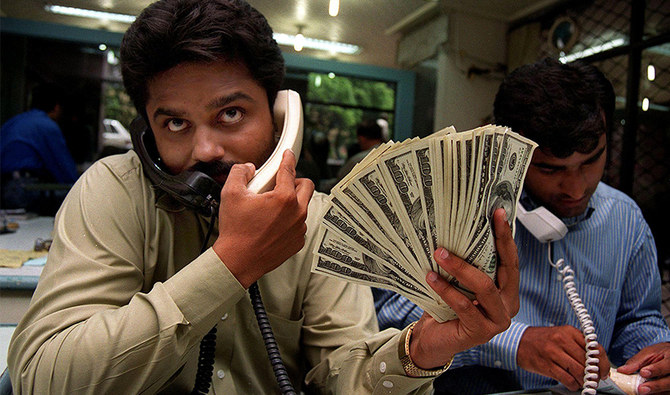

KARACHI: Pakistan expects more inflows of hot money in the coming months, following the US central bank’s interest rate cuts, which experts argue are unlikely to affect the country’s debt market.
“The FED has slashed its rate cut, but our interest rates are still unchanged. The spread between two interest rates is a big incentive for foreign investors, which can increase inflows of money in Pakistan’s short-term treasury bills,” Khurram Schehzad, senior financial analyst and CEO of financial advisory firm Alpha Beta Core, told Arab News on Thursday.
The Federal Reserve System, the central bank of the US, on Tuesday cut the benchmark US interest rate by half a percentage point to a target range of 1.00 percent to 1.25 percent in an attempt to ease economic disruptions from the coronavirus outbreak.
The cut is the biggest single reduction in more than a decade and, according to Pakistani financial experts, makes the South Asian country a more attractive destination for hot money.
The term “hot money” refers to cross-border flows of funds for short-term profits on interest rate differentials or expected changes in exchange rates. With the sole objective of short-term gains, overseas investors search new jurisdictions to take advantage of it.
“Hot money for countries like Pakistan, where inflows of dollars through exports and foreign direct investment for the last few years remained low, is one way of attracting the dollar flows to provide stability to the external account and to the local currency,” Muhammad Sohail, CEO of Topline Securities, told Arab News, adding that it will boost the confidence of overseas investors.
Pakistan’s debt market has been a hot destination for foreign investors after the country’s central bank jacked up its key policy rate to 13.25 percent in July 2019. The interest rate on government papers, including Treasury Bills (T-Bills), then surged to 13.66% and remains high.
Since July 2019, the country has attracted $4.1 billion in its debt and equity markets, with major flows coming in T-Bills being worth $3.4 billion on Tuesday, according to the central bank’s Special Convertible Rupee Account (SCRA). The inflows are largely driven by overseas investors from the US, the UK, and the UAE.
Although the central bank’s governor, Dr. Reza Baqir, on Tuesday declined to divulge the identity of individual investors, State Bank of Pakistan data shows that total inflows from the UK were $2.33 million, followed by the US at $892,514 and the UAE at $109,353.
The government’s short-term paper of three months currently offers a 13.38 percent return, which means that an investment of Rs500,000 promises a return of Rs66,900 after three months.
Although with the beginning of March foreigners sold $158 million worth of T-Bills and outflows of hot money have been recorded, experts say there is nothing to worry about.
“There is nothing to worry about because the worldwide investment in equities and bonds has declined due to the coronavirus outbreak,” said Schehzad, adding that “the money withdrawn has gone into gold.”
According to Sohail, “The rippling effects of the outflows have not been felt because of the country’s better forex reserve position.”
Others, however, argue that as hot money is invested for shorter periods of time, it makes the economy of the host country volatile.
“After the FED rate cut, they (foreign investors) will come to Pakistan but if the currency is revalued or interest rate is slashed they will move out and we would have a problem because our forex reserves are based on deposits from Saudi Arabia, UAE, China etc.,” Ashfaq Yousuf Tola of the Chartered Accountants of Pakistan told Arab News.
Meanwhile, the central bank’s governor made an assurance that the quantum of hot money is not that much and should not affect the temperature of Pakistan’s debt market.
“The temperature in the money market is not so high and there is no need to worry. The amount is even less than 5 percent of the amount invested in Pakistan Investment Bonds and T-Bills,” Baqir said on Monday. “We are aware of the associated risks,” he added.