MAKKAH: Saudi Arabia announced on Thursday that the Grand Mosque in Makkah and the Prophet’s Mosque in Madinah will close an hour after the Isha prayer and will open an hour before Fajr (dawn) prayers each day.
It is the latest precaution to prevent the spread of the coronavirus in Saudi Arabia.
The Kingdom suspended all Umrah pilgrimages on Wednesday over coronavirus fears and authorities have cleared out the Grand Mosque in preparation for its sterilization, following the recent suspension of Umrah visits.
A Saudi official said the deep-cleaning operation is a “temporary preventive measure” that is “unprecedented.” Upper floors remain open for prayers, he added. Videos posted online on Thursday showed a deserted mataf, the area where pilgrims circumambulate the Kaaba.
The areas surrounding the Kaaba where pilgrims walk around it seven times and between the hills of Safa and Marwah where they perform a ritual called Sa’ee will remain closed until the Umrah ban is lifted. Prayers will be performed inside the Grand Mosque.
HIGHLIGHTS
Palestine imposes a 2-week tourist ban after finding 7 cases.
Italy closes schools for 10 days. Iran closes colleges.
California declares emergency after first coronavirus death.
Cruise ship with 3,500 on board is being held off its coast.
Bringing food and drink into the mosques is now prohibited and access to Zamzam containers will temporarily be stopped.
The Sacred Chamber in the Prophet’s Mosque in Madinah which houses the graves of Prophet Muhammad and his two companions, Abu Bakr Siddiq and Omar ibn Al-Khattab, will also be closed off to worshippers.
The changes at the Two Holy Mosques came as the Kingdom accused Iran of increasing the global threat from the coronavirus by not properly documenting the arrival and departure of foreign visitors.
The Ministry of Health previously announced five Saudis tested positive for COVID-19 after returning from Iran, via Bahrain and Kuwait, without revealing they had been in Iran.
An official source in the Kingdom denounced the irresponsible action of granting Saudi citizens entry to Iran without stamping their passports at a time when there is an outbreak of the virus in the country.
It is proof of Iran’s direct responsibility for growing infection rates and the spread of the virus around the world, the source said. Such behavior poses a serious public-health threat to the global community, undermines international containment efforts, and puts communities at greater risk, he added.
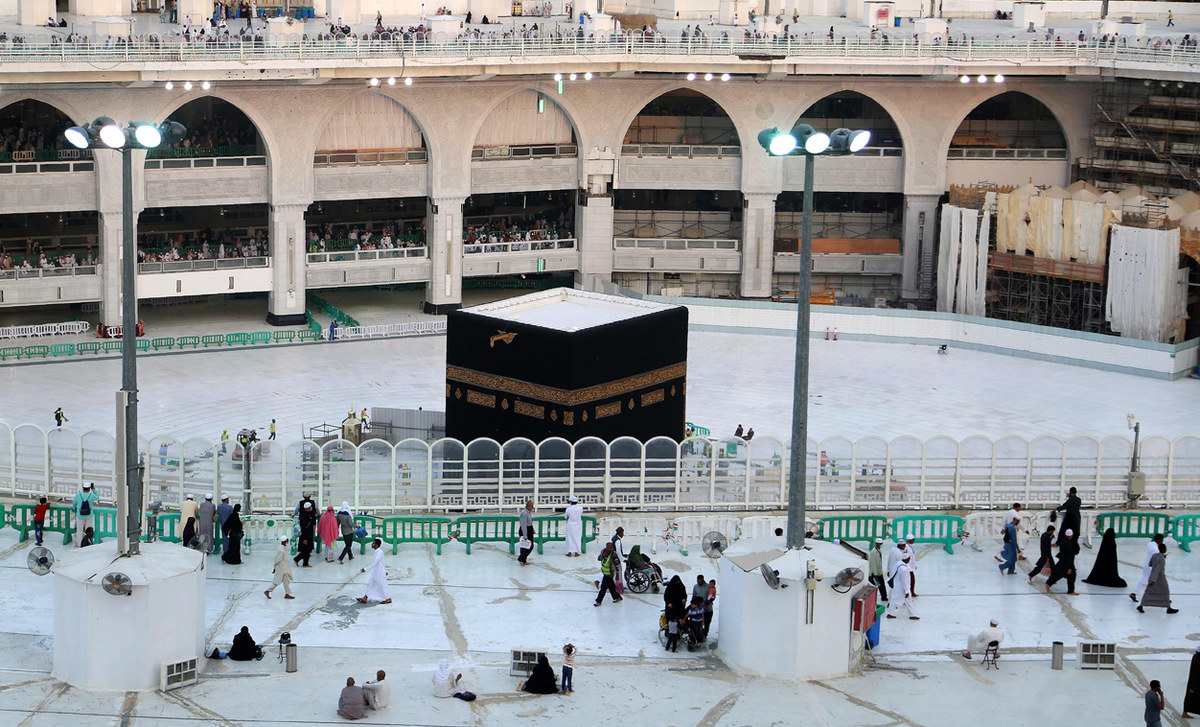
Small groups of people walk around the empty white-tiled area surrounding the Kaaba, inside Meakkah's Grand Mosque. Authorities emptied Islam's holiest site for sterilization over fears of the new coronavirus. (AFP / Abdel Ghani Bashir)
The official urged all Saudis who have visited Iran recently to call the Ministry of Health’s toll-free number (937) so that health precautions can be taken. Saudis currently in Iran were urged to report their visit immediately upon return.
Citizens who voluntarily report their visits to Iran within 48 hours of this announcement will not be subject to the Travel Documents Law and related regulations, the official said. The priority is to ensure the health and safety of citizens who have visited Iran, and their families, by removing the threat of legal action so that they take advantage of safety measures, he added.
The official reiterated that Saudi citizens should not travel to Iran for any reason, and anyone who ignores this faces serious legal repercussions. He called on Iranian authorities to disclose the identities of Saudi nationals who have illegally visited Iran since Feb. 1, and added that they are fully responsible for all Saudis who fail to report their visits and become infected in Iran.
In another development, seven Palestinians working at a hotel in Bethlehem where Greek tourists were staying have tested positive for the coronavirus. The government has declared a two-week ban on tourists.
Italy has closed all schools for at least 10 days, and Iran is closing educational institutions until April. California has declared a state of emergency after its first coronavirus death, and a cruise ship with 3,500 people on board is being held off its coast.