- Financial experts say traders are withdrawing money from banks and using promissory notes while making transactions
- The country’s central bank believes digitization of economy will help create a potential market of $36 billion by 2025
KARACHI: Pakistan’s migration from cash transactions to digital payments remains elusive owing to the fear of the taxman, said the governor of the country’s central bank on Tuesday, adding that people did not want to come into the tax net.
“People are withdrawing money from banks and they do not want to come into the tax net,” Dr. Reza Baqir, Governor State Bank of Pakistan (SPB), told parliamentarians while attending a meeting of the Public Accounts Committee (PAC), local media reported.
The central bank governor has been striving to reduce people’s dependence on cash transactions since he believes it will reduce the cost of printing money and documentation.
In November last year, an agreement was signed between the country’s tax department and financial institutions to help keep an eye on the undocumented money flowing through banking channels. The agreement bounds the commercial banks operating in the country to share details of their account holders, transactions, withdrawals, deposits and payments through debit and credit cards with the tax agency.
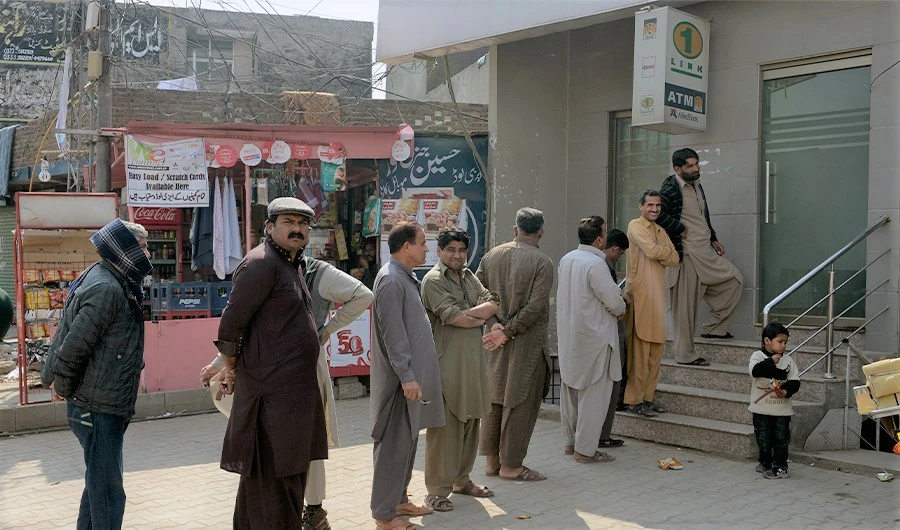
Bankers say the market feedback shows that people have started withdrawing money and are now relying on cash to make transactions.
The increase in the demand of cash has led to the surge of currency circulation in the country’s economy which, according to the SBP data, has increased from Rs4.3 trillion in June 2018 to Rs5.4 trillion in February 2020.
“There is a general fear of tax authorities among people, and many of them have withdrawn money from banks. It also saves them from a number of taxes including on cash transactions done through the banks,” Ahmed Ali Siddiqui, senior banker and Director of the Center for Excellence in Islamic Finance (CEIF) at the Institute of Business Administration (IBA), told Arab News on Wednesday.
“It is like an incentive for people not to deal with banks,” he continued, “and this has developed informal banking channels in some markets where simple promissory notes are circulating for day to day business transactions. It is good that the central bank has understood the reality.”
However, another banker said that it was still not an alarming situation, though it was true that people were preferring cash-based transactions. “The corporates prefer digital transactions but individuals and small businesses prefer cash,” Zubair Shaikh, Convener of the Central Committee of the Federation of Pakistan Chambers of Commerce and Industry (FPCCI) on Islamic Banking, said.
Despite the growing number of Internet and mobile phone users, cash continues to dominate the Pakistani economy with minimal use of electronic payments, regardless of the value of transaction, especially by micro and small retailers.
According to the Pakistan Telecommunications Authority (PTA), the number of cellphone users has increased to 164 million out of which 74 million have subscribed to 3 or 4G services and 76 million are broadband subscribers.
Keeping in view the fast digital transformation, the central bank has launched a digital payment strategy that envisages a migration to efficient electronic payments to stimulate consumption and enhance trade to bring benefits to the country’s whole economy.
By migrating to electronic means, the strategy intends to boost Pakistan’s GDP by seven percent, create four million jobs, generate $263 billion of new deposits and create a potential market of $36 billion by 2025, according to the SBP.
Financial experts warn, however, that this can only be done once people develop faith in the country’s tax authorities.