PARIS: An increasing focus on only one element of identity, whether national, racial or religious, poses a growing danger to the world, according to Amin Maalouf, the influential French-Lebanese writer and recent recipient of France's prestigious National Order of Merit.
In an interview with Arab News shortly after receiving the award from French President Emmanuel Macron at the Elysee Palace on Feb. 29, Maalouf called on people to accept “the many elements of our identity.”
“When we accept that our identity is complex, we can build bridges with the other,” he said.
Maalouf, the author of a series novels written in French, including “Leo Africanus,” “Samarkand” and “The Rock of Tanios,” was formerly a journalist at An-Nahar newspaper in Lebanon. He has lived in France since 1976 and his works have been translated into over 40 languages. In 1993, he was awarded the Prix Goncourt for “The Rock of Tanios” and was also honored by Spain in 2010 with the Prince of Asturias award for literature.
At present, he is the only Arab author who is a member of the Academie Francaise, the 400-year-old institution that protects and honors the French language.
Arab News met the 71-year-old Maalouf at his Paris home in the company of his two grandchildren and wife Andree.
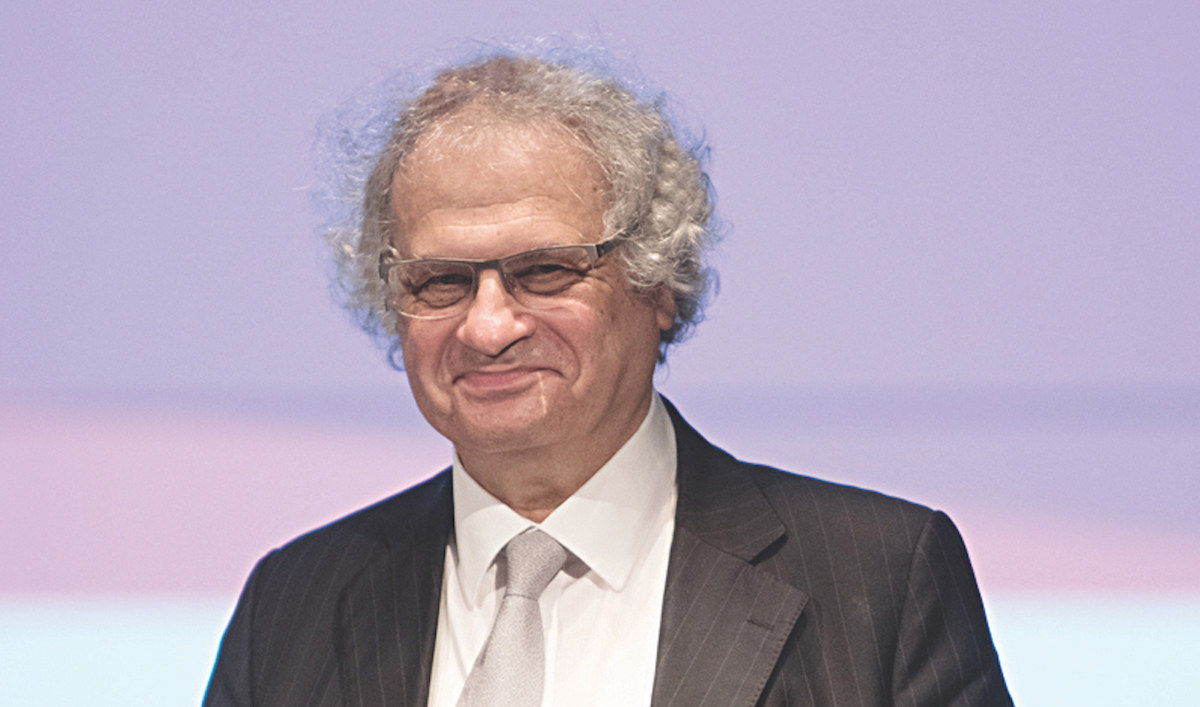
The writer said his major books reflected the point of view of somebody “who lives today, who was born in Lebanon, who is a journalist who watches the world around him and since he moved to France and Europe has continued to watch the world.
“I am not writing from a distant planet; I am myself, with my limitations and my point of view, trying to understand what is happening around me,” he said.
On his recent change from writing novels to penning essays, he commented: “I have always written different types of books — novels, essays, history and even librettos for operas. Maybe in the last few years the focus on the evolution of the world has been more important in essays or novels.
“I think we are not living in ordinary times. These times are worrying, but also fascinating. My book ‘Adrift,’ which will be translated into English and published later this year, sums up what I am trying to say. It is the third part of a reflection on what is happening today. The first was ‘In the Name of Identity’ and the second was ‘The Disordered World.’
“In the second book, the main topic is that we are in a world that is disintegrating. It describes the collapse of order in the world and is an indictment of the way we dealt with the aftermath of the fall of the Berlin Wall. I think at that moment around 1989 or 1990, there was a possibility of building something different, of building a new world order; but, unfortunately, we failed.
“Had those who were in the driver’s seat behaved in a responsible way, they would have consolidated not only the world order but also their own positions because everybody at that time accepted the primacy of the US. A series of adventures and so many interventions that were not followed by responsible strategies has led to what we see today — and we are drifting to an unknown place.
“We are not sure we are going in the right direction. It is obvious that nobody is leading the world and there is no order. We are heading toward a confrontation involving a superpower, the US, which has lost most of its moral credibility and some of its influence, while other powers are emerging that will play more important roles, but we don’t know what the consequences will be. I am talking about Russia, China, India.
“We are in a world where there is no real order and no rules; it is a jungle. We knew at the time when there were only two superpowers, the Soviet Union and the US, that if something happened somewhere, we could stop whatever it was. When the Cuban missile crisis happened, we had two leaders who could decide either to go to war or not go to war. Neither Kennedy nor Khrushchev wanted to go to war, so they decided to make an arrangement. The crisis receded and the world was relieved. Today there are all kinds of players with various agendas — internal and external. There is no real process of consultation to avoid a crisis, and it is all very worrying.”
Maalouf declined to discuss the current situation in Lebanon, which faces growing civil unrest amid a mounting economic crisis. “I follow what is happening with great interest every day, but I do not talk about it and do not take any position. I hope for the best, however.”
Describing his early life and his beginnings as a writer, Maalouf said: “I was born in Lebanon in 1949. My father was a poet and a journalist; my background included teachers since my grandfather and grandmother founded a school in 1912, and most of my uncles and aunts were teachers at the American University of Beirut. I was sent to a French school. My first job when I was 22 was as a reporter for An-Nahar newspaper, where I started in 1971.
“I enjoyed it a lot because it was a golden age for journalism in Beirut. I realize now how marvelous those years were. I traveled a lot for An-Nahar — to Ethiopia, Somalia, Vietnam, India, Bangladesh and to many other places. When the civil war started in 1975, I wanted to stay in Beirut, but it was obvious one could not have a normal life there.
“I left for France in 1976 and worked for the magazine Jeune Afrique (Young Africa) and also for An-Nahar. In 1983, I wrote my first book which was not a novel, ‘The Crusades Through Arab Eyes,’ and then my first novel in 1986, ‘Leo Africanus.’
“I was lucky enough that the novel helped me a lot and I then decided to devote all my time to writing,” he said.