UN probe highlights Russia, Turkey roles in Syria ‘war crimes’

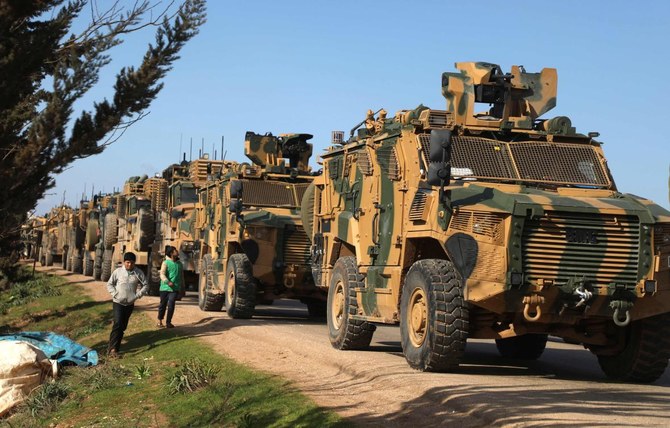
A Turkish military convoy parked near the town of Batabu on the highway linking Idlib to the Syrian Bab Al-Hawa border crossing with Turkey. (AFP)
Short Url
Updated 02 March 2020
Follow

UN probe highlights Russia, Turkey roles in Syria ‘war crimes’

  • The UN Commission of Inquiry on the rights situation in Syria said in its latest report that it had evidence that Russian planes participated in two air strikes
  • The investigators also said Turkey might be held criminally liable for serious violations by its allies, the Syrian National Army rebel fighters

GENEVA: Moscow has participated in war crimes connected with deadly air strikes in Syria, UN investigators said Monday, warning that Ankara could also be responsible for similar crimes against Kurds there.
The charges come as tensions soar between Turkey and Russian-backed Syrian forces following escalating clashes in the last rebel stronghold of Idlib, but predates the latest unrest.
The UN Commission of Inquiry on the rights situation in Syria said in its latest report that it had evidence that Russian planes participated in two air strikes, in Idlib and in rural Damascus last July and August, which killed more than 60 people.
The report, which covers the period from July 2019 to January 10 this year, said there was evidence to prove Russian planes took part in both attacks, and that since the attacks were not directed at military objectives they amounted to a “war crime.”
The investigators also said Turkey might be held criminally liable for serious violations by its allies, the Syrian National Army rebel fighters.
Turkish troops and their Syrian proxies overran a swathe of northern Syria last October, after a military campaign against Kurdish forces resulted in tens of thousands fleeing their homes.
The UN investigators referred to allegations that Ankara-backed Syrian rebels had carried out executions, home confiscations and looting.
They highlighted in particular the case of Hevrin Khalaf, the 35-year-old leader of the Future Syria Party, who on October 12 was pulled from her car and executed along with her driver.
They had been traveling from Qamishli when members of the Syrian National Army’s Brigade 123 pulled Khalaf from the car by her hair and mutilated her body before the executions.
The Commission said there were “reasonable grounds” to believe that the Syrian National Army fighters committed several war crimes, including “murder.”
If it could be shown they had acted under “the effective command and control of Turkish forces” it could entail the “criminal responsibility for such commanders who knew or should have known about the crimes,” it warned.
While the investigators acknowledged they had not uncovered evidence the Turkish forces gave orders leading to the violations, the report pointed out that liability could also fall on those who “failed to take all necessary and reasonable measures to prevent or repress their commission.”
The investigators also referred to an air strike on a civilian convoy the same day as the Khalaf’s murder and in the same region that killed 11 people and wounded 74.
And they highlighted the apparent targeting of non-military sites such as strikes near the Aluk water station that cut the water supply to 460,000 people.
Ankara has denied involvement, but the commission urged “Turkish authorities to launch (their) own investigations and make the findings public.”
The UN’s Syria commission, set up in 2011 shortly after the civil war began, has repeatedly accused the various sides of war crimes and in some cases crimes against humanity. Monday’s report was the 19th to date.
It also indicated a range of violations by Damascus-backed forces, including targeting civilian sites such as schools and medical facilities in western Syria.
The investigators expressed alarm at the growing humanitarian tragedy at Syria’s border with Turkey, where they said some 1.5 million people displaced by violence around Idlib had become stranded in desperate conditions.
“It is scandalous that the international community has not been able ... to deal with the situation,” commission chair Paulo Pinheiro told reporters.
“You have children in open air with their families, without a tent, without shelter, without blankets,” he said, lamenting that “children are freezing to death.”
In nearly nine years of conflict, more than 380,000 people have been killed and millions have been displaced from their homes.


US senators visit key Ukrainian port city as they push for fresh sanctions on Russia

Updated 19 February 2026
Follow

US senators visit key Ukrainian port city as they push for fresh sanctions on Russia

  • The visit and the push for Congress to take up sanctions on Russia come at a crucial moment in the conflict

WASHINGTON: A delegation of US senators was returning Wednesday from a trip to Ukraine, hoping to spur action in Congress for a series of sanctions meant to economically cripple Moscow and pressure President Vladimir Putin to make key concessions in peace talks.
It was the first time US senators have visited Odesa, Ukraine’s third-most populous city and an economically crucial Black Sea port that has been particularly targeted by Russia, since the war began nearly four years ago. Democratic Sens. Jeanne Shaheen, Chris Coons, Richard Blumenthal and Sheldon Whitehouse made the trip. Republican Sen. Thom Tillis had planned to join but was unable to for personal reasons.
“One of the things we heard wherever we stopped today was that the people of Ukraine want a peace deal, but they want a peace deal that preserves their sovereignty, that recognizes the importance of the integrity of Ukraine,” Shaheen said on a phone call with reporters.
The visit and the push for Congress to take up sanctions on Russia come at a crucial moment in the conflict. Delegations for the two sides were also meeting in Switzerland for two days of US-brokered talks, but neither side appeared ready to budge on key issues like territory and future security guarantees. The sanctions, senators hoped, could prod Putin toward settling for peace, as the US has set a June deadline for settlement.
“Literally nobody believes that Russia is acting in good faith in the negotiations with our government and with the Ukrainians,” Whitehouse said. “And so pressure becomes the key.”
Still, legislation to impose tough sanctions on Russia has been on hold in Congress for months.
Senators have put forward a range of sanction measures, including one sweeping bill that would allows the Trump administration to impose tariffs and secondary sanctions on countries that purchase Russia’s oil, gas, uranium and other exports, which are crucial to financing Russia’s military. The Senate Foreign Relations Committee has also advanced a series of more-targeted bills that would sanction China’s efforts to support Russia’s military, commandeer frozen Russian assets and go after what’s known as Moscow’s “shadow fleet” of oil tankers being used to circumvent sanctions already in place.
Republican Sen. Lindsey Graham, who has co-sponsored the Senate’s sweeping sanctions and tariff legislation, also released a statement during the Munich Security Conference this weekend saying that Senate Majority Leader John Thune had committed to bringing up the sanctions bill once it clearly has the 60 votes needed to move through the Senate.
“This legislation will be a game changer,” Graham said. “President Trump has embraced it. It is time to vote.”
Blumenthal, who co-sponsored that bill alongside Graham, also said there is bipartisan support for the legislation, which he called a “very tough sledgehammer of sanctions and tariffs,” but he also noted that “we need to work out some of the remaining details.” Democrats, and a handful of Republicans, have been opposed to President Donald Trump’s campaign to impose tariffs around the world in an effort to strike trade deals and spur more manufacturing in the US
In the House, Democrats are opposed to the tariff provisions of that bill. Instead, a bipartisan group of lawmakers, led by Republican Rep. Brian Fitzpatrick, has proposed separate legislation that makes it more difficult for Trump to waive sanctions, but does away with the tariff provisions.
A separate bill, led by the top Democrat on the House Foreign Affairs Committee, Rep. Gregory Meeks, would bolster US military support for Ukraine by $8 billion. Democrats currently need one more Republican to support an effort to force a vote on that bill.
Once they return to the US, the senators said they would detail how US businesses based in Ukraine have been attacked by Russia. The Democrats are also hoping to build pressure on Trump to send more US weapons to Ukraine. “Putin understands weapons, not words,” Blumenthal said.
Still, the lawmakers will soon return to a Washington where the Trump administration is ambivalent about its long-term commitments to securing peace in Ukraine, as well as Europe. For now, at least, they were buoyed by the conversations from their European counterparts and Republican colleagues.
“We and the Republican senators who were with us in Munich spoke with one voice about our determination to continue to support Ukraine,” Coons said.