

OIC condemns violence against Muslims in India

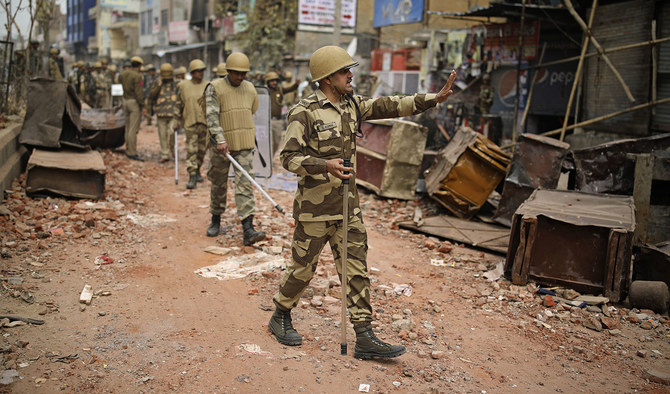
An Indian paramilitary soldier asks residents to stay indoors as they patrol a street vandalized in Tuesday's violence in New Delhi on Feb. 27, 2020. (AP)
Short Url
Updated 27 February 2020
Follow

OIC condemns violence against Muslims in India

  • The inter-governmental organization calls on Indian authorities to ensure safety of all Muslim citizens
  • Pakistan welcomes the OIC condemnation of communal violence against Indian Muslims

ISLAMABAD: The Organization of Islamic Cooperation (OIC) on Thursday condemned anti-Muslim violence in India, asking the administration in New Delhi to bring the extremist Hindus perpetrating such extremist acts to justice.

“OIC condemns the recent and alarming violence against Muslims in India, resulting in the death and injury of innocent people and the arson and vandalism of mosques and Muslim-owned properties. It expresses its sincere condolences to the families of the victims of these heinous acts,” the OIC said in a Twitter post while calling on the Indian government to protect Muslim minorities across the country.

“The OIC calls on Indian authorities to bring the instigators and perpetrators of these acts of anti-Muslim violence to justice and to ensure the safety and security of all its Muslim citizens and the protection of Islamic holy places across the country,” said the tweet.

India has witnessed intense violence since the country passed the Citizenship Amendment Act (CAA) last December which was widely viewed as anti-Muslim. More than 30 people have been killed so far in the deadliest violence the Indian capital, New Delhi, has experienced in several decades.

“We welcome the response and concern shown by the OIC on communal violence against Muslims in India,” Pakistan’s foreign office spokesperson Aisha Farooqui told Arab News on Thursday.
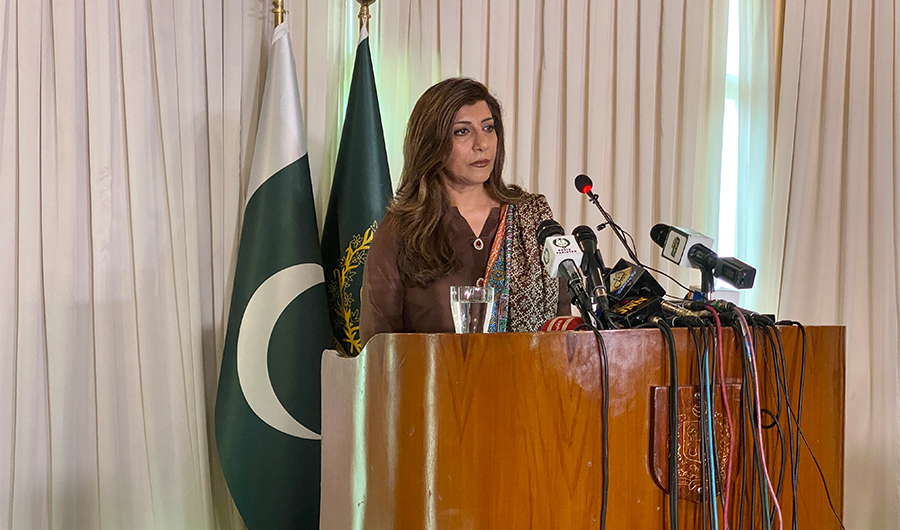


Pakistan’s Foreign Office Spokesperson Aisha Farooqui is addressing a weekly media briefing in Islamabad on Feb. 27, 2020. (AN Photo)

She demanded further deliberations on the matter by the biggest inter-governmental body of Muslim countries.

“The OIC should take up this issue and talk about it since more than 30 people have died and over 200 have been injured in the violence. This is the worst form of communal violence and Islamophobia in India. This is a matter of great concern for us and should also be a matter of grave concern for the entire Muslim world,” Farooqui said, acknowledging that the OIC had played a consistent, clear and positive role on Kashmir through its contact group for the last many decades.

“Pakistan is very concerned about the reports of vandalizing Muslim community’s homes and shops, and the desecration of their mosques. Our leadership and the international community at large have also expressed concern over the situation,” Farooqui said.

She said the people of Kashmir had suffered state oppression for decades at the hands of Indian authorities, and now that violence had also reached New Delhi.

“What is happening in India, especially during the last two weeks, is a continuation of an extremist and majoritarian mindset that proposes discriminatory policies toward minorities. This is the pattern we have witnessed in India for the last few years. The state oppression through which Kashmiris were suffering in the occupied territory has now found its way into the Indian capital,” Farooqui said.


At least 42 civilians killed in Afghanistan in conflict with Pakistan, UN agency says

Updated 6 sec ago
Follow

At least 42 civilians killed in Afghanistan in conflict with Pakistan, UN agency says

  • Civilian ​casualties ‌include ⁠those ​caused by ⁠indirect fire, airstrikes, says UN Assistance Mission in Afghanistan
  • Conflict was sparked last Thursday after Afghan forces said were retaliation for Pakistani airstrikes earlier this month

KABUL/ISLAMABAD: At least 42 civilians have been killed and 104 wounded in Afghanistan in the fighting with Pakistan between February 26 and March 2, the United Nations Assistance Mission in Afghanistan (UNAMA) said on Tuesday, as the military conflict between the neighbors entered its sixth day.

Military tensions between the South Asian nations remained high on Tuesday, with Afghanistan saying it had captured another Pakistani post in the ‌Kandahar region and ‌the fighting between the allies-turned-foes was “still ongoing.”

“The civilian ​casualties ‌include ⁠those ​caused by ⁠indirect fire in cross-border clashes...as well as those caused by airstrikes,” the UN agency said, adding that the numbers were “preliminary.”

The conflict — the worst between the countries in years — was sparked last week by what Afghanistan’s Taliban rulers said were retaliatory strikes on Pakistani installations in response to Pakistan’s targeting of militants in Afghanistan.

Afghanistan says Pakistani forces targeted its civilians, a charge Islamabad denies.

Islamabad has ⁠launched air-to-ground missiles at Taliban military sites over the ‌last week, and even directly targeted the ‌Taliban government for the first time over ​allegations it harbors militants executing attacks on ‌Pakistan from its soil.

Pakistani forces destroyed a military base in ‌Nangarhar province of Afghanistan in a successful air operation, Pakistani security sources said on Tuesday.

UNAMA CALLS FOR HALT TO FIGHTING

Both sides have claimed to have killed scores of troops of the other and inflicted heavy damage on military facilities since the fighting ‌began.
Reuters has not been able to verify the numbers.

Pakistani President Asif Ali Zardari, while addressing a joint session ⁠of parliament ⁠on Monday, reiterated that Islamabad would not allow territory in its neighborhood to be used for attacks against it.

“The soil of Pakistan is sacred. We will not allow any entity — domestic or foreign — to use neighboring territory to destabilize our peace,” he said.

UNAMA called for a halt to the fighting and warned that the violence, which has displaced an estimated 16,400 households, has worsened the situation of Afghanistan’s people who were still recovering from successive earthquakes in August and September that killed more than 1,400 people.

“Restrictions on movements in the border area due to the active conflict have ​reduced the capacity of humanitarian agencies ​and partners to deliver life-saving and other assistance in the most-affected areas,” it said.