Expelled reporters leave China after headline row

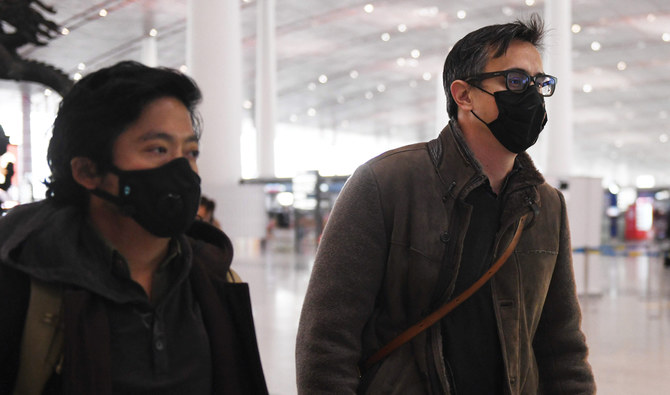
Wall Street Journal reporters Josh Chin (R) and Philip Wen were expelled over a controversial headline in an op-ed that angered Beijing. (AFP)
Short Url
Updated 24 February 2020
Follow

Expelled reporters leave China after headline row

  • The journalists work for the WSJ’s news section, which is not linked to the editorial and opinion pages

Two Wall Street Journal (WSJ) reporters left China on Monday after being expelled over a controversial headline in an op-ed that angered Beijing.

Three reporters were ordered out of the country last week over what Beijing deemed a racist headline that the journalists were not involved in writing — marking one of the harshest moves against foreign media in years.

But analysts noted that the decision to revoke their credentials came a day after Washington tightened rules on Chinese state media operating in the US — raising suspicion that Beijing had retaliated.

The WSJ opinion piece — headlined “China is the Real Sick Man of Asia” — was written by a US professor who criticized the Chinese government’s initial response to the coronavirus outbreak.

China’s foreign ministry said it was “racially discriminatory,” and as the newspaper wouldn’t apologize, the three reporters had their press cards revoked.

Deputy bureau chief Josh Chin and reporter Chao Deng, both US nationals, as well as reporter Philip Wen, an Australian, were given five days to leave the country, according to the Journal.

The journalists work for the WSJ’s news section, which is not linked to the editorial and opinion pages.

Decoder

Title

Content...

A letter from 53 WSJ reporters and editors called for the newspaper’s leadership to apologize, according to reports in the Washington Post, saying the headline was “derogatory.”

An AFP reporter saw Chin and Wen, wearing face masks, check in for their flight at Beijing’s main international airport and then pass through security.

Deng, the third journalist affected, had been reporting from Wuhan — the epicenter of the virus outbreak which has killed over 2,500 people.

The WSJ confirmed that she was still in the quarantined city.

The newspaper’s publisher said the outlet was “deeply disappointed” with China’s decision and that none of the journalists being expelled had “any involvement” with the opinion piece in question.

Decoder

Sick man of Asia

The phrase “sick man of Asia” originally referred to China in the late 19th and early 20th century, when it was exploited by foreign powers during a period sometimes called the country’s “century of humiliation.”


Israeli court overturns conviction of officer who assaulted Palestinian journalist, citing ‘Oct. 7 PTSD’

Updated 25 February 2026
Follow

Israeli court overturns conviction of officer who assaulted Palestinian journalist, citing ‘Oct. 7 PTSD’

  • Judge sentenced Yitzhak Sofer to 300 hours of community service, saying officer “devoted his life to Israel’s security” and conviction was “disproportionate to severity of his actions”
  • Footage shows Sofer throwing photojournalist Mustafa Alkharouf to the ground, and repeatedly beating and kicking him while he covered Palestinian gatherings near Al-Aqsa Mosque

LONDON: An Israeli court overturned the conviction of a border police officer who assaulted a Palestinian journalist, ruling his actions were influenced by post-traumatic stress disorder from serving during the Oct. 7 2023 attacks.

On Tuesday, the Jerusalem Magistrate’s Court sentenced officer Yitzhak Sofer to 300 hours of community service for assaulting Anadolu Agency photojournalist Mustafa Alkharouf in occupied East Jerusalem in December 2023.

Footage shows Sofer and other officers drawing weapons, throwing Alkharouf to the ground, and repeatedly beating and kicking him while he covered Palestinian gatherings near Al-Aqsa Mosque amid heavy restrictions.

Alkharouf was hospitalized with facial and body injuries. His cameraman, Faiz Abu Ramila, was also attacked.

Sofer had been convicted in September 2024 of assault causing bodily harm (acquitted of threats) and initially faced six months’ community service, as recommended by Mahash, the Justice Ministry’s police misconduct unit.

Judge Amir Shaked accepted the defense request to cancel the conviction, replacing it with community service.

He cited Sofer’s PTSD from responding to the Oct. 7 Hamas-led attack, noting the officer had “no prior criminal record” and had “devoted his life to Israel’s security.”

“The court cannot ignore this when considering whether the defendant’s conviction should stand,” he said, adding that while the incident is “serious and does cross the criminal threshold,” the conviction in place could cause Sofer harm “disproportionate to the severity of his actions.”

The ruling comes amid surging attacks on journalists in the West Bank, East Jerusalem and Gaza since Israel’s war on Gaza began.

The Committee to Protect Journalists reported Israel responsible for two-thirds of the 129 media workers killed worldwide in 2025, the deadliest year on record, citing a “persistent culture of impunity” and lack of transparent probes.

Reporters Without Borders called the Israeli army the “worst enemy of journalists” in its 2025 report, with nearly half of global reporter deaths in Gaza.

Foreign journalists face raids, arrests and intimidation. In late January 2026, Israel’s Supreme Court granted a delay on ruling a ban on foreign media access to Gaza.