Iranian democracy ‘castrated’: Ex-president’s son

1 / 2
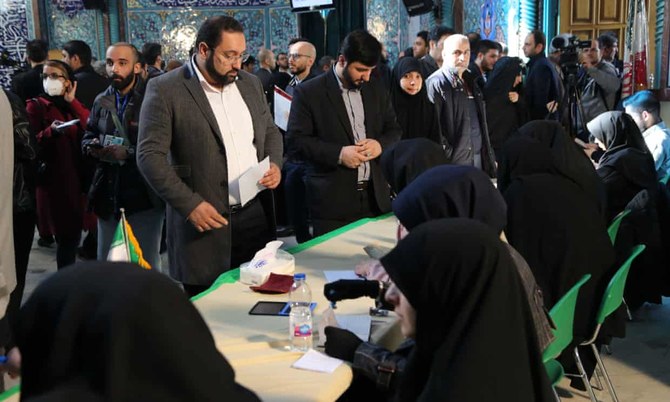
Iranians voted in parliamentary elections on Friday. (Anadolu Agency via Getty Images)
2 / 2
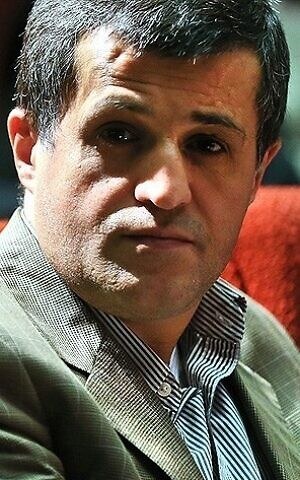
Yasser Rafsanjani. (Wikipedia)
Short Url
Updated 25 February 2020
Follow

Iranian democracy ‘castrated’: Ex-president’s son

  • Yasser Rafsanjani’s comments follow record low turnout in parliamentary election

LONDON: Iranian democracy has been “castrated,” the youngest son of Akbar Hashemi Rafsanjani, a former president and a key figure in the 1979 revolution, told The Guardian newspaper.

Reacting to historically low turnout in Friday’s parliamentary election, which saw hardliners sweep to victory, Yasser Rafsanjani said: “Democracy has become a eunuch. It has been castrated. Our society is somehow sick. We are infected by viruses ... such as coronavirus but also a societal virus where people do not respect others.”

Friday’s turnout was just 42 percent. In Tehran it was even lower at 25 percent. Critics have blamed the low turnout on the regime’s clampdown on reformist and moderate candidates. Thousands were prevented from running for office, including 90 MPs who sought re-election.

“Now with these elections, it shows the Iranian hardliners are getting stronger,” said Yasser. “People vote when they think it will create change. The people felt they kept sending a message to the government but they are not heard.”

He added: “In the last elections, people voted for a Parliament to bring change, and it did not happen, but there are forces outside the Parliament — politicians, military guards — that limit the power of the Parliament.”

Yasser said if his father, who died in 2017, was still alive, he would be deeply disappointed in the state of Iranian politics.

Despite coming from one of the most prominent political families in post-revolution Iran, Akbar’s children have faced repeated difficulties with the regime.

Yasser’s sister Faezeh was jailed in Tehran in 2012 after calling for Supreme Leader Ali Khamenei’s resignation and backing support for a female president. 

Two of Yasser’s brothers, Moshen and Mehdi, are imprisoned, with Mehdi facing 15 years on charges of corruption.

Yasser said throwing people in jail for their beliefs is not the answer: “My father always said you can eradicate bodies but you cannot delete ideas.”


Iran unrest persists, top judge warns protesters

Updated 08 January 2026
Follow

Iran unrest persists, top judge warns protesters

  • Demonstrations sparked by soaring inflation
  • Western provinces worst affected

DUBAI: Iran’s top judge warned protesters on Wednesday there would be “no ​leniency for those who help the enemy against the Islamic Republic,” while accusing Israel and the US of pursuing hybrid methods to disrupt the country.
The current protests, the biggest wave of dissent in three years, began last month in Tehran’s Grand Bazaar by shopkeepers condemning the currency’s free fall. 
Unrest has since spread nationwide amid deepening distress over economic hardships, including rocketing inflation driven by mismanagement and Western sanctions, and curbs on political and ‌social freedoms.
“Following announcements ‌by Israel and the US president, there is no excuse for those coming ‌to the ​streets for ‌riots and unrest, chief justice Gholamhossein Mohseni Ejei, the head of Iran’s judiciary, was quoted as saying by state media.
“From now on, there will be no leniency for whoever helps the enemy against the Islamic Republic and the calm of the people,” Ejei said.
Iranian authorities have not given ‌a death toll for protesters, but have said at least two members of the security services have died and more than a dozen have been injured.
Iran’s western provinces have witnessed the most violent protests.
“During the funeral of two people ​in Malekshahi on Tuesday, a number of attendees began chanting harsh, anti-system slogans,” said Iran’s Fars, news agency.
After the funeral, Fars said, “about 100 mourners went into the city and trashed three banks ... Some started shooting at the police trying to disperse them.”
The semi-official Mehr news agency said protesters stormed a food store and emptied bags of rice, which has been affected by galloping inflation that has made ordinary staples increasingly unaffordable for many Iranians.