

Sanders wins decisively in Nevada, Biden headed for second-place finish

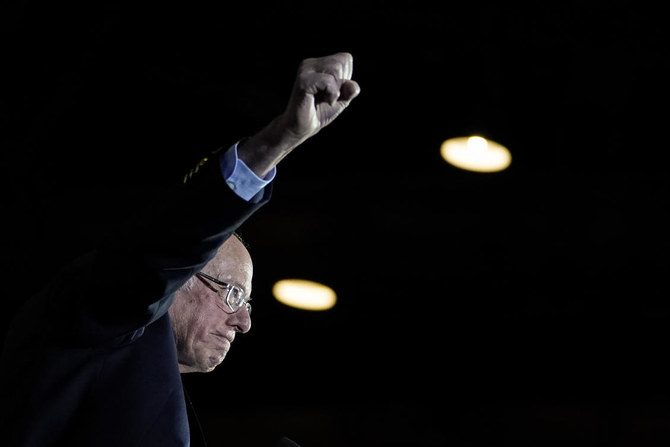
Democratic presidential candidate Sen. Bernie Sanders (I-VT) raises his fist as he arrives onstage after winning the Nevada caucuses during a campaign rally at Cowboys Dancehall. (File/Drew Angerer/Getty Images North America /AFP)
Short Url
Updated 23 February 2020
Follow

Sanders wins decisively in Nevada, Biden headed for second-place finish

  • Self-described democratic socialist, Sanders was backed by a diverse coalition of voters
  • The race now begins to broaden across the country, with the next primary on Feb. 29 in South Carolina

LAS VEGAS: Bernie Sanders strengthened his front-runner position for the Democratic presidential nomination with a decisive victory in the Nevada caucuses on Saturday, while Joe Biden was on track for a second-place finish that would give his struggling campaign new hope.
A self-described democratic socialist, Sanders was backed by a diverse coalition of young and middle-aged voters, Latinos, union members and white college-educated women for the win in Nevada, according to Edison Research, showing signs of expanding support for his surging campaign beyond his longstanding core.
“We have put together a multi-generational, multiracial coalition that is going to not only win in Nevada, it’s going to sweep the country,” Sanders, a US senator from Vermont, told cheering supporters in San Antonio, Texas.
Biden, a former vice president, appeared to score a badly needed strong finish after poor showings in the first two contests in Iowa and New Hampshire for the party’s nomination to face Republican President Donald Trump in the November election.
Sanders’ triumph in the first racially diverse state suggests his unapologetic message of social and economic justice, including his signature pledge to provide universal health care for all Americans, is resonating with a broader coalition of Democratic voters.
For Biden and other moderates who argue that Sanders is too liberal to beat Trump and who have been trying to blunt his momentum, however, the job has become much harder.
Sanders had 47% of the county convention delegates in Nevada with 50% of the precincts reported. Biden was a distant second to Sanders with 19%, but ahead of former Mayor Pete Buttigieg of South Bend, Indiana, in third place with 15%.
“The press is ready to declare people dead quickly, but we’re alive and we’re coming back and we’re gonna win,” Biden told supporters in Las Vegas on Saturday night.
Senator Elizabeth Warren, who had been looking to jump-start her campaign after poor finishes in the first two states, was again trailing in a disappointing fourth with more than 10% in Nevada, where voters poured into more than 250 sites around the state. Senator Amy Klobuchar and activist billionaire Tom Steyer were well back at around 4%.
Buttigieg cautioned Democrats about nominating Sanders, portraying him as an ideologue.
“We can prioritize either ideological purity or inclusive victory. We can either call people names online or we can call them into our movement. We can either tighten a narrow and hardcore base or open the tent to a new, broad, big-hearted American coalition,” Buttigieg told supporters in Las Vegas.
Despite another poor showing in Nevada, Warren said she got a boost in fundraising and support from an aggressive debate performance on Wednesday — which came too late to affect early voting in the state.
“We have a lot of states to go, and right now I can feel the momentum,” Warren said at a rally in Seattle.
The race now begins to broaden across the country, with the next primary on Feb. 29 in South Carolina, followed by the Super Tuesday contests in 14 states on March 3 that pick more than one-third of the pledged delegates who will help select a Democratic nominee.

Bloomberg looms in race
Biden, vice president under former President Barack Obama, is counting on a strong showing in South Carolina, which has a large bloc of black voters. In Nevada, entrance polls showed Biden led among African Americans with 36%, followed by Sanders with 27%.
The Super Tuesday states will bring former New York Mayor Michael Bloomberg, who has not been competing in the four early voting states but has been rising in opinion polls, into the race.
“The Nevada results reinforce the reality that this fragmented field is putting Bernie Sanders on pace to amass an insurmountable delegate lead,” Bloomberg campaign manager Kevin Sheekey said in a statement.
On Twitter, Trump appeared to be enjoying the Democratic race.
“Looks like Crazy Bernie is doing well in the Great State of Nevada. Biden & the rest look weak, & no way Mini Mike,” Trump wrote, the last a reference to Bloomberg.
Nevada caucus officials and voters at multiple sites on Saturday reported voting rules confusion, calculation glitches and delays in reporting tallies — despite efforts to avoid the issues that plagued Iowa’s caucuses earlier this month.
After a technical meltdown delayed results in Iowa, state officials promised a revised reporting system using a telephone hotline and photos of caucus reporting sheets would ensure a smoother process. Nevertheless, precinct chairs at some caucuses experienced long waits on the phone lines.
In the final result of a caucus at the famed Bellagio hotel on the Las Vegas strip, Sanders finished with 76 votes, Biden had 45 and no other candidate ended with a vote.
Workers at the hotel, who are members of the Culinary Workers Union, streamed out of the caucus after backing Sanders despite their leadership expressing reservations about his health care plan.
“I went for Bernie. I’m not big into politics, but I like the things he’s going for: student loan debt, schools, free health care,” said Aleiza Smith, 22, a housekeeper at the Bellagio.
Sanders was aided in Nevada by strong support from the six in 10 voters who said they backed a government-run Medicare for All, the Edison entrance poll showed.
It showed that Sanders led across all age groups except for those older than 65. Around 54% of Latino voters said they backed him, while 24% of college-educated white women and 34% of those who have a union member in their families supported him.



US House of Representatives passes war powers resolution backing Trump’s attacks on Iran

Updated 8 sec ago
Follow

US House of Representatives passes war powers resolution backing Trump’s attacks on Iran

WASHINGTON: The House narrowly rejected a war powers resolution Thursday to halt President Donald Trump’s attacks on Iran, an early sign of unease in Congress over the rapidly widening conflict that is reordering US priorities at home and abroad.
It’s the second vote in as many days, after the Senate defeated a similar measure. Lawmakers are confronting the sudden reality of representing wary Americans in wartime and all that entails — with lives lost, dollars spent and alliances tested by a president’s unilateral decision to go to war with Iran.
While the tally in the House, 212-219, was expected to be tight, the outcome provided a clarifying snapshot of political support for, and opposition to, the US-Israel military operation and Trump’s rationale for bypassing Congress, which alone has the power to declare war. At the Capitol, the conflict has quickly carried echoes of the long wars in Afghanistan and Iraq, and many Sept. 11-era veterans now serve in Congress.
“Donald Trump is not a king, and if he believes the war with Iran is in our national interest, then he must come to Congress and make the case,” said Rep. Gregory Meeks, the top Democrat on the House Foreign Affairs Committee.
House Speaker Mike Johnson warned that it would be “dangerous” to limit the president’s authority while the US military is already in conflict.
“We are not at war,” said Johnson, R-Louisiana, a close ally of Trump, contradicting others. He said the operation is limited in scope and duration, and the “mission is nearly accomplished.”
Republicans largely back Trump, and most Democrats oppose the war
Trump’s Republican Party, which narrowly controls the House and Senate, largely sees the conflict with Iran not as the start of a new war, but the end of a government that has long menaced the West. The operation has killed Iran’s Supreme Leader Ayatollah Ali Khamenei, which some view as an opportunity for regime change, though others warn of a chaotic power vacuum.
Republican Rep. Brian Mast of Florida, chairman of the House Foreign Affairs Committee, publicly thanked Trump for taking action against Iran, saying the president is using his own constitutional authority to defend the US against the “imminent threat” the country posed.
Mast, an Army veteran who worked as a bomb disposal expert in Afghanistan, said the war powers resolution was effectively asking “that the president do nothing.”
For Democrats, Trump’s attack on Iran, influenced by Israeli Prime Minister Benjamin Netanyahu, is a war of choice that is testing the balance of powers in the Constitution.
“The framers weren’t fooling around,” said Rep. Jamie Raskin, D-Md., arguing that the Constitution is clear that only Congress can decide matters of war. “It’s up to us.”
Crossover coalitions emerged among those in Congress. Two Republicans joined most Democrats in voting for the war powers resolution, while four Democrats joined Republicans to reject it.
The war powers resolution, if signed into law, would have immediately halted Trump’s ability to conduct the war unless Congress approved the military action. The president would likely veto it.
Trump officials provide shifting rationale for war
Trump has scrambled to win support for the nearly week-old conflict as Americans of all political persuasions take stock. Administration officials spent hours behind closed doors on Capitol Hill this week trying to reassure lawmakers that they have the situation under control.
Six US military members were killed over the weekend in a drone strike in Kuwait, and Trump has said more Americans could die. Thousands of Americans abroad have scrambled for flights, many lighting up phone lines at congressional offices as they sought help trying to flee the Middle East.
Trump said Thursday he must be involved in choosing Iran’s new leader. Yet Johnson, R-Louisiana, said this week that America has enough problems at home and is not about to be in the “nation-building business.”
Defense Secretary Pete Hegseth said that the war could extend eight weeks, twice as long as the president first estimated. Trump has left open the possibility of sending US troops into what has largely been a bombing campaign. More than 1,230 people in Iran have died.
The administration said the goal is to destroy Iran’s ballistic missiles that it believes are shielding its nuclear program. It has also said Israel was ready to act, and American bases would face retaliation if the US did not strike Iran first. The US said Wednesday it torpedoed an Iranian warship near Sri Lanka.
“This administration can’t even give us a straight answer of as to why we launched this preemptive war,” said Rep. Thomas Massie, the Republican from Kentucky, an outlier in his party.
Massie and Rep. Ro Khanna, D-Calif., who had teamed up to force the release the Jeffrey Epstein files, also pushed the war powers resolution to the floor, past objections from Johnson’s GOP leadership. Republican Rep. Warren Davidson of Ohio, a former Army Ranger, also voted for it. Democratic Reps. Henry Cuellar of Texas, Jared Golden of Maine, Greg Landsman of Ohio and Juan Vargas of California voted against.
“Congress must stand with the president to finally close, once and for all, this dark chapter of history,” said Rep. Michael McCaul, R-Texas.
Rep. Yassamin Ansari, D-Arizona, said that as the daughter of Iranian immigrants who fled their homeland, she opposes the regime but is concerned that a democratic transition for the people of Iran never seems to a priority for Trump or the officials who briefed Congress.
“War carries profound and deadly consequences for our troops, for the American people and for the entire world,” she said. “It’s the most serious decision that a nation can make.”
Other Democrats have proposed an alternative resolution that would allow the president to continue the war for 30 days before he must seek congressional approval. The House also approved a separate measure affirming that Iran is the largest state sponsor of terrorism.
Senators sit in their desks for solemn vote
In the Senate, Republican leaders have successfully, though narrowly, defeated a series of war powers resolutions pertaining to several other conflicts during Trump’s second term. This one, however, was different.
Underscoring the gravity Wednesday, Democratic senators sat at their desks as the voting got underway.
Senate Democratic leader Chuck Schumer of New York said that every senator will pick a side. “Do you stand with the American people who are exhausted with forever wars in the Middle East?” he asked. Or with Trump and Hegseth “as they bumble us headfirst into another war?”
Sen. John Barrasso, second in Senate Republican leadership, said, “Democrats would rather obstruct Donald Trump than obliterate Iran’s national nuclear program.”
The legislation failed on a 47-53 tally mostly along party lines, with Sen. Rand Paul, R-Kentucky, in favor and Sen. John Fetterman, D-Pennsylvania, against.