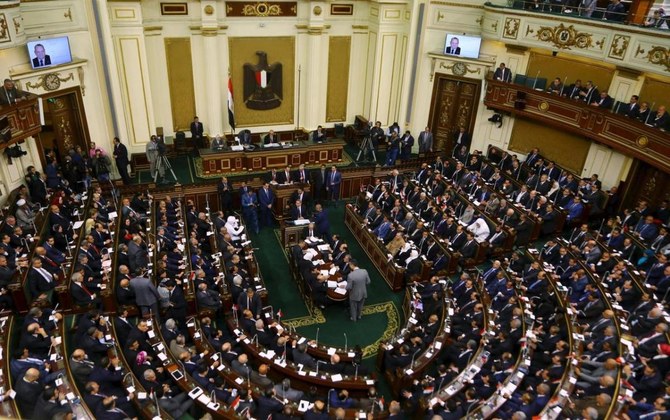

CAIRO: The Egyptian parliament has announced that laws that imprison investors have been scratched, stressing that imposing jail time on financial wrongdoers affects investment in Egypt.
Speaker Ali Abdel-Aal said in a public parliamentary session that he and parliament will not allow investment to “escape” from Egypt, “so the idea of replacing imprisonment with deterrent fines must be preserved”.
“I will never allow the imprisonment of businessmen involved in financial violations,” Abdel-Aal said.
Egypt’s parliament takes its cue from countries which have abolished penalties to safeguard the freedom of investors in economic legislation, in support and encouragement of investment, Chairman of the Economic Affairs Committee in parliament Ahmed Samir said.
Samir said the principle of not imprisoning investors in financial crimes was approved by parliament at the beginning of the current legislative term but is not final.
He explained that investors do not enjoy absolute immunity against imprisonment and that there are crimes in which jail is necessary, including harming public money or the interest of the state or harming the health of citizens.
“Harming public money or the health of citizens entails serving sentences. Any economic or administrative violations are punishable,” Samir told Arab News.
Mohsen Adel, former head of the Investment Authority, stressed that Egypt has taken the view of international institutions which is believed may encourage investment incentives to attract direct foreign investment, and that preventing businessmen from going to jail guarantees the protection of the investor who works in good faith and is similar to international standards.
Ahmed El-Zayat, a member of the Egyptian Businessmen’s Association, said that the abolition by parliament of imprisoning businessmen in economic legislation is aimed at encouraging investors to invest more and to provide all logistical support to help deal with global competition and attract foreign investment.
El-Zayat pointed to efforts such as solving the problems of troubled factories, refinancing, operating, reconciling with investors and providing a safe business environment that provides the factors needed to increase investments.
El-Zayat said doing away with incarceration of investors and replacing that with financial fines and providing new mechanisms to tighten control over economic business to prevent any excesses and achieve economic justice will raise the confidence of businessmen in the Egyptian economy, especially in industry. He said this will realize the state’s vision of increasing Egyptian exports $55 billion over the coming years.
Mohamed Waheed, chairman of Catalyst Company and founder of the first electronic market for trade in Egyptian products, said the state’s new initiative is a “legislative boom” which will add to the advantages and incentives guaranteed by the investment law, making Egypt the most prominent destination for investors as it enhances its competitiveness and increases demand for work and investment.
Waheed emphasized that the new investment law and its amendments, in addition to investment incentives and positive benefits for projects, organizes the file of penalties for the economic sector within the framework of a general approach from the state to develop the investment environment in a way that enhances its competitiveness and elements of its attraction to local and foreign investments.
He said this vision is a message from the state that supports serious investment and protects well-intentioned investors from the risks and fluctuations of local and global markets.
Al-Waheed added that this will guarantee the seriousness of work and strengthen the values of governance, transparency and serious competition on the basis of common interests and hard work to reap the fruits of development without measures that limit market capabilities and hinder opportunities for expansion and prosperity.