

France launches crackdown on foreign imams

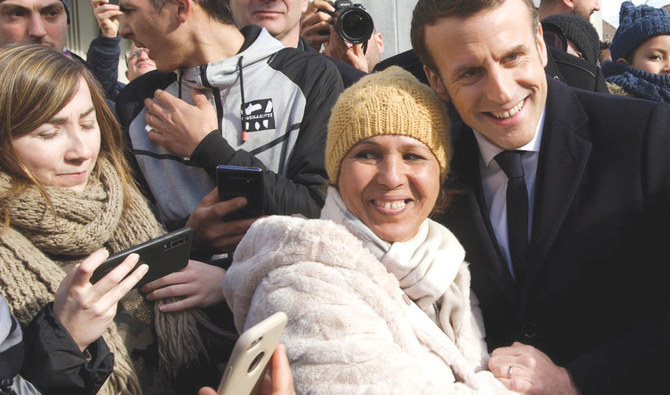
French President Emmanuel Macron meets with Muslim women during his visit to Bourtzwiller, a quarter of the eastern city of Mulhouse, France. (Reuters/File)
Short Url
Updated 20 February 2020
Follow

France launches crackdown on foreign imams

  • French president says: New laws will counter ‘foreign interference’

ANKARA: French President Emmanuel Macron announced on Tuesday that he will restrict other countries from sending imams and Islamic teachers to France in what he said is an attempt to counter “foreign interference.”

A new law is also being prepared to ensure transparency over how mosques are financed, the French leader said.

The moves are part of a longstanding campaign to have more say over imams and Islamic teachers sent to France, home to Europe’s largest Muslim community.

Macron highlighted the risk of “separatism” and “foreign interference” in the way Islam is practiced in the country.

He said the French Muslim Council (CFCM) has been instructed to focus on training imams on French territory, and ensuring they speak French and do not spread radical views.

France will receive its last intake of imams in 2020.

Macron said France will establish bilateral agreements with other countries to allow French authorities to have control over school courses and their content starting in September.

France currently has agreements with nine countries whereby their governments can send teachers to French schools to teach students originally from these countries on culture and language, without any supervision from French authorities.

From September, France is not expected to provide classes in other languages by using curricula of other countries, including Turkey, Morocco and Tunisia.

The move is designed to halt the rising number of teachers who are unable to speak French and are disconnected from the national education system.

“From September, the teaching of culture, and in foreign languages, will be removed from everywhere on Republic soil,” Macron said.

Turkey is the only country with which France has yet to reach an agreement on the issue.

“Turkey today can make the choice to follow that path with us or not, but I won’t let any foreign country feed a cultural, religious or identity-related separatism on our Republic’s ground. We cannot have Turkey’s laws on France’s ground. No way,” Macron said.

HIGHLIGHT

The moves are part of a longstanding campaign to have more say over imams and Islamic teachers sent to France, home to Europe’s largest Muslim community.

Ahmet Erdi Ozturk, assistant professor at London Metropolitan University, said Turkey’s educational and religious activities abroad have provided Ankara with a perfect tool to control and monitor the diaspora.

“It is part of Turkey’s longstanding ambition and extra-territorial policy to be a leader in the Muslim world. Mosques and educational institutions have become a political tool and a propaganda method in Ankara’s hands,” he told Arab News.

According to Ozturk, Turkey’s illiberal regime is strengthening its grip on Islamic preaching abroad.

“Following the failed coup attempt in 2016, the ruling Justice and Development Party, and especially President Recep Tayyip Erdogan, emphasized establishing political and religious domination over diaspora Muslims in their struggle against the religiously motivated movement of Fethullah Gulen, believed to be the mastermind behind the coup attempt,” he said.

Mosques abroad have cooperated with the Turkish intelligence agency, sparking fears over “imams spying on their followers,” he said.

“Now Turkey is accused of exporting domestic politics via religious apparatus,” Ozturk said.

France has around 300 imams from abroad, working across 2,500 places of worship around the country. About 150 imams are sent from Turkey, 120 from Algeria and 30 from Morocco.

Ankara has not responded to Macron’s announcement.


Australia to toughen gun laws as it mourns deadly Bondi attack

Updated 7 sec ago
Follow

Australia to toughen gun laws as it mourns deadly Bondi attack

  • Footage showed one man, identified by local media as fruit seller Ahmed al Ahmed, grabbing one of the gunmen as he fired
  • Prime Minister Anthony Albanese convened a meeting of leaders of Australia’s states and territories in response on Monday, agreeing with them “to strengthen gun laws across the nation”

SYDNEY: Australia’s leaders have agreed to toughen gun laws after attackers killed 15 people at a Jewish festival on Bondi Beach, the worst mass shooting in decades decried as antisemitic “terrorism” by authorities.
Dozens fled in panic as a father and son fired into crowds packing the Sydney beach for the start of Hanukkah on Sunday evening.
A 10-year-old girl, a Holocaust survivor and a local rabbi were among those killed, while 42 others were rushed to hospital with gunshot wounds and other injuries.
Prime Minister Anthony Albanese convened a meeting of leaders of Australia’s states and territories in response on Monday, agreeing with them “to strengthen gun laws across the nation.”
Albanese’s office said they agreed to explore ways to improve background checks for firearm owners, bar non-nationals from obtaining gun licenses and limit the types of weapons that are legal.
Mass shootings have been rare in Australia since a lone gunman killed 35 people in the town of Port Arthur in 1996, which led to sweeping reforms long seen as a gold standard worldwide.
Those included a gun buyback scheme, a national firearms register and a crackdown on ownership of semi-automatic weapons.
But Sunday’s shooting has raised fresh questions about how the two suspects — who public broadcaster ABC reported had possible links to the Daesh group — obtained the guns.

- ‘An act of pure evil’ -

Police are still unraveling what drove Sunday’s attack, although authorities have said it targeted Jews.
Albanese called it “an act of pure evil, an act of antisemitism, an act of terrorism on our shores.”
A string of antisemitic attacks has spread fear among Australia’s Jewish communities after the October 7, 2023, Hamas assault on Israel and the ensuing war in Gaza.
The Australian government this year accused Iran of orchestrating a recent wave of antisemitic attacks and expelled Tehran’s ambassador nearly four months ago.
But Israeli Prime Minister Benjamin Netanyahu accused Australia’s government of “pouring oil on the fire of antisemitism” in the months before the shooting, referring to Canberra’s announcement that it would recognize Palestinian statehood in August.
Other world leaders expressed revulsion, with US President Donald Trump condemning the “antisemitic attack.”
The gunmen opened fire on an annual celebration that drew more than 1,000 people to the beach to mark Hanukkah.
They took aim from a raised boardwalk at a beach packed with swimmers cooling off on the steamy summer evening.
Witness Beatrice was celebrating her birthday and had just blown out the candles when the shooting started.
“We thought it was fireworks,” she told AFP. “We’re just feeling lucky we’re all safe.”
Carrying long-barrelled guns, they peppered the beach with bullets for 10 minutes before police shot and killed the 50-year-old father.
The 24-year-old son was arrested and remains under guard in hospital with serious injuries.
Australian media named the suspects as Sajid Akram and his son Naveed Akram.
Tony Burke, the home affairs minister, said the father arrived in Australia on a student visa in 1998 and had become a permanent resident. The son was an Australia-born citizen.
Hours after the shooting, police found a homemade bomb in a car parked close to the beach, saying the “improvised explosive device” had likely been planted by the pair.
Rabbi Mendel Kastel said his brother-in-law was among the dead.
“We need to hold strong. This is not the Australia that we know. This is not the Australia that we want.”
Wary of reprisals, police have so far avoided questions about the attackers’ religion or ideological motivations.
Misinformation spread quickly online after the attacks, some of it targeting immigrants and the Muslim community.
Police said they responded to reports on Monday of several pig heads left at a Muslim cemetery in southwestern Sydney.

- Panic and bravery -

A brave few dashed toward the beach as the shooting unfolded, wading through fleeing crowds to rescue children, treat the injured and confront the gunmen.
Footage showed one man, identified by local media as fruit seller Ahmed al Ahmed, grabbing one of the gunmen as he fired.
The 43-year-old wrestled the gun out of the attacker’s hands, before pointing the weapon at him as he backed away.
A team of off-duty lifeguards sprinted across the sand to drag children to safety.
“The team ran out under fire to try and clear children from the playground while the gunmen were firing,” said Steven Pearce from Surf Life Saving New South Wales.
Bleeding victims were carried across the beach atop surfboards turned into makeshift stretchers.
On Monday evening, a flower memorial next to Bondi Beach swelled in size as mourners gathered.
Hundreds, including members of the Jewish community, sang songs, clapped and held each other.
Leading a ceremony to light a menorah candle, a rabbi told the crowd: “The only strength we have is if we bring light into the world.”