KUALA LUMPUR: Olympics host Japan is going for gold in a race against time to train 1,000 chefs in halal food preparation for the summer 2020 Games.
With 5 million Muslim visitors from the Middle East, Africa and Southeast Asia expected to descend on Tokyo for the sporting spectacular, which takes place between July and September, Japan has teamed up with Malaysia to introduce Muslim-friendly standards (MFS) for the Japanese food industry.
“Most Muslim tourists would want to try Japanese food,” said Keith Wong, CEO of Acrosx Malaysia, which has been appointed to the halal expert training committee of Japan’s Ministry of Health, Labor and Welfare to help develop halal versions of Japanese dishes.
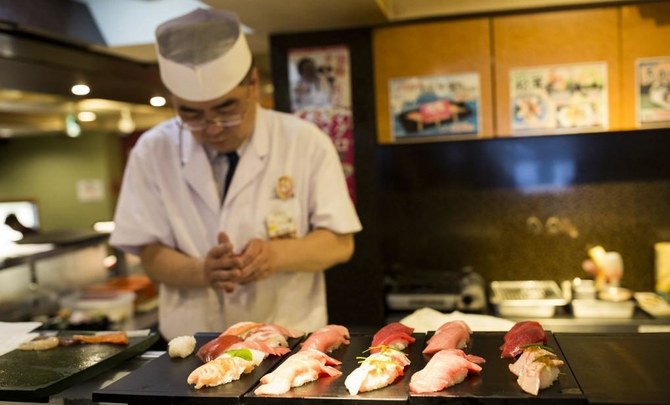
Demand for halal Japanese food was booming and Wong told Arab News: “Tempura is popular among Middle Easterners and in South Asia, while ramen and unagi (eels) are popular among Muslims from Southeast Asia. Sashimi and sushi are very popular among all Muslims.”
He pointed out that MFS were needed because the number of halal restaurants in Japan was currently insufficient to cater for all visitor preferences during the Olympics.
The Japanese government has partnered with Malaysia’s Halal Industry Development Corporation to have more than 1,000 chefs trained in preparing halal food and become MFS-certified.
“We are aiming to train 500 restaurants for ‘Muslim-friendly’ certification for the Olympics,” Wong said, adding that MFS were even stricter than general halal standards.
Restaurants adopting MFS would be required to have a separate halal kitchen and provide different utensils for Muslim customers.
The Japanese chefs and restaurant operators taking part in the training will learn about the history of Islam, halal food storage and cooking methods.
The global halal industry is estimated to be worth around $2 trillion, and the Japanese see Muslim travelers as being more valuable than Chinese tourists, Wong said. “Chinese travelers to Japan would usually spend money on high-end, luxury goods. While Muslim travelers, with their friends and family, would spend money on food, lodgings and tourism.”
He noted that the MFS partnership with Malaysia was expected to extend beyond the 2020 Olympic Games.
“We will be aiming for the World Expo 2025 in Osaka,” he said, adding that Japan may become a global and high-quality player in the halal industry.


![]()

Japan joins Malaysia in Olympics race to train 1,000 halal chefs for 2020 summer Games
Short Url
https://arab.news/gq44z
Japan joins Malaysia in Olympics race to train 1,000 halal chefs for 2020 summer Games
- Japan has teamed up with Malaysia to introduce Muslim-friendly standards (MFS) for the Japanese food industry
- The MFS partnership with Malaysia is expected to extend beyond the 2020 Olympic Games

Latest updates


© 2026 SAUDI RESEARCH & PUBLISHING COMPANY, All Rights Reserved And subject to Terms of Use Agreement.