

Traditional music returns as security improves in Pakistan

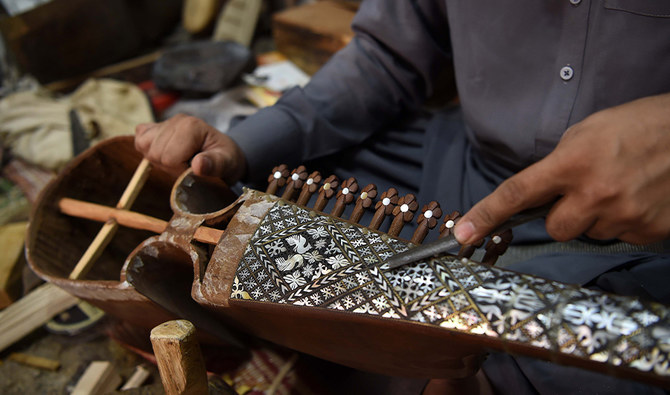
A Pakistani craftsman makes a rubab, a traditional instrument used in Pashto music at a workshop in Peshawar on May 24, 2017. (AFP)
Short Url
Updated 17 February 2020
Follow

Traditional music returns as security improves in Pakistan

  • After the 2001 ouster of Taliban regime, militancy erupted across Pakistani borderlands
  • Singers and musicians fled en masse while others were gunned down

PESHAWAR: For years the distinctive twang of Pashtun music was drowned out by rattling gunfire and deafening explosions as musicians in Pakistan’s northwest were targeted by militants. But, as security improves, a centuries-old tribal tradition is staging a comeback.
Performances that once took place in secret are returning. Shops selling instruments are open and thriving again, while local broadcasters frequently feature rising Pashto pop singers in their programming.
And new, up and coming bands like Peshawar’s Khumariyaan have reached rare, nationwide acclaim after appearing on the popular Coke Studios broadcast, where they fused traditional sounds with modern tastes — spreading Pashtun music far from its native homeland.
“Music is the spice of life... it has been a part of our culture from time immemorial,” says Farman Ali Shah, a village elder and Pashto poet in Warsak village near Pakistan’s tribal areas in Khyber Pakhtunkhwa province.
Pashtun music is characterised by the rabab, a Central Asian stringed instrument, played to the beat from tablas drums, with songs salted with florid lyrics describing the pain of unrequited love or calls for politcial revolution.
“For centuries we were a liberal society,” explains rabab player and member of the National Assembly Haider Ali Khan from Pakistan’s Swat Valley.
“We love our religion but at the same time we love our traditional music.”
Yet the slow creep of extremism had been threatening that tradition for decades.
Beginning in the 1970s more hard-line Islamist movements started gaining influence in the Pashtun areas along the border with Afghanistan, promoting strict interpretations of the religion including dismissive takes toward music.
The shift toward violent extremism intensified with the 1979 Soviet invasion of Afghanistan and the later Taliban regime of the 1990s.
After the US invasion of 2001 toppled the Taliban, militancy erupted across the border in Pakistan also. A Pakistani Taliban movement formed and took control of the country’s tribal areas and swathes of Khyber Pakhtunkhwa.
“The extremists were killing artists and singers in the society to create fear,” explains singer Gulzar Alam, who was attacked three separate times and later left Pakistan, fearing for his life.
“If you remove the culture from a community, tribe, or ethnic group the community will be eliminated.”
Public performances were all but halted as waves of suicide bombers unleashed havoc.
CD markets were bombed, instrument shops destroyed, and musicians were intimidated or either outright targeted.
Singers and musicians fled en masse, while others were gunned down.
A brave few continued to invite musicians to play in private shows at hujras and weddings, albeit without large sound systems that could possibly attract militants.
“They were asking people to stop music but villagers never accepted them,” says Noor Sher from Sufaid Sang village, where his family has been making rababs by hand for 25 years.
Amid the chaos the art form was also maintained thanks to increasing numbers of Afghan musicians also fleeing violence in their own country who resettled in places like Peshawar, opening music schools that kept the tradition alive.

The Pakistani military began intensifying efforts to push the militants out in 2014, and security has dramatically improved in the years since.
“Now the situation is good, very good. We can play anywhere, whenever people invite us,” says rabab player Akhtar Gul during a performance at a hujra — a traditional Pashtun community space.
As music has returned to its traditional settings in the country’s northwest, slick broadcasts like Coke Studio have helped introduce Pashtun acts to millions of music fans across South Asia.
Many still remain cautious in Khyber Pakhtunkhwa, however, fearing the gains are tenuous at best. Some interviewed by AFP refused to criticize militants, fearing their eventual return.
And while the insurgents might have been pushed back, conservative attitudes toward music continues to resonate in the area.
For Abdul Latif, 24, his love of playing the rabab is largely kept secret from his family who consider such instruments to be out of sync with Islam.
“This is a part of Pashtun culture but I think my family lacks awareness,” he says.
For musicians like Alam who were forced to flee their homes, the damage runs deeper.
“It takes a lot of time, to set the mind or brain of the artists free from fear,” says Alam from Kabul where he is waiting for a response to an asylum request with the United Nations.
“You can change the policy of a government with a stroke of a pen, it doesn’t take much time,” adds the the lawmaker Khan.


Islamabad dismisses claims about paying up to 8 percent interest on foreign loans as ‘misleading’

Updated 22 February 2026
Follow

Islamabad dismisses claims about paying up to 8 percent interest on foreign loans as ‘misleading’

  • Pakistan has long relied on external loans to help bridge persistent gaps in public finances and foreign exchange reserves
  • Pakistan’s total external debt, liabilities stand at $138 billion at an overall average cost of around 4 percent, ministry says

KARACHI: Pakistan’s finance ministry on Sunday dismissed as “misleading” claims that the country is paying up to 8 percent interest on external loans, saying the overall average cost of external public debt is approximately 4 percent.

Pakistan has long relied on external loans to help bridge persistent gaps in public finances and foreign exchange reserves, driven largely by a narrow tax base, chronic trade deficits, rising debt-servicing costs and repeated balance-of-payments pressures.

Over the decades, successive governments have turned to multilateral and bilateral lenders, including the International Monetary Fund, the World Bank and the Asian Development Bank, to support budgetary needs and shore up foreign exchange reserves.

The finance ministry on Sunday issued a clarification in response to a “recent press commentary” regarding the country’s external debt position and associated interest payments, and said the figures required contextual explanation to ensure accurate understanding of Pakistan’s external debt profile.

“Pakistan’s total external debt and liabilities currently stand at $138 billion. This figure, however, encompasses a broad range of obligations, including public and publicly guaranteed debt, debt of Public Sector Enterprises (both guaranteed and non-guaranteed), bank borrowings, private-sector external debt, and intercompany liabilities to direct investors. It is therefore important to distinguish this aggregate figure from External Public (Government) Debt, which amounts to approximately $92 billion,” it said.

“Of the total External Public Debt, nearly 75 percent comprises concessional and long-term financing obtained from multilateral institutions (excluding the IMF) and bilateral development partners. Only about 7 percent of this debt consists of commercial loans, while another 7 percent relates to long-term Eurobonds. In light of this composition, the claim that Pakistan is paying interest on external loans ‘up to 8 percent’ is misleading.

The overall average cost of External Public Debt is approximately 4 percent, reflecting the predominantly concessional nature of the borrowing portfolio.”

With respect to interest payments, public external debt interest outflows increased from $1.99 billion in Fiscal Year (FY) 2022 to $3.59 billion in FY2025, representing an increase of 80.4 percent, not 84 percent as reported. In absolute terms, interest payments rose by $1.60 billion over this period, not $1.67 billion, it said.

According to the State Bank of Pakistan’s records, Pakistan’s total debt servicing payments to specific creditors during the period under reference were as follows: the IMF received $1.50 billion, of which $580 million constituted interest; Naya Pakistan Certificates payments totaled $1.56 billion, including $94 million in interest; the Asian Development Bank received $1.54 billion, including $615 million in interest; the World Bank received $1.25 billion, including $419 million in interest; and external commercial loans amounted to nearly $3 billion, of which $327 million represented interest payments.

“While interest payments have increased in absolute terms, this rise cannot be attributed solely to an expansion in the debt stock,” the ministry said. “Although the overall debt stock has increased slightly since FY2022, the additional inflows have primarily originated from concessional multilateral sources and the IMF’s Extended Fund Facility (EFF) under the ongoing IMF-supported program.”

Pakistan secured a $7 billion IMF bailout in Sept. 2024 as part of Prime Minister Shehbaz Sharif’s efforts to stabilize the South Asian economy that narrowly averted a default in 2023. The government has since been making efforts to boost trade and bring in foreign investment to consolidate recovery.

“It is also important to note that the increase in interest payments reflects prevailing global interest rate dynamics. In response to the inflation surge of 2021–22, the US Federal Reserve raised the federal funds rate from 0.75-1.00 percent in May 2022 to 5.25–5.50 percent by July 2023. Although rates have since moderated to around 3.75 percent, they remain significantly higher than 2022 levels,” the finance ministry said.

“The government remains committed to prudent debt management, transparency, and the continued strengthening of Pakistan’s macroeconomic stability,” it added.