

Powers renew pledge to uphold Libya arms embargo

1 / 2
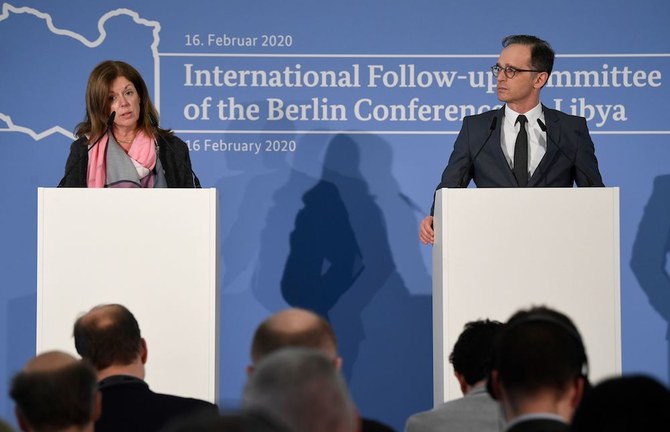
Foreign ministers and other high-ranking officials met on the sidelines of the Munich Security Conference to discuss peace in Libya. (AFP)
2 / 2
German Foreign Minister Heiko Maas (R) and the Deputy Special Representative of the UN Secretary-General for Political Affairs in Libya, United Nations Support Mission in Libya (UNSMIL) Stephanie Williams give a press statement at the end of a follow-up meeting on Libya, on the sidelines of the 56th Munich Security Conference (MSC) in Munich, southern Germany, on Feb. 16, 2020. (AFP)
Short Url
Updated 17 February 2020
Follow

Powers renew pledge to uphold Libya arms embargo

  • Libya has been in turmoil since 2011, when a civil war toppled longtime dictator Moammar Gadhafi
  • UAE says it working with other partners to reach a political solution in LIbya, which would also curb extremism

MUNICH: An arms embargo aimed at curbing fighting in Libya has become meaningless because of violations, and it is imperative that those who breach it are held to account, a senior UN official said on Sunday.

“The arms embargo has become a joke. We all really need to step up here,” UN Deputy Special Representative to Libya Stephanie Williams said after a meeting to follow up on a summit in Berlin last month that agreed to uphold the embargo. Fighting has continued despite a call for a truce.

A fragile existing truce “is holding only by a thread, with numerous — over 150 violations,” she said.

Germany and the UN, which co-hosted the summit, gathered foreign ministers and other officials from a dozen countries on the sidelines of the Munich Security Conference to try to bolster a drive to cut off outside military support for Libya’s warring parties.

The countries involved include the five permanent members of the UN Security Council (Britain, China, France, Russia and the (US) along with Italy, Turkey and the United Arab Emirates. Sunday’s meeting formally launched an international follow-up committee on Libya. Italy will co-chair the next meeting, in Rome in March.

At the Berlin summit, participants agreed to respect the arms embargo, hold off on military support to Libya’s warring parties and push them to reach a full cease-fire. 

But UN Secretary-General Antonio Guterres says that agreement has been repeatedly violated by continuing arms deliveries and an escalation in fighting.

Sunday’s meeting formally launched an international follow-up committee on Libya. Italy will co-chair the next meeting, in Rome in March.

“It’s complicated because there are violations by land, sea and air, but it needs to be monitored and there needs to be accountability,” Williams told a news conference, adding that Libya was now awash with advanced weapons.

“The situation on the ground remains deeply troubling. The truce is holding only by a thread ... The economic situation continues to deteriorate.”


German Foreign Minister Heiko Maas (R) and the Deputy Special Representative of the UN Secretary-General for Political Affairs in Libya, United Nations Support Mission in Libya (UNSMIL) Stephanie Williams give a press statement at the end of a follow-up meeting on Libya, on the sidelines of the 56th Munich Security Conference (MSC) in Munich, southern Germany, on Feb. 16, 2020. (AFP)

A joint statement issued on Sunday by the 13 countries involved in Libya said there had been a discussion on the “deplorable” arms embargo violations, and “renewed determination to contribute to its thorough implementation.” But there was no mention of how the embargo would be monitored or enforced, or whether there would be any consequences for violating it.

German Foreign Minister Heiko Maas said he wanted EU foreign ministers to make a decision on Monday on their role in monitoring the embargo.

“Everyone needs to know that if they violate the embargo in future, then they violate a UN resolution and that this can’t remain without consequences,” Maas said, without elaborating.

Libya has been in turmoil since 2011, when a civil war toppled longtime dictator Muammar Qaddafi, who was later killed.

A weak UN-recognized administration that now holds the capital of Tripoli and parts of the country’s west is backed by Turkey, which recently sent thousands of soldiers to Libya, and to a lesser degree Qatar and Italy as well as local militias.

On the other side is a rival government in the east that supports eastern commander Gen. Khalifa Hafter, whose forces launched an offensive to capture Tripoli last April. They are backed by the United Arab Emirates, Egypt, France and Russia.

United Arab Emirate’s Minister of Foreign Affairs Anwar Gargash said the UAE is working with other partners to reach a political solution in Libya, which would also curb extremism.

Since the Berlin summit, the rival Libyan military factions have met in Geneva in a UN-led effort to forge a lasting truce. A first round of talks ended without officials signing an agreement, but Maas said a second round will begin in Geneva on Tuesday.

On Wednesday, the UN Security Council endorsed the Berlin summit conclusions, including a 55-point road map for ending the war in Libya and condemned the recent increase in violence in the oil-rich North African country.

The European Union, which will discuss Libya in Brussels on Monday, has been arguing about possibly having naval ships enforce the UN arms embargo against Libya.

Maas, however, stressed the need to enforce the weapons embargo by sea, air and land, given that arms find their way to the warring parties by different routes. He said EU ships may not be needed in the Mediterranean Sea “because sea routes, air routes and land routes can be monitored from the air.”


Syrian military tells civilians to evacuate contested area east of Aleppo amid rising tensions

Updated 15 January 2026
Follow

Syrian military tells civilians to evacuate contested area east of Aleppo amid rising tensions

  • Syria’s military has announced it will open a “humanitarian corridor” for civilians to evacuate from an area in Aleppo province
  • This follows several days of intense clashes between government forces and the Kurdish-led Syrian Democratic Forces

DAMASCUS: Syria’s military said it would open a corridor Thursday for civilians to evacuate an area of Aleppo province that has seen a military buildup following intense clashes between government and Kurdish-led forces in Aleppo city.
The army’s announcement late Wednesday — which said civilians would be able to evacuate through the “humanitarian corridor” from 9 a.m. to 5 p.m. Thursday — appeared to signal plans for an offensive in the towns of Deir Hafer and Maskana and surrounding areas, about 60 kilometers (40 miles) east of Aleppo city.
The military called on the Kurdish-led Syrian Democratic Forces and other armed groups to withdraw to the other side of the the Euphrates River, to the east of the contested zone.
Syrian government troops have already sent troop reinforcements to the area after accusing the SDF of building up its own forces there, which the SDF denied. There have been limited exchanges of fire between the two sides, and the SDF has said that Turkish drones carried out strikes there.
The government has accused the SDF of launching drone strikes in Aleppo city, including one that hit the Aleppo governorate building on Saturday shortly after two Cabinet ministers and a local official held a news conference there.
The tensions in the Deir Hafer area come after several days of intense clashes last week in Aleppo city that ended with the evacuation of Kurdish fighters and government forces taking control of three contested neighborhoods. The fighting killed at least 23 people, wounded dozens more, and displaced tens of thousands.
The fighting broke out as negotiations have stalled between Damascus and the SDF, which controls large swaths of northeast Syria, over an agreement to integrate their forces and for the central government to take control of institutions including border crossings and oil fields in the northeast.
Some of the factions that make up the new Syrian army, which was formed after the fall of former President Bashar Assad in a rebel offensive in December 2024, were previously Turkiye-backed insurgent groups that have a long history of clashing with Kurdish forces.
The SDF for years has been the main US partner in Syria in fighting against the Daesh group, but Turkiye considers the SDF a terrorist organization because of its association with the Kurdistan Workers’ Party, or PKK, which has waged a long-running insurgency in Turkiye. A peace process is now underway.
Despite the long-running US support for the SDF, the Trump administration has also developed close ties with the government of interim Syrian President Ahmad Al-Sharaa and has pushed the Kurds to implement the integration deal. Washington has so far avoided publicly taking sides in the clashes in Aleppo.
The SDF in a statement warned of “dangerous repercussions on civilians, infrastructure, and vital facilities” in case of a further escalation and said Damascus bears “full responsibility for this escalation and all ensuing humanitarian and security repercussions in the region.”
Adm. Brad Cooper, commander of US Central Command, said in a statement Tuesday that the US is “closely monitoring” the situation and called for “all parties to exercise maximum restraint, avoid actions that could further escalate tensions, and prioritize the protection of civilians and critical infrastructure.” He called on the parties to “return to the negotiating table in good faith.”
Al-Sharaa blasts the SDF
In a televised interview aired Wednesday, Al-Sharaa praised the “courage of the Kurds” and said he would guarantee their rights and wants them to be part of the Syrian army, but he lashed out at the SDF.
He accused the group of not abiding by an agreement reached last year under which their forces were supposed to withdraw from neighborhoods they controlled in Aleppo city and of forcibly preventing civilians from leaving when the army opened a corridor for them to evacuate amid the recent clashes.
Al-Sharaa claimed that the SDF refused attempts by France and the US to mediate a ceasefire and withdrawal of Kurdish forces during the clashes due to an order from the PKK.
The interview was initially intended to air Tuesday on Shams TV, a broadcaster based in Irbil — the seat of northern Iraq’s semi-autonomous Kurdish region — but was canceled for what the station initially said were technical reasons.
Later the station’s manager said that the interview had been spiked out of fear of further inflaming tensions because of the hard line Al-Sharaa took against the SDF.
Syria’s state TV station instead aired clips from the interview on Wednesday. There was no immediate response from the SDF to Al-Sharaa’s comments.