


France announces first coronavirus victim outside Asia as Chinese tourist dies in Paris hospital

1 / 4
An emergency vehicle arrives at the Bichat Hospital in Paris, France, Feb. 15, 2020. (Reuters)
2 / 4
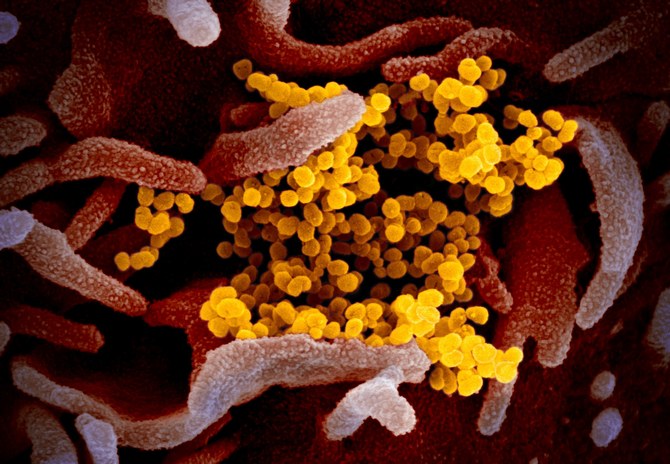
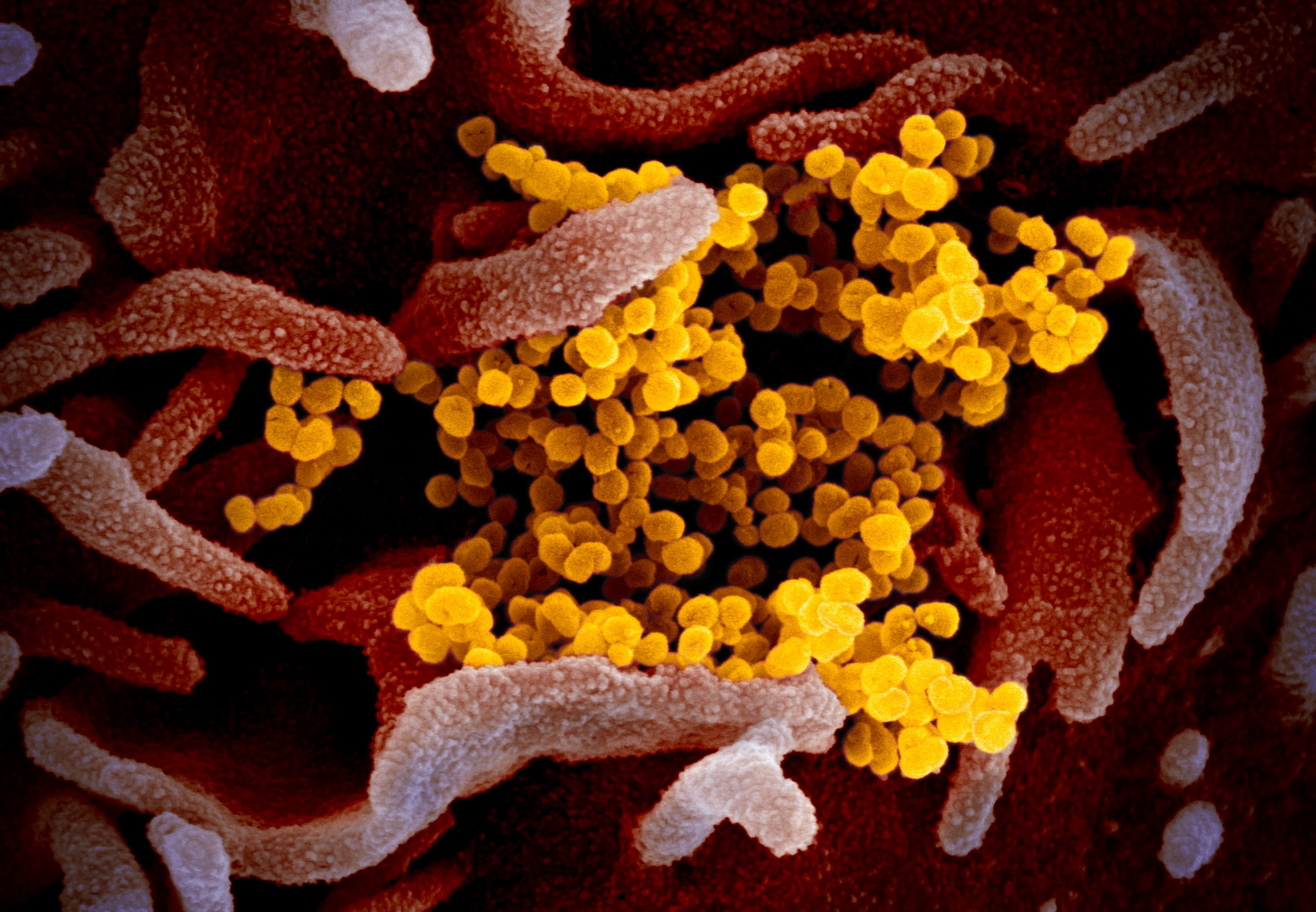
A scanning and transmission electron microscope image of coronavirus released by the National Institute of Allergy and Infectious Diseases' (NIAID) Rocky Mountains Laboratories (RML). (NIAID-RML)
3 / 4
A scanning and transmission electron microscope image of coronavirus released by the National Institute of Allergy and Infectious Diseases' (NIAID) Rocky Mountains Laboratories (RML). (NIAID-RML)
4 / 4
A scanning and transmission electron microscope image of coronavirus released by the National Institute of Allergy and Infectious Diseases' (NIAID) Rocky Mountains Laboratories (RML). (NIAID-RML)
Short Url
Updated 15 February 2020
Follow

France announces first coronavirus victim outside Asia as Chinese tourist dies in Paris hospital

  • The patient from China’s Hubei province had a serious lung infection
  • The man’s daughter also tested positive for the virus and admitted to Bichat Hospital

PARIS: France on Saturday reported the first death outside Asia of a person infected with the new virus from China, an 80-year-old Chinese tourist who two French hospitals initially turned away when he first fell ill, French authorities said.
Health Minister Agnes Buzyn said she learned Friday night about the death of the patient, a man who tested positive for the virus in late January and had been in intensive care at a Paris hospital equipped with isolation rooms.
The patient from China’s Hubei province had a serious lung infection, and French health officials had said they were concerned about his condition. All the previous deaths outside mainland China due to COVID-19, the disease the virus causes, were in Asia: one each in Japan, the Philippines and Hong Kong.

------

READ MORE: Arab News' China Coronavirus spotlight

------

There were contradictory reports about the timing of the tourist’s illness. Buzyn said he arrived in France on Jan. 16 and was hospitalized on Jan. 25 under strict isolation measures but that man’s condition deteriorated rapidly.
Other French medical officials had said previously that the patient arrived in France on Jan. 23 and quickly fell ill.
Dr. Yazdan Yazdanpanah, head of Bichat’s infectious diseases unit, said the man visited two French hospitals. Because he “didn’t fulfill the definition” of someone considered at risk of infection with the virus, the hospitals decided it was unnecessary to test him, Yazdanpanah said.


The man did not live in Wuhan, the central Chinese city hardest-hit by the virus, but was from the province that includes Wuhan. He later tested positive and was put in isolation at Bichat Hospital on Jan. 28, Yazdanpanah said.
The man’s daughter also tested positive for the virus and admitted to Bichat Hospital for treatment, but is doing well and should be able to leave soon, the French health minister said.
As of Saturday, four of France’s 11 confirmed virus cases were in people since declared “cured” and released from the hospital, including a French doctor who was allowed to go home Friday, Buzyn said. Six others remained hospitalized.
Buzyn said she had no news about a French person who was among the 285 people from a cruise ship near Tokyo who tested positive for the virus and was hospitalized in Japan. Three other French are on the ship, which is in quarantine in Yokohama.
Germany’s dpa news agency reported Saturday that two infected passengers on the quarantined Diamond Princess are German citizens, according to the German Embassy in Tokyo.
Nine European countries collectively have 46 cases of the virus that first emerged in central China in December, with Germany having the most at 16.

The virus has infected more than 67,000 people globally and has killed at least 1,526 patients, the vast majority in China. The World Health Organization has called the virus a threat to global health.
Chinese authorities have placed some 60 million people under a strict lockdown, built emergency hospitals and instituted controls across the country to fight the spread of the virus. Restaurants, cinemas and other businesses have been closed nationwide and sports and cultural events have been canceled to prevent crowds from gathering.
In Munich on Saturday, Chinese Foreign Minister Wang Yi told a gathering of the world’s top defense officials and diplomats that his country was “determined to fight and win this battle” against the virus, and suggested that its efforts were paying off.
“Dawn is breaking and we are seeing light coming through,” Wang said through a translator.


He said the epidemic has presented a “severe challenge” to China’s economy growth but said it was well positioned to rebound.
“The fundamentals sustaining strong economic growth have not changed, and will not change,” he said. “After the storm comes the rainbow, and we are confident that China will emerge stronger from the epidemic.”
Italian Foreign Minister Luigi Di Maio said all Italians who sought repatriation from Wuhan due to the coronavirus have returned to Italy. The last was 17-year-old student who arrived on a military flight early Saturday after being twice refused passage due to a fever. The teen has tested negative for coronavirus, and will now spend two weeks in quarantine at a military facility near Rome.


Democrats outpace Republicans in fundraising for key US House races

Updated 6 sec ago
Follow

Democrats outpace Republicans in fundraising for key US House races

  • Democratic strategists say House Republicans are more focused on preserving ‌their small majority than expanding it, prioritizing member retention over candidate recruitment

WASHINGTON: Democratic candidates so far have outraised Republican hopefuls in the most ​competitive districts for the US House of Representatives with crucial mid-term elections nine months away, according to a Reuters analysis of campaign finance reports.
Incumbents in battleground districts, regardless of party, have a clear edge over their challengers, hauling in more than $84 million last year, according to federal reports released in January.
But a Reuters review of disclosures in 30 of the most competitive districts where incumbents are seeking reelection found that Republican challengers have struggled to raise money from donors when compared to Democratic challengers taking on Republican ‌incumbents.
Forty-two Republican candidates ‌in 16 Democratic-held districts last year collected some $20 million, ​about $465,000 each, ‌while ⁠54 ​Democratic candidates ⁠in 14 Republican-held districts hauled in around $50 million, nearly $918,000 each.
Republicans hold a narrow 218-214 majority in the House. The party that controls the White House historically suffers losses in midterm elections, and Democrats would only need to flip a handful of seats in November to gain control of the chamber for the final two years of Donald Trump’s presidency.
Democrats have a fundraising edge in each of the three battleground districts in which there is ⁠no incumbent seeking reelection.
The reports show the financial picture of campaigns ‌in the districts that will likely determine control ‌of the House heading into the primary election season, which ​begins March 3 with votes in Texas, ‌North Carolina and Arkansas.
Democratic strategists say House Republicans are more focused on preserving ‌their small majority than expanding it, prioritizing member retention over candidate recruitment.
“Given the fact that Republicans have claimed for the last year that they’re on offense, one could be shocked to learn how weak their recruitment has been this cycle,” said Katarina Flicker, a spokesperson for the Democratic ‌super PAC House Majority PAC. “In competitive, Democratic-held seats across the country, Republicans are struggling to field credible candidates.”

REPUBLICANS CLAIM ADVANTAGE AMONG INCUMBENTS
Mike ⁠Marinella, a spokesperson ⁠for the National Republican Congressional Committee, said GOP incumbents as a whole “are absolutely dominating Democrats” in fundraising and on issues voters care about.
“It says a lot about the national Democrats’ desperation when they have to cherry-pick scraps of data to convince themselves they’re competing,” Marinella said.
At least 31 House Republicans will vacate their seats early next year after retiring or seeking higher office. The DCCC, House Democrats’ campaign arm, is targeting six of those seats, though only three are expected by political analysts to be competitive.
Control of the House and Senate will be determined by races in nearly three dozen districts and eight key states, respectively. The Republicans have a 53-47 edge in the Senate.
Other ​factors — such as the mid-decade redraw ​of congressional districts in several states and spending by political committees, national parties and super PACs — could play a significant role in the outcome of November’s congressional elections.