Al-Qaeda alleges retired Pakistani general had militant links, died in 2018

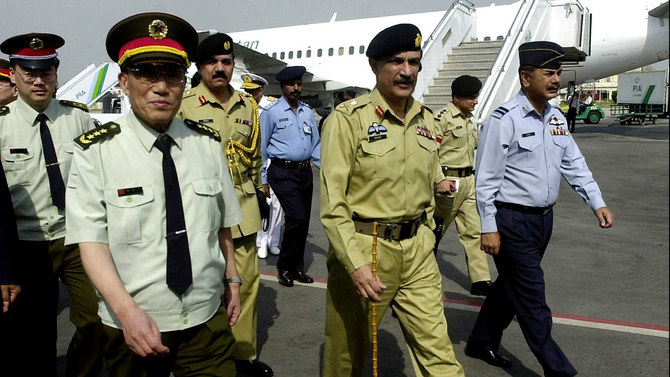
Lt. General Shahid Aziz (C) walks with Chinese Defense Minister Cao Gangchauan (L) and others upon his arrival at Allama Iqbal International Airport in Lahore on March 25, 2004. (AFP/File)
Short Url
Updated 15 February 2020
Follow

Al-Qaeda alleges retired Pakistani general had militant links, died in 2018

  • Former general Shahid Aziz’s voluntary disappearance in 2016 has been mired in mystery
  • Al-Qaeda in the Indian Subcontinent (AQIS) was formed in 2014 after an announcement by Ayman Al-Zawahiri

PESHAWAR: A magazine published by a regional branch of Al Qaeda said that retired Pakistani General Shahid Aziz-- whose voluntary disappearance in 2016 has been mired in mystery-- had died some years ago in its February edition, while alleging he had close ties with the militant organization. 
Aziz, formerly a top general in the country, retired in 2005 after serving with the Pakistan army for 37 years. While Pervez Musharraf was military chief, Aziz was promoted to director general of military operations among other key posts. After his retirement, Aziz authored a book in 2013 that criticized the policies of the former army chief.
When rumors of his disappearance and death began circulating widely in 2018, Aziz’s relatives rejected widespread reports that claimed he had died fighting alongside anti-American forces in Afghanistan or Syria. Aziz’s son denounced the reports in an interview to Voice of America, and said the General lived a ‘very private life’ of religious preaching.
Reports of his death have never been confirmed, with the latest claim by Al-Qaeda in the Indian Subcontinent’s (AQIS) Urdu language magazine, ‘Nawa-e-Afghan Jihad,’ (Voice of Afghan Jihad) the most recent in a series of rumored accounts over the last two years.
AQIS was formed by Al-Qaeda chief Ayman Al-Zawahiri in 2014, and aims to fight the governments of Pakistan, India, Afghanistan, Myanmar and Bangladesh. It has attempted to posture itself as a rival group to Daesh in the region, but has met with little success in inciting attacks. Last year, Afghanistan announced it had killed the group’s leader in a joint US-Afghan military raid in Helmand province.
The February edition of the AQIS magazine also claimed Aziz had close ties with members of the militant organization and that the former general wrote a damning, never-before-seen manuscript for a book which was sent to AQIS in 2015, and would be published in the Urdu magazine in the coming months.
Saleem Mehsud, a senior journalist, told Arab News: “For the first time, an organization has stated that Aziz had any sort of contacts with any entity, and now the magazine will publish his alleged articles from his book, which is expected to make startling revelations.”


Pakistan denies reports army ordered ‘depopulation’ in Tirah Valley ahead of anti-militant operation

Updated 5 sec ago
Follow

Pakistan denies reports army ordered ‘depopulation’ in Tirah Valley ahead of anti-militant operation

  • Tirah Valley residents started fleeing homes this month ahead of a planned military operation against militants
  • Reports aimed at creating alarm among public, disinformation against security institutions, says information ministry

ISLAMABAD: Pakistan’s information ministry on Sunday denied reports the army has ordered depopulation in the northwestern Tirah Valley ahead of a planned anti-militant offensive, stating that any movement of residents from the area is voluntary. 

The denial from the government comes as residents of Tirah Valley in Pakistan’s northwestern Khyber Pakhtunkhwa (KP) province bordering Afghanistan flee their homes ahead of a planned military operation by the army against militants, particularly the Tehreek-e-Taliban Pakistan (TTP) group. 

Despite major military operations in the mid-2010s, Tirah Valley has remained a stronghold for insurgents, prompting authorities to plan what they describe as a targeted clearance.

“The government has taken notice of misleading claims in circulation regarding alleged ‘depopulation’ from Tirah Valley on the orders of the Army,” the Ministry of Information and Broadcasting (MoIB) said in a statement on Sunday. 

“These assertions are baseless, malicious, and driven by ulterior motives aimed at creating alarm among the public, disinformation against security institutions and furthering vested political interest.”

The ministry said Pakistan’s federal government and the armed forces had not issued directives for any such depopulation of the territory. It clarified that law enforcement agencies are “routinely conducting targeted, intelligence-based operations strictly against terrorist elements” with care to avoid disruption to peaceful civilian life. 

It said locals are increasingly concerned over presence of the “khawarij,” a term the military and government frequently use for the TTP, in Tirah Valley and desire peace and stability in the area.

The information ministry mentioned that the Khyber Pakhtunkhwa Relief, Rehabilitation and Resettlement Department issued a notification on Dec. 26 last year for the release of funds, reportedly Rs4 billion [$14.24 million], for the “anticipated temporary and voluntary movement of population from certain localities of Tirah.”

Families load their belongings onto vehicles in Pakistan’s Tirah Valley on January 15, 2026. (AN photo)

It also said that the notification mentioned that the deputy commissioner of Khyber District, where Tirah Valley is located, said the voluntary movement of people reflects the views of the local population articulated through a jirga at the district level. 

“Hence any stated position of the Provincial Government or their officials being conveyed to media that the said migration has anything to do with the Armed Forces is false and fabricated,” the information ministry said. 

“Given with malafide intent to gain political capital and unfortunately malign security institutions and therefore highly regrettable.”

The evacuation has exposed tensions between the provincial government, run by former prime minister Imran Khan’s Pakistan Tehreek-e-Insaf (PTI) party, and the military establishment over the use of force in the region.

“We have neither allowed the operation nor will we ever allow the operation,” KP Law Minister Aftab Alam Afridi said earlier this month, arguing that past military campaigns had failed to deliver lasting stability.

Pakistan military spokesperson Lt. Gen. Ahmed Shareef Chaudhry has previously defended security operations as necessary as militant attacks surge in the country. 

In a recent briefing, Chaudhry said security forces carried out 75,175 intelligence-based operations nationwide last year, including more than 14,000 in Khyber Pakhtunkhwa, attributing the surge in violence to what he described as a “politically conducive environment” for militants.