

‘Lucrative deals’ await UAE agritech investment in Pakistan – Fawad Chaudhry

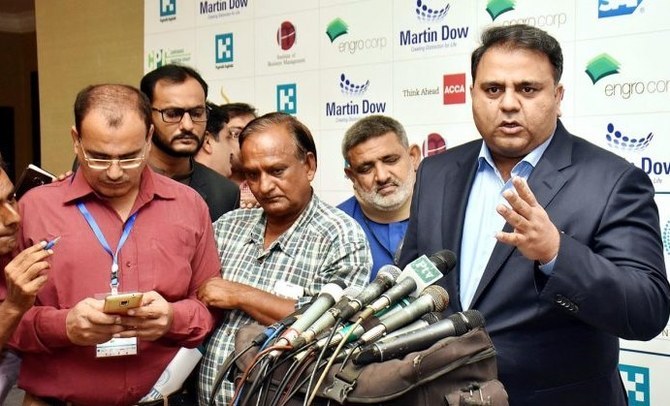
Science Minister Fawad Chaudhry talks to reporters at the Future Summit in Karachi, Sept. 18 2019. (APP)
Short Url
Updated 11 February 2020
Follow

‘Lucrative deals’ await UAE agritech investment in Pakistan – Fawad Chaudhry

  • Chaudhry has been seeking more science and hi-tech cooperation with the Arab world
  • Agriculture contributes 24 percent to Pakistan’s GDP

ISLAMABAD: Pakistan is ready to offer land and expertise to Emirati companies willing to invest in its precision agriculture sector, Science and Technology Minister Fawad Chaudhry said on Monday.

“The UAE is one of the biggest investor(s) in agriculture. We can offer land and expertise to Dubai companies who want to come to Pakistan and invest in precision agriculture,” the minister said in a Twitter post.

He said that special offers would be available to those Emirati businesses which will help Pakistan develop its agricultural technology sector.

“We can have lucrative business deals for those UAE companies,” Chaudhry tweeted.

Chaudhry has been seeking more science and hi-tech cooperation with the Arab world, particularly the UAE and Saudi Arabia.

In late January, he told Arab News that the Arab world “can benefit immensely from Pakistan’s experience,” giving as examples software development and drone technology, which according to him in Pakistan are as advanced as in Europe.

The minister has called for Saudi and UAE investment in Pakistan’s agritech sector on numerous occasions. 

“We want to bring public-private partnership in the manufacturing of batteries, and in precision agriculture ... an approach for farm management with the utilization of information technology,” he told Arab News in September, on the sidelines of the Future Summit in Karachi. Precision agriculture is a farming concept based on site-specific crop management.

“In precision agriculture, we have invited Saudi Arabia and United Arab Emirates (as partners),” Chaudhry said.

In Pakistan, farmers continue to use age-old methods of conventional farming, which has hindered growth in its agricultural sector, coupled with water-shortages and the effects of climate change. As the largest sector of the economy, agriculture contributes 24 percent to the country’s GDP according to the Pakistan Bureau of Statistics.


Pakistan deputy PM speaks with Iranian FM as Saudi Arabia intercepts missiles and drones

Updated 06 March 2026
Follow

Pakistan deputy PM speaks with Iranian FM as Saudi Arabia intercepts missiles and drones

  • Ishaq Dar expresses concern over evolving regional situation as both officials agree to remain in contact
  • Pakistan earlier reminded Tehran of its mutual defense pact with Saudi Arabia during diplomatic outreach

ISLAMABAD: Pakistan’s Deputy Prime Minister and Foreign Minister Ishaq Dar spoke with Iranian Foreign Minister Seyyed Abbas Araghchi on Friday amid escalating tensions in the Gulf, including recent missile and drone attacks targeting Saudi Arabia that were intercepted by the Kingdom’s air defenses.

The call comes as Islamabad remains in contact with both Tehran and Gulf states to prevent the widening Iran conflict from spilling further across the region, particularly after attempted strikes on Saudi territory, a sensitive development for Pakistan, which signed a mutual defense pact with the Kingdom last year.

Pakistan’s foreign ministry said Dar raised concerns about the evolving regional situation during the conversation.

“Deputy Prime Minister/Foreign Minister Senator Mohammad Ishaq Dar spoke this evening with the Foreign Minister of Iran, Seyyed Abbas Araghchi,” the ministry said in a statement.

“The DPM/FM expressed concern over the evolving regional situation. The two agreed to remain in touch on the developments,” it added.

The ministry did not share details of the conversation, though it came amid fast-moving developments in the region, with Saudi Arabia saying its air defenses intercepted multiple missiles and drones early on Friday.

Earlier this week, Prime Minister Shehbaz Sharif’s adviser on political affairs Rana Sanaullah said Pakistan was in contact with Iran to discourage attacks on Gulf countries and prevent misunderstandings.

“Such attacks should not be carried out from Iran’s side,” he told Geo TV.

Prior to that, the deputy prime minister told Pakistan’s Senate that Islamabad had engaged both Iran and Saudi Arabia at the outset of Iran’s retaliation in the region, reminding Tehran of its defense agreement with Saudi Arabia and conveying assurances from Riyadh that Saudi territory would not be used against Iran.

Pakistan says its administration is striving to end the conflict, though the United States-Israeli strikes on Iran, which triggered the war and led to its spillover, have only intensified.

Iranian President Masoud Pezeshkian said on Friday some countries had begun mediation efforts but insisted Tehran would defend its sovereignty.

Meanwhile, US President Donald Trump has called for Iran’s “unconditional surrender” on his Truth Social platform as the confrontation shows little sign of easing.