

Housing program for Saudi media professionals agreed as part of Sakani initiative

1 / 2
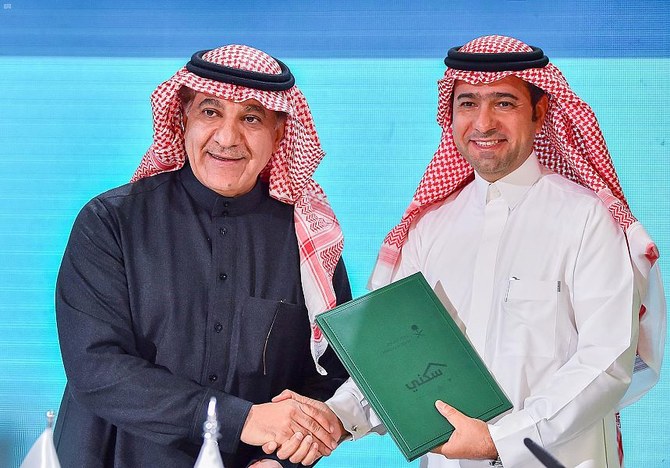
Saudi Arabia’s ministries of information and housing launched a new program on Sunday to build houses for the Kingdom’s media professionals as part of Sakani. (SPA)
2 / 2
Minister of Information Turki Al-Shabana and Housing Minister Majid Al-Haqeel signed the agreement on the project at Riyadh’s Digital City. (SPA)
Short Url
Updated 10 February 2020
Follow

Housing program for Saudi media professionals agreed as part of Sakani initiative

  • Aims to build residential neighborhoods specifically for those working in the Kingdom’s media industry
  • Ministers called it “important step in strategic partnership between both ministries”

RIYADH: Saudi Arabia’s ministries of information and housing launched a new program on Sunday to build houses for the Kingdom’s media professionals as part of Sakani, a Saudi-wide housing development scheme.

Sakani was launched in 2017 by the Ministry of Housing to build homes across Saudi Arabia and 280,000 units were provided in its first year with a further 300,000 built in 2018, according to the ministry.

The new initiative signed on Sunday will support Saudi media professionals by creating residential neighborhoods specifically for those working in the Kingdom’s media industry.
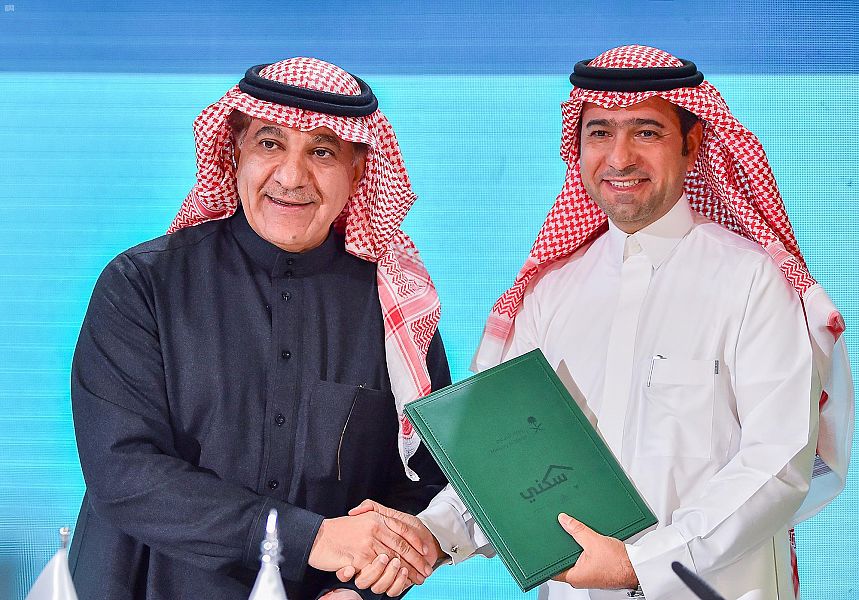


Minister of Information Turki Al-Shabana and Housing Minister Majid Al-Haqeel signed the agreement on the project at Riyadh’s Digital City. (SPA)

Minister of Information Turki Al-Shabana and Housing Minister Majid Al-Haqeel signed the agreement on the project at Riyadh’s Digital City.

The signing ceremony took place in the presence of officials from both ministries as well as a group of Saudi media figures and representatives from financial bodies.

Al-Shabana said during the ceremony that the new initiative is an “important step in the strategic partnership between both ministries,” and that the it would make it easier for media professionals to obtain residences in the “easiest and fastest way.”


Saudi kitchen to provide 24,000 daily meals to Palestinians in Gaza

Updated 27 February 2026
Follow

Saudi kitchen to provide 24,000 daily meals to Palestinians in Gaza

  • The kitchen plans to produce 3,600,000 meals to Palestinians in central Gaza and to enable the employment of 40 local workers
  • Dr. Abdullah Al-Rabeeah, the general supervisor of KSrelief, said that 90 percent of Gaza’s population is below the poverty line, lacking access to food, water, and medicine

RIYADH: King Salman Humanitarian Aid and Relief Center, also known as KSrelief, established a central kitchen in the Gaza Strip to support the Palestinian people as part of Saudi Arabia’s humanitarian efforts.

The Saudi kitchen has begun providing 24,000 daily hot meals since the start of Ramadan last week for Palestinians in the central Gaza towns of Deir Al-Balah and Al-Qarara.

The initiative is part of the Saudi Popular Campaign for the Relief of the Palestinian People in the Gaza Strip, in cooperation with the Saudi Center for Culture and Heritage.

At the end of the initiative period, the kitchen will have produced and distributed 3,600,000 meals to Palestinians in central Gaza and enabled the employment of 40 local workers, according to the Saudi Press Agency.

Dr. Abdullah Al-Rabeeah, the general supervisor of KSrelief, told SPA that the humanitarian crisis in the Gaza Strip is “one of the largest crises in the history of humanity.”

He highlighted that Palestinians are facing displacement and urgent humanitarian needs, with 90 percent of Gaza’s population below the poverty line, lacking access to food, water, medicine, and necessities for children and infants.

Saudi Arabia was one of the first countries to launch an air bridge, as well as sea and land convoys, sending aid to Gaza via over 80 planes and dozens of vessels, through the Jordanian and Egyptian crossings.

Dr. Al-Rabeeah noted that KSrelief used airdrops to deliver aid to Gaza after October 2023, when other means were not possible, the SPA added.

He said the Saudi kitchen will serve over 36,000 families and described it as “the largest central kitchen available for a group of displaced people.”