

Banks lose foreign reserves as Pak rupee offers big returns: experts

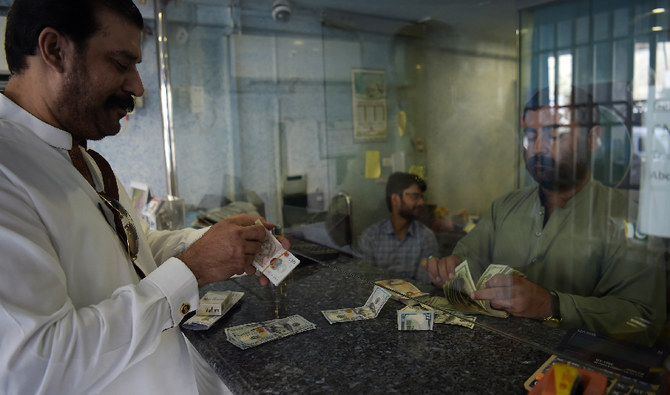
A Pakistani man purchases foreign currency at a currency exchange shop in Islamabad on October 9, 2018. (AFP)
Short Url
Updated 09 February 2020
Follow

Banks lose foreign reserves as Pak rupee offers big returns: experts

  • Commercial bank forex deposits decline by 13.4 percent to $6.4 billion by end January 2020, SBP
  • Rupee based accounts offer massive returns of over 13 percent which has stabilized the rupee against dollar, experts

KARACHI: Commercial banks in Pakistan have witnessed a decline of 13.49 percent in their foreign exchange reserves on the back of subdued demand for the US dollar, as rupee-based investments become more attractive to investors, banking experts said on Sunday. 
Financial analysts say banks’ forex reserves have declined mainly due to rupee dominated treasury bills (T-bills), where the return on investment is a whopping 13.5 percent.
At the same time, the country’s foreign currency reserves have been consistently on the rise for the past seven months. This has stabilized the Pakistani rupee with a drop in the US dollar of 6 percent since the end of the last fiscal year. This makes the rate of return on rupee-based investments much more attractive than smaller returns on foreign currency deposits in banks. 
“The inflow of the hot money vis-a-vis investment in T-Bills has stabilized the Pak rupee and now people think that the investment in the dollar is not attractive as compared to investment in rupee-based deposits with above 13 percent returns,” Muzamil Aslam, a senior financial expert, told Arab News. 
“People are selling dollars they were holding for better returns which is stabilizing the national currency,” he said.
The foreign exchange reserves held by commercial banks fell to a 14 month low at $6.4 billion on Jan. 31, 2020 compared to $7.36 billion on Aug. 17, 2019, State Bank of Pakistan (SBP) data shows.
The current level of forex reserves stand at $12.27 billion as of Jan. 31, 2020, according to SBP.

Additionally, experts say overseas investors are pouring in “hot money” into Pakistan, to take advantage of the huge rate of return on T-bills.
“Based on the current economic scenario, we are estimating an inflow of around $5 billion worth of ‘hot money’ into the country during the current fiscal year,” Ashfaq Tola, a Karachi-based tax consultant, told Arab News.

Net Foreign Portfolio Investment in T-Bills has increased by $209 million since July 2019 to reach $2.9 billion, and in Pakistan Investment Bonds (PIB) to $36 million by the end of January 2020, according to research shared by brokerage Topline Securities.

However, some bankers link the decline of the commercial banks' forex reserves with the withdrawal of dollars from bank accounts amid speculations of tax authorities’ access to those accounts.

“It was noticed that some businessmen had withdrawn dollar accounts and rupees as well, because of the fear of FBR (Federal Board of Revenue)”, Ahmed Ali Siddiqui, a banker and deputy convenor of the standing committee on Islamic Banking of Federation at Pakistan Chambers of commerce and Industry, said.

“The return on the dollar account is not attractive and encouraging as compared to the rupee based accounts. People may prefer to keep the dollar in hand or in lockers,” he added. 


Pakistan PM to visit Qatar today to explore trade, investment, energy cooperation 

Updated 4 sec ago
Follow

Pakistan PM to visit Qatar today to explore trade, investment, energy cooperation 

  • Shehbaz Sharif to lead high-level delegation comprising deputy premier, senior ministers and officials on two-day visit 
  • Sharif to meet Qatari amir, discuss economic collaboration, regional and global developments, says Pakistan’s foreign office

ISLAMABAD: Prime Minister Shehbaz Sharif will visit Qatar today, Monday, for a two-day visit to the country during which both sides will explore new avenues of cooperation in trade, investment, energy and manpower export, the foreign ministry said in a statement. 

Sharif will visit Qatar from Feb. 23-24 at the invitation of Qatari Amir Sheikh Tamim bin Hamad Al Thani, the foreign office said. The Pakistani premier will be accompanied by Deputy Prime Minister and Foreign Minister Ishaq Dar as well as other ministers and senior officials. 

Sharif is expected to meet the Qatari amir during his visit and review bilateral ties, political engagement, economic collaboration, energy partnership and people-to-people exchanges, it added. 

“The two sides will also explore new avenues of cooperation, particularly in the areas of trade, investment, energy, infrastructure development and manpower export,” the statement said. 

The foreign office said Sharif’s visit will provide both leaderships an opportunity to exchange views on regional and global developments, reaffirming their resolve to work closely for peace, stability and prosperity in the region.

Pakistan enjoys robust trade and investment relations with Qatar. In 2022, the Qatari amir’s office said that the Qatar Investment Authority aims to invest $3 billion in Pakistan to support the South Asian nation’s cash-strapped economy. This investment would focus on Pakistan’s transport, civil aviation, education, health, culture, media, communications, information technology and labor sectors, the amir’s office said.

Qatar is also host to almost 300,000 Pakistanis, which is a large part of the country’s total population, according to Pakistan’s foreign office. Qatar employs a large number of Pakistanis in the health, education, engineering, finance and public service sectors. 

A large number of semi-skilled and unskilled Pakistani work force also dominate the construction and transport sectors of Qatar. Pakistan’s efforts to expand employment opportunities for its skilled labor in Qatar have led to both sides signing several memoranda of understanding and letters of intent over the years. 

The two nations also promote bilateral cooperation through several forums such as the Bilateral Political Consultations (BPC), Joint Ministerial Commission, Joint Business Council and Working Group on Trade & Investment.

Qatar was also instrumental in easing tensions by hosting talks between Pakistan and Afghanistan in October last year, after both sides were involved in fierce border clashes that killed several and wounded dozens.