LAHORE: One of the Middle East’s most celebrated contemporary artists, who recently showcased at the much talked about desert X AlUla’s inaugural art biennale in Saudi Arabia, Wael Shawky, brought his extraordinary work to Pakistan for the first time at the Lahore Biennale-- on display between Jan. 26 to Feb. 29.
Shawky’s spectacular ‘Cabaret Crusades’ installation along the walkways of the Lahore Fort Summer Palace draws on site-specific constructions and videos, playfully harnessing the boundaries between history and storytelling. This is the first time a platform for this kind of cross-cultural dialogue has been created by showcasing an internationally acclaimed artist in the backdrop of a local historical landmark.
“The summer palace was a gift,” Shawky told Arab News on Saturday.
“It’s incredible to see a Muslim city with a long history of transitions and transformations. (Lahore possesses) complexity that may be difficult to see in other Muslim Arab cities. At the same time, Lahore’s culture plays a big role in the Arab Gulf contemporary cities like Dubai, Abu Dhabi, Doha, Kuwait...” he added.
Pakistan is not new to the Egyptian artist, who gained recognition when he gave a voice to Pakistani workers in the UAE through his award-winning musical project ‘Dictums 10:120,’ originally performed for the 2013 Sharjah Biennial.
After attending the 10th Sharjah Biennale in 2011, Shawky realized that there was an unintentional disconnect-- the majority of the South Asian workforce employed in setting up the event was missing at the public events.
Therefore he came up with the idea of an artwork to highlight their cultural roots; a project that eventually took him to Pakistan’s southern city of Karachi. After a series of workshops held in Sharjah over two years, translating fragments of curatorial talks from an earlier bienniale into Urdu, and asking workers to sift through the language for meaningful phrases- the output was eventually translated into an Urdu qawwali with the help of renowned professional Pakistani qawwals, Fareed Ayaz and Abu Muhammad.
This sound piece, which examined the relationship between arts establishments and local communities, stems from Shawky’s belief that the main purpose of biennales is to bridge the gap between the local community and contemporary art.
“Working with Farid Ayyaz and Abu Muhammad was so special, it was a way to give a huge Pakistani community in UAE a voice and a dominancy over and inside art institution,” Shawky said.
“The reaction was big and positive, I think it was one of the most successful performances I have ever done,” he said.
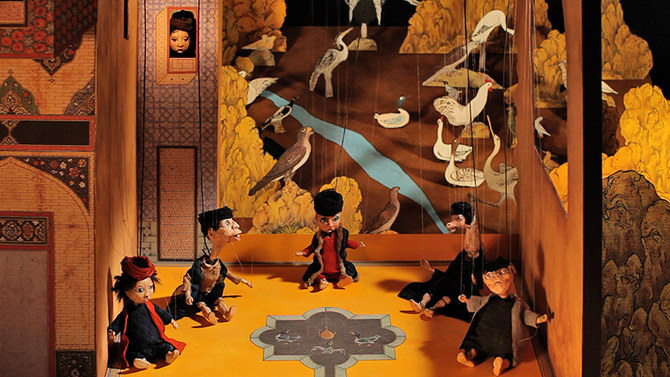
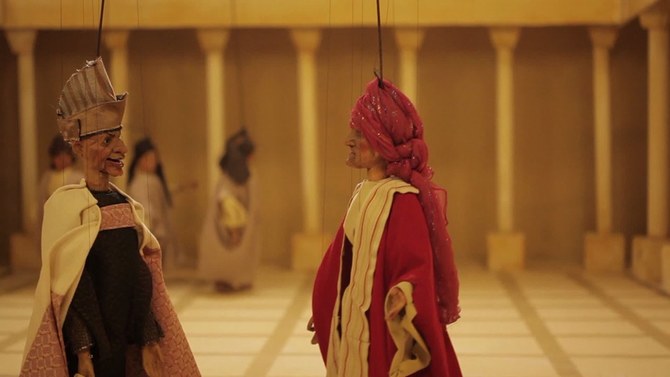
As for his work at the Lahore Biennale 2020, Shawky uses his filming of puppet-theater to tell the story of the Crusades. In his film series Cabaret Crusades, based on a book by the French-Lebanese writer Amin Maalouf, the story of the war is told from an Arab perspective. In 2011, the first part of the trilogy, The Horror Show File (2010), made Shawky famous overnight.
A large cluster of master professionals, from native classical singers, craftsmen, and puppeteers to a full film crew, crafted these intelligible videos on elaborate sets. The magnificent, handcrafted puppets are more than enough to hypnotize the viewer emotionally and intellectually.
The hundreds of Arabic speaking puppets are clad in sumptuously oriental clothing: embroidered capes, velvet corsets or metal armor. Shawky uses a bizarre mixture of the medieval and science fiction. Puppet theater is a popular art form in Pakistan as well, but a film made from this art as opposed to a live theater show, enthralled the audience.
Each video uses different puppets and a new approach, but overall the effect is dance-like, the camera movement invigorating, the sound wisely minimal, and the songs captivating. With each successive video, Shawky expertly juxtaposes historical narrative with the childlike world of puppetry, solemnity with gullibility, terror with humor, horror with entertainment, to emphasize events that were crucial to the development of an Arab Muslim identity. Shawky does not present Arabs as victims but as active players responsible for their fate.
“In Lahore, the audience were also celebrating Cabaret Crusades, I think mainly, because I care about details and I work a lot with historical Indian miniatures as a base for my film scenography,” Shawky said.
The artist’s ambitious, multilayered film renditions look at the ways in which history and folklores are recorded, highlighting the unreliability of cultural memory, while offering critical evaluations on our current narratives of uncertainty and change.
At first sight, the videos seem like a history lesson for children, but the project eventually raises essential questions about the history of identity and consequently the role of history itself. In his words, Shawky makes a critical attempt “to translate this experience as a society that lives on their ancestor’s history.”
As with all of Shawky’s work, these hauntingly beautiful videos navigate the territory between truth and myth to raise questions about history, culture and the effect of globalization on contemporary societies.


![]()
![]()
![]()
![]()
![]()
![]()

Arab artist Wael Shawky retells history at Lahore Biennale



Short Url
https://arab.news/ntj6a
Arab artist Wael Shawky retells history at Lahore Biennale
- Shawky uses his filming of puppet-theater to tell the story of the Crusades in video installations at the Lahore Fort
- Says Lahore’s culture plays big role in Arab Gulf cities like Dubai, Abu Dhabi and Kuwait
Latest updates


Recommended


© 2026 SAUDI RESEARCH & PUBLISHING COMPANY, All Rights Reserved And subject to Terms of Use Agreement.