BEIJING: The endangered pangolin may be the link that facilitated the spread of the novel coronavirus across China, Chinese scientists said Friday.
Researchers have long suspected that the virus, which has now killed more than 630 people and infected some 31,000, was passed from an animal to a human at a market in the central Chinese city of Wuhan late last year.
Researchers at the South China Agricultural University have identified the scaly mammal as a “potential intermediate host,” the university said in a statement, without providing further details.
The new virus is believed to have originated in bats, but researchers have suggested there could have been an “intermediate host” in the transmission to humans.
After testing more than 1,000 samples from wild animals, scientists from the university found the genome sequences of viruses found on pangolins to be 99 percent identical to those on coronavirus patients, the official Xinhua news agency reported.
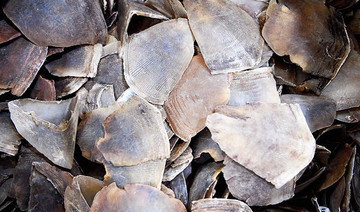
The pangolin is considered the most trafficked animal on the planet and more than one million have been snatched from Asian and African forests in the past decade, according to the International Union for Conservation of Nature (IUCN).
They are destined for markets in China and Vietnam, where their scales are used in traditional medicine — despite having no medical benefits — and their meat is bought on the black market.
Experts on Friday called for the Chinese scientists to release more data from their research.
Simply reporting the similarity between the genome sequences of viruses is “not sufficient,” said James Wood, a veterinary medicine professor at the University of Cambridge.
Wood said the results could have been caused by “contamination from a highly infected environment.”
“We would need to see all of the genetic data to get a feel for how related the human and pangolin viruses are,” Jonathan Bell, a professor of molecular virology at the University of Nottingham, said.
China in January ordered a temporary ban on the trade in wild animals until the epidemic is under control.
The country has long been accused by conservationists of tolerating a shadowy trade in endangered animals for food or as ingredients in traditional medicines.
A price list that circulated on China’s Internet for a business at the Wuhan market showed a menagerie of animals or animal-based products including live foxes, crocodiles, wolf puppies, giant salamanders, snakes, rats, peacocks, porcupines, camel meat and other game — 112 items in all.
The SARS (Severe Acute Respiratory Syndrome) virus that killed hundreds of people in China and Hong Kong in 2002-03 also has been traced to wild animals, with scientists saying it likely originated in bats, later reaching humans via civets.
“Working to end the trade in wildlife can help to resolve some of the longer-term risks associated with animal reservoirs of zoonoses,” Wood said, referring to infectious diseases that can be passed between animals and humans.

Pangolin identified as potential link for coronavirus spread
Short Url
https://arab.news/4rdyt
Pangolin identified as potential link for coronavirus spread
- Researchers have long suspected that the virus was passed from an animal to a human at a market in the central Chinese city of Wuhan
- Researchers at the South China Agricultural University have identified the scaly mammal as a potential intermediate host
Philippine volcano eruption sends ash 2.5 kilometers into sky
- Kanlaon Volcano, one of 24 active volcanoes in the archipelago nation, has had several major eruptions in the past century
- A 1996 blast killed three hikers who were near the summit at the time
MANILA: A volcano erupted in the central Philippines on Thursday evening, sending a billowing plume of ash about 2,500 meters (1.5 miles) into the nighttime sky.
The two-minute eruption began at 7:04 p.m. (1104 GMT), state volcanology agency director Teresito Bacolcol said, saying “there might be a bigger explosive eruption in the next few days.”
Kanlaon Volcano, one of 24 active volcanoes in the archipelago nation, has had several major eruptions in the past century — including a 1996 blast that killed three hikers who were near the summit at the time.
“This is the second moderate eruption in a week,” Bacolcol said in a phone interview, adding his agency would monitor the volcano for 24 hours before deciding if it should raise the alert level from two to three on its five-point scale.
“This event generated a plume that rose 2,500 meters above the crater before drifting southwest. Incandescent ballistics were observed to have rained around the crater,” the volcanology center said in a statement released minutes later.
John De Asis, a rescuer in the nearby town of La Castellana, said that ash had begun to descend on local neighborhoods.
“Tonight, we heard a sudden, loud boom, then after a few minutes, people started reporting that there was ashfall in their areas,” he said, noting that rescue personnel were handing out facemasks.
Bacolcol said it was possible that “gas pressure had built up at the vent” of the volcano. He said recent low sulfur dioxide emissions suggested a potential blockage that would have caused pressure to build.
The volcano, which straddles Negros Oriental and Occidental provinces, currently has a four-kilometer exclusion zone in place.
The Philippines is on the seismically active region of the Pacific known as the “Ring of Fire,” where more than half the world’s volcanoes are located.
The most powerful volcanic explosion in the Philippines in recent years was the 1991 eruption of Pinatubo, about 100 kilometers (62 miles) from Manila, which killed more than 800 people.
The two-minute eruption began at 7:04 p.m. (1104 GMT), state volcanology agency director Teresito Bacolcol said, saying “there might be a bigger explosive eruption in the next few days.”
Kanlaon Volcano, one of 24 active volcanoes in the archipelago nation, has had several major eruptions in the past century — including a 1996 blast that killed three hikers who were near the summit at the time.
“This is the second moderate eruption in a week,” Bacolcol said in a phone interview, adding his agency would monitor the volcano for 24 hours before deciding if it should raise the alert level from two to three on its five-point scale.
“This event generated a plume that rose 2,500 meters above the crater before drifting southwest. Incandescent ballistics were observed to have rained around the crater,” the volcanology center said in a statement released minutes later.
John De Asis, a rescuer in the nearby town of La Castellana, said that ash had begun to descend on local neighborhoods.
“Tonight, we heard a sudden, loud boom, then after a few minutes, people started reporting that there was ashfall in their areas,” he said, noting that rescue personnel were handing out facemasks.
Bacolcol said it was possible that “gas pressure had built up at the vent” of the volcano. He said recent low sulfur dioxide emissions suggested a potential blockage that would have caused pressure to build.
The volcano, which straddles Negros Oriental and Occidental provinces, currently has a four-kilometer exclusion zone in place.
The Philippines is on the seismically active region of the Pacific known as the “Ring of Fire,” where more than half the world’s volcanoes are located.
The most powerful volcanic explosion in the Philippines in recent years was the 1991 eruption of Pinatubo, about 100 kilometers (62 miles) from Manila, which killed more than 800 people.
© 2026 SAUDI RESEARCH & PUBLISHING COMPANY, All Rights Reserved And subject to Terms of Use Agreement.


