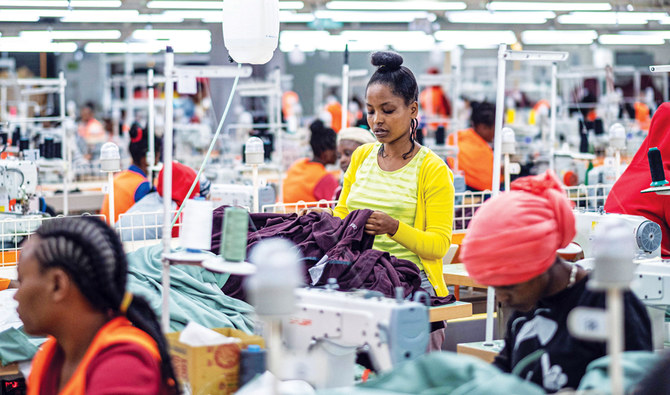

HAWASSA: Zemen Zerihun thought he’d left farming behind and found the ticket to a better life when he began a job cutting fabric for a clothing company at a massive industrial park in southern Ethiopia.
But the 22-year-old ended up quitting within months, weary of working eight hours a day, six days a week and still not making ends meet earning $35 a month.
Managers were so strict they would go into bathrooms and yank out workers deemed to be taking too long, he said.
His supervisor would loudly berate him as “slow” and “lazy” when he failed to keep pace on the production line, he told AFP.
“After I joined the company, I suffered,” he said. “The supervisors treat you like animals.”
Experiences like his highlight a major challenge facing Ethiopia’s push to embrace industrialization and become less dependant on agriculture.
By attracting foreign investors through cheap labor, it wants to follow the model of China and other Asian nations in creating a robust manufacturing sector that can offer badly needed jobs for its young workforce.
But despite high unemployment, young Ethiopians are not going along with it, preferring to quit rather than stay in jobs where they feel underpaid and disrespected.
Thousands of employees have already walked out of the country’s new and burgeoning network of industrial parks.
At the Hawassa Industrial Park, where Zemen worked, staff turnover in 2017-18 “hovered around 100 percent,” according to a May 2019 report from the Stern Center for Business and Human Rights at New York University.
The added recruitment and training costs are a main reason why, in the eyes of manufacturers, Ethiopian labor has “turned out to be considerably more costly than the government had initially advertised,” the report said.
Government officials say they are taking steps to address workers’ concerns while balancing them with industry representatives’ interests.
But labor organizers argue the measures are too little, too late, leaving them no choice but to begin unionizing the parks — a development Zemen says is long overdue. “The government needs to pay attention to what is happening in the industrial parks,” he said.
“They think they are giving everyone good jobs, but some of the workers, they are really struggling.”
Prime Minister Abiy Ahmed sees industrial parks as an important engine of growth that can help stave off unrest ahead of elections tentatively planned for August.
Yet the strategy was adopted several years before Abiy came to power, after the government realized in 2014 that agriculture couldn’t provide enough jobs for a booming population, said Arkebe Oqubay, an architect of the strategy and now special adviser to the premier.
Ethiopia is one of Africa’s fastest-growing economies but youth unemployment remains a major problem.
The World Bank estimates that 2 million people enter the workforce every year.
Despite long-running efforts to restructure the economy, officials estimate that manufacturing still only makes up 10 percent of economic activity.