

Pakistan will 'compensate' Malaysia by buying more palm oil after India withdraws -PM Khan

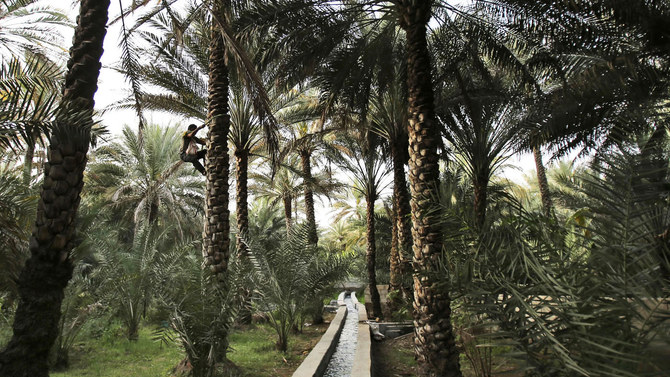
In this file photo, a date farm worker from Pakistan climbs up a palm tree over a fresh water canal in the city of Al Ain, UAE, on March 10, 2015. (AP)
Short Url
Updated 04 February 2020
Follow

Pakistan will 'compensate' Malaysia by buying more palm oil after India withdraws -PM Khan

  • India has repeatedly objected to Mahathir speaking out against its Kashmir policy
  • Pakistan bought 1.1 mln tonnes of Malaysian palm oil in 2019

KUALA LUMPUR: Pakistan will do its best to buy more palm oil from Malaysia after top buyer India put curbs on such imports last month amid a diplomatic row with the Southeast Asian nation, Prime Minister Imran Khan said on Tuesday.
India has put general restrictions on refined palm oil imports and informally asked traders specifically to stop buying from Malaysia, the world’s second-biggest producer and exporter of the edible oil, in retaliation for Malaysia’s accusation that recent Indian policies discriminate against Muslims.
India is a Hindu-majority country while Malaysia and Pakistan are mainly Muslim. Neighbours India and Pakistan have been mostly hostile to each other since the partition of British India in 1947, and have fought two of their three wars over competing territorial claims in Kashmir.
Malaysian Prime Minister Mahathir Mohamad said he discussed palm oil with Khan — in Malaysia on a state visit — and that Pakistan had indicated it would import more from Malaysia.
“That’s right, especially since we noticed India threatened Malaysia for supporting the Kashmir cause, threatened to cut palm oil imports,” Khan told a joint news conference, referring to India’s Muslim-majority region of Kashmir.
“Pakistan will do its best to compensate for that.”
Pakistan bought 1.1 million tons of palm oil from Malaysia last year, while India bought 4.4 million tons, according to the Malaysian Palm Oil Council.

STRONG TIES
India has repeatedly objected to Mahathir speaking out against its move last year to strip Kashmir’s autonomy and make it easier for non-Muslims from neighboring Muslim-majority Bangladesh, Pakistan and Afghanistan to gain citizenship.
In the news conference, 94-year-old outspoken leader Mahathir did not refer to Kashmir but Khan did.
“The way you, PM, have stood with us and spoken about this injustice going on, on behalf of Pakistan I really want to thank you,” Khan said.
The former cricketer said he was sad he could not attend a summit of Muslim leaders in Malaysia in December. The summit was outside the ambit of the Saudi-based Organization of Islamic Cooperation, and Saudi Arabia — a close ally of Pakistan — had said the gathering was “dividing” to the Islamic world.
“Unfortunately our friends, who are very close to Pakistan as well, felt that somehow the conference was going to divide the ummah,” Khan said, using the Arabic word for the Muslim community but not mentioning Saudi Arabia by name.
“It’s is clearly a misconception, as that was not the purpose of the conference,” he said.
Khan also said Malaysia and Pakistan were working on a joint media project to broadcast a positive image of Islam, fight Islamophobia and develop content for young Muslims.


Pakistan’s president defends ongoing strikes in Afghanistan, urges Kabul to dismantle militants

Updated 02 March 2026
Follow

Pakistan’s president defends ongoing strikes in Afghanistan, urges Kabul to dismantle militants

  • Afghanistan on Thursday launched attacks in retaliation for Pakistani airstrikes the previous Sunday
  • Pakistan’s military says it is only targeting Afghan military installations to avoid civilian casualties

ISLAMABAD: Pakistan’s president on Monday defended his country’s ongoing military strikes in neighboring Afghanistan, saying Islamabad tried all forms of diplomacy before targeting militants operating from Afghan territory, and called on the Taliban government in Kabul to disarm groups responsible for attacks in Pakistan.

Pakistan earlier said it is in “open war” with Afghanistan, alarming the international community. The border area remains a stronghold for militant organizations including Al-Qaeda and the Daesh (Islamic State) group.

“(The Afghan Taliban) must choose to dismantle the terror groups that survive on conflict and its war economy,” Asif Ali Zardari said during a speech to lawmakers, adding that “no state accepts serial attacks on its soil.”

Afghanistan on Thursday launched attacks in retaliation for Pakistani airstrikes the previous Sunday. Since then, Pakistan has carried out operations along the border, with Information Minister Attaullah Tarar claiming the killing of 435 Afghan forces and the capture of 31 Afghan positions.

Kabul has denied such claims.

In Afghanistan, the deputy government spokesman Hamdullah Fitrat said Pakistan’s military fired mortar shells at a refugee camp in eastern Kunar province, killing three children and injuring three others.

Afghanistan’s defense ministry said Afghan forces carried out strikes targeting a Pakistani military facility near Paktia province, causing “substantial losses and heavy casualties.”

Pakistan’s military did not respond to questions. It has said Pakistan is only targeting Afghan military installations to avoid civilian casualties.

Pakistan has witnessed a surge of violence in recent months and blames it on the outlawed Pakistani Taliban, known as Tehreek-e-Taliban Pakistan or TTP. It operates both inside Pakistan and from Afghan territory.
Islamabad accuses Afghanistan’s Taliban government of providing safe havens for the TTP, which Kabul denies.

The latest cross-border fighting ended a ceasefire brokered by Qatar and Turkiye in October. The two sides failed to reach a permanent agreement during talks in Istanbul.

Zardari reiterated Pakistan’s call for talks, saying, “We have never walked away from dialogue.”

The Pakistani leader again accused Afghanistan of acting as a proxy for India by sheltering militant groups.

“Stop being used by another country as a battlefield for their ambitions,” he said.

Zardari cited a recent report from the United Nations Security Council’s monitoring team that described the presence of militant groups in Afghanistan as an extra-regional threat.