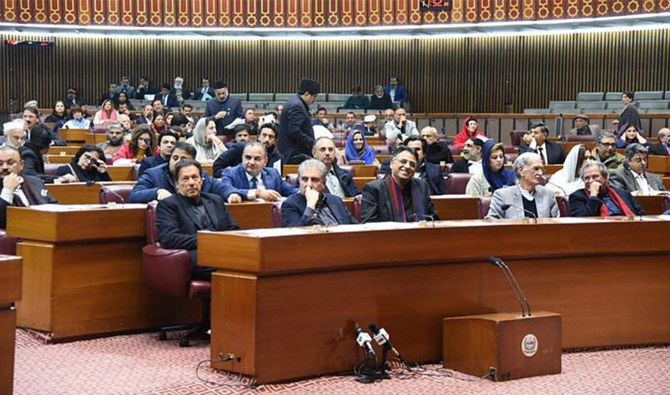
ISLAMABAD: Citing the ongoing price hike and devaluation of the Pakistani currency as the main reasons for their demands, a few members of parliament from Balochistan and Khyber Pakhtunkhwa plan to introduce a bill in the Senate, seeking a 400 percent increase in the salaries of the Senate chairman, deputy chairman, National Assembly (NA) speaker, and the deputy speaker, reported a local newspaper on Saturday.
The bill is also asking for a 100 percent increase in the paychecks of all MNAs and senators, in addition to a revised travel allowance for all MPs and their families, The News International said in an exclusive report.
If made into a law, the bill — a copy of which has been sent to the Ministry of Finance (MOF) and the Ministry of Parliamentary Affairs (MPA) for a review — will amend a clause in the Chairman and Speaker Act 1975 to increase the salary of the Senate chairman and the NA Speaker from Rs250,000 ($1,619) to Rs870,000 ($5,633) and those of the Senate Deputy Chairman and NA Deputy Speaker from Rs185,000 ($1,199) to Rs829,000 ($5,367).
The draft bill also seeks to increase the salaries of all senators and MNAs from Rs150,000 ($971) to Rs300,000 ($1,942).
According to a January 28 letter sent by the Senate Secretariat to the MPA, several senators “have given notice of their intention to introduce the subject cited Bill in the Senate.”
“An advance copy of the Bill is forwarded herewith for necessary action at your end,” excerpts from the document read, adding that the salaries drawn by those mentioned in the letter are not sufficient to meet their daily expenditures ever since the recent price hike and currency devaluation.


Pakistan MPs demand 400 percent increase in salaries, says report
https://arab.news/4jhsq
Pakistan MPs demand 400 percent increase in salaries, says report

- Parliamentarians argue that current paychecks are insufficient to meet daily expenses
- If approved, bill could revise Chairman and Speaker’s earnings from Rs250,000 to Rs870,000

Pakistani, Bangladeshi officials discuss trade, investment and aviation as ties thaw
- Pakistan and Bangladesh were once one nation, but they split in 1971 as a result of a bloody civil war
- Ties between Pakistan, Bangladesh have warmed up since last year and both nations have resumed sea trade
ISLAMABAD: Pakistan's High Commissioner to Bangladesh Imran Haider on Sunday met Chief Adviser Muhammad Yunus in Dhaka, the latter's office said on, with the two figures discussing trade, investment and aviation.
Pakistan and Bangladesh were once one nation, but they split in 1971 as a result of a bloody civil war, which saw the part previously referred to as East Pakistan seceding to form the independent nation of Bangladesh.
Ties between Pakistan and Bangladesh have warmed up since former prime minister Sheikh Hasina’s ouster as a result of a student-led uprising in August 2024. Relations remain frosty between Dhaka and New Delhi over India’s decision to grant asylum to Hasina.
Pakistan has attempted to forge closer ties with Bangladesh in recent months and both South Asian nations last year began sea trade, followed by efforts to expand government-to-government commerce.
"During the meeting, both sides discussed ways to expand cooperation in trade, investment, and aviation as well as scaling up cultural, educational and medical exchanges to further strengthen bilateral relations between the two South Asian nations," Yunus's office said in a statement on X.
In 2023-24 Pakistan exported goods worth $661 million to Bangladesh, while its imports were only $57 million, according to the Trade Development Authority of Pakistan. In Aug. this year, the Pakistani and Bangladeshi commerce ministries signed a memorandum of understanding to establish a Joint Working Group on Trade, aiming to raise their bilateral trade volume to $1 billion in the financial year that began in July.
The Pakistani high commissioner noted that bilateral trade has recorded a 20 percent growth compared to last year, with business communities from both countries actively exploring new investment opportunities, according to the statement.
He highlighted a significant increase in cultural exchanges, adding that Bangladeshi students have shown strong interest in higher education opportunities in Pakistan, particularly in medical sciences, nanotechnology, and artificial intelligence. Haider also said that Dhaka-Karachi direct flights are expected to start in January.
"Chief Adviser Professor Muhammad Yunus welcomed the growing interactions between the two countries and emphasized the importance of increased visits as well as cultural, educational and people-to-people exchanges among SAARC (South Asian Association for Regional Cooperation) member states," the statement read.
"Professor Yunus also underscored the need to further boost Bangladesh–Pakistan trade and expressed hope that during Mr. Haider’s tenure, both countries would explore new avenues for investment and joint venture businesses."


