

When Pakistan braces for coronavirus, here's how you can protect yourself

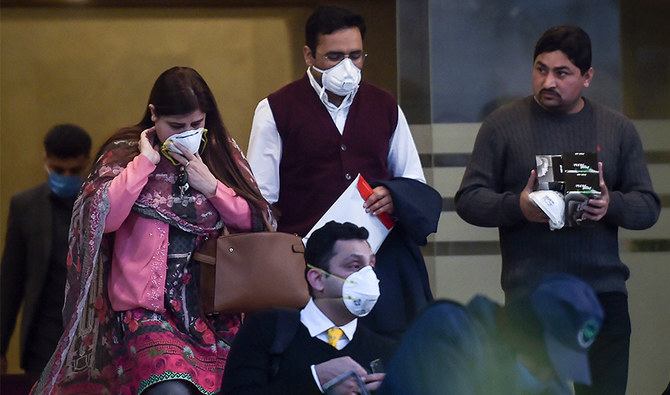
People wear protective face masks in Islamabad on Jan. 30, 2020. (AFP)
Short Url
Updated 15 March 2020
Follow

When Pakistan braces for coronavirus, here's how you can protect yourself

  • WHO has declared a global health emergency
  • Hand-washing is a first line of defense

ISLAMABAD: Pakistan is bracing for the novel coronavirus, as the World Health Organization on Thursday declared its outbreak a public health emergency of international concern. 

We suggest several basic steps to help you protect yourself and others from the mysterious infection and from other viral diseases such as flu, which reign supreme during the cold season.
Although no cases have been reported in Pakistan, authorities are introducing precautionary measures, as at least 213 people have died from the new coronavirus, with about 9,800 infections cases confirmed, mainly in China.

On Friday, all flights to and from China have been suspended with immediate effect, while Islamabad’s National Institute of Health will be receiving screening kits from Japan to test samples that possibly contain the disease.

Coronaviruses are a family of zoonotic viruses – spread between animals and humans –which vary in extremity from the common cold and flu to Severe Acute Respiratory Syndrome (SARS).

Amid ongoing panic, which has also been fueled by the media, there are steps that can help you protect yourself and others from infection.

Wash hands frequently using alcohol-based hand rub or soap and water
In markets, avoid direct contact with animals
When you cough or sneeze, cover your mouth and nose with a flexed elbow or a tissue
Throw tissues away immediately and wash your hands, avoid direct skin contact with droplets of saliva or mucus from coughing and sneezing
Do not consume raw or undercooked animal products, including meat, milk or organs, both when traveling and at home
Handle animal products with caution and avoid cross-contamination of foods with raw, uncooked meat
For extra protection while in public spaces or on public transportation, wear air filtering masks – opt for 3Ply medical grade masks available at most pharmacies, dispose after each use
If you experience fever, cough and difficulty in breathing, seek medical attention immediately. If you have traveled prior to experiencing infection symptoms, inform your health providers to help them assess your risk.


Pakistan, Afghanistan trade heavy casualty claims, battlefield losses as cross-border fighting escalates

Updated 4 sec ago
Follow

Pakistan, Afghanistan trade heavy casualty claims, battlefield losses as cross-border fighting escalates

  • Pakistan says 133 Afghan Taliban killed in counter-strikes, Kabul says 55 Pakistani soldiers dead
  • Both sides report destruction, capture of military posts as escalation deepens, signaling widening conflict

Islamabad/Karachi: Pakistan and Afghanistan traded claims of heavy battlefield losses early Friday as cross-border fighting intensified along their shared frontier, marking the most serious escalation in hostilities between the bitter neighbors in recent months.

The fighting follows Pakistani airstrikes earlier this week targeting what Islamabad said were Tehreek-e-Taliban Pakistan (TTP) and Daesh militant camps inside Afghanistan. Pakistan said those strikes killed more than 100 militants, while Kabul said women and children were killed and condemned the attacks as violations of Afghan sovereignty.

With both governments now announcing retaliatory operations and publishing sharply conflicting casualty figures, the confrontation signals a rapid deterioration in relations between the two countries.

Pakistani officials said the latest strikes were in response to what they described as unprovoked firing by Afghan forces along multiple sectors of the border late Thursday. The Pakistani prime minister’s spokesman Mosharraf Zaidi said at 0345 hours Friday counter-strikes were continuing.

“A total of 133 Afghan Taliban are confirmed killed, more than 200 wounded,” Zaidi said in an X update. “Twenty seven (27) Afghan Taliban posts have been destroyed, and nine (9) have been captured.”

He added that strikes had targeted military positions in Kabul, Paktia and Kandahar, and that corps headquarters, brigade headquarters, ammunition depots, logistics bases and other installations had been destroyed.

Pakistan’s Information Minister Attaullah Tarar described the military action as “Operation Wrath for the Sake of Truth,” saying Pakistan’s “effective counter operations are ongoing.”

Defense Minister Khawaja Asif adopted sharply escalatory language on X, declaring: “Now it is open war between us and you.”

On the Afghan side, Taliban government spokesperson Zabihullah Mujahid accused Pakistan of bombing major cities. 

“The cowardly Pakistani army has bombed some places in Kabul, Kandahar, and Paktia. Praise be to God, no one was harmed,” Mujahid said on X.

In a separate statement, Afghanistan’s Ministry of National Defense said its forces had conducted retaliatory operations along the shared border. 

The ministry claimed 55 Pakistani soldiers were killed, two garrisons and 19 posts captured and military equipment seized. It said eight Afghan fighters were killed and 11 wounded in the clashes, and alleged that 13 civilians were injured in Nangarhar.

Pakistani officials said no Pakistani posts had been damaged or captured. 

None of the casualty figures or battlefield claims from either side could be independently verified.

Cross-border violence has intensified in recent weeks, with Pakistan blaming a surge in suicide bombings and militant attacks on insurgents it says are based in Afghanistan. Kabul denies providing safe havens to anti-Pakistan militant groups.

The latest clashes mark the third major escalation between the neighbors in less than a year. Similar Pakistani strikes last year triggered weeklong fighting before Qatar, Türkiye and other regional actors mediated a ceasefire in October.

The 2,600-kilometer (1,600-mile) frontier, a key trade and transit corridor linking Pakistan to landlocked Afghanistan and onward to Central Asia, has faced repeated closures amid tensions, disrupting commerce and humanitarian movement. Trade and movement of people between the two nations has remained closed since October 2025.

The confrontation also unfolds against a backdrop of growing friction over Afghanistan’s regional alignments. Pakistan has repeatedly accused the Taliban authorities of allowing Indian influence to expand in Afghanistan, an allegation Kabul has rejected.

Pakistan’s defense minister Asif renewed that accusation on Friday, saying the Taliban government had turned Afghanistan into “a colony of India.”

Islamabad has long accused India of using Afghan territory to support anti-Pakistan militant groups, a charge New Delhi denies.