

When Pakistan braces for coronavirus, here's how you can protect yourself

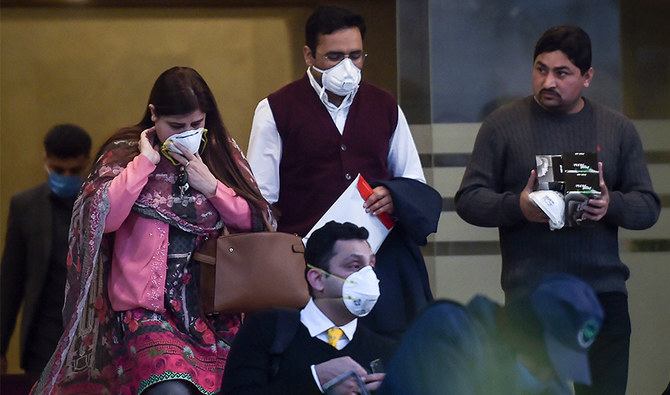
People wear protective face masks in Islamabad on Jan. 30, 2020. (AFP)
Short Url
Updated 15 March 2020
Follow

When Pakistan braces for coronavirus, here's how you can protect yourself

  • WHO has declared a global health emergency
  • Hand-washing is a first line of defense

ISLAMABAD: Pakistan is bracing for the novel coronavirus, as the World Health Organization on Thursday declared its outbreak a public health emergency of international concern. 

We suggest several basic steps to help you protect yourself and others from the mysterious infection and from other viral diseases such as flu, which reign supreme during the cold season.
Although no cases have been reported in Pakistan, authorities are introducing precautionary measures, as at least 213 people have died from the new coronavirus, with about 9,800 infections cases confirmed, mainly in China.

On Friday, all flights to and from China have been suspended with immediate effect, while Islamabad’s National Institute of Health will be receiving screening kits from Japan to test samples that possibly contain the disease.

Coronaviruses are a family of zoonotic viruses – spread between animals and humans –which vary in extremity from the common cold and flu to Severe Acute Respiratory Syndrome (SARS).

Amid ongoing panic, which has also been fueled by the media, there are steps that can help you protect yourself and others from infection.

Wash hands frequently using alcohol-based hand rub or soap and water
In markets, avoid direct contact with animals
When you cough or sneeze, cover your mouth and nose with a flexed elbow or a tissue
Throw tissues away immediately and wash your hands, avoid direct skin contact with droplets of saliva or mucus from coughing and sneezing
Do not consume raw or undercooked animal products, including meat, milk or organs, both when traveling and at home
Handle animal products with caution and avoid cross-contamination of foods with raw, uncooked meat
For extra protection while in public spaces or on public transportation, wear air filtering masks – opt for 3Ply medical grade masks available at most pharmacies, dispose after each use
If you experience fever, cough and difficulty in breathing, seek medical attention immediately. If you have traveled prior to experiencing infection symptoms, inform your health providers to help them assess your risk.


Pakistan says defense pact with Saudi Arabia elevated brotherly ties to ‘new heights’

Updated 25 February 2026
Follow

Pakistan says defense pact with Saudi Arabia elevated brotherly ties to ‘new heights’

  • Pakistan, Saudi Arabia signed strategic defense pact last year pledging aggression against one will be treated as attack on both
  • Deputy PM Ishaq Dar says enduring bonds with Islamic and Arab nations form vital pillar of Pakistan’s foreign policy 

ISLAMABAD: Deputy Prime Minister Ishaq Dar said on Wednesday that Pakistan’s defense pact with Saudi Arabia elevated its brotherly ties with the Kingdom to “new heights,” stressing that close ties with Arab and Islamic nations form a key pillar of Islamabad’s foreign policy. 

Pakistan and Saudi Arabia signed a Strategic Mutual Defense Agreement on Sept. 17 last year, pledging that aggression against one country would be treated as an attack on both, enhancing joint deterrence and formalizing decades of military and security cooperation.

Both nations agreed in October 2025 to launch an economic cooperation framework to strengthen trade and investment ties. 

“In the Middle East, our landmark Strategic Mutual Defense Agreement with Saudi Arabia has elevated our brotherly ties to new heights,” Dar said while speaking at the Pakistan Governance Forum 2026 event in Islamabad. 

The Pakistani deputy prime minister was speaking on the topic “Navigating International Relations Amidst Changing Geo-Politics.”

Dar noted that Pakistan has reinforced partnerships with other Middle Eastern nations such as the UAE, Qatar, Jordan, Oman, Egypt and Bahrain. He said these partnerships have yielded “concrete agreements” in investment, agriculture, infrastructure, and energy sectors. 

“Our enduring bonds with Islamic and Arab nations form a vital pillar of our foreign policy, and we will continue to expand our partnerships across Asia, Latin America, and Africa,” he said. 

Dar pointed out that the presidents of Kazakhstan, Uzbekistan and Kyrgyzstan have undertaken visits to Pakistan in recent months, reflecting Central Asian nations’ desire to boost cooperation with Islamabad.

On South Asia, the Pakistani deputy PM said Pakistan has successfully transformed its fraternal ties with Bangladesh into “a substantive partnership.”

“Similarly, the trilateral mechanism involving China, Pakistan, and Bangladesh has been launched with a view to expanding and deepening regional cooperation and synergy,” the Pakistani minister said. 

He said Islamabad has strengthened its “all-weather” partnership with China via the second phase of the multi-billion-dollar China-Pakistan Economic Corridor agreement and “unwavering support” from both sides for each other’s core interests. 

Dar said Pakistan had also reinvigorated its partnership with the US, advancing cooperation in trade, technology, investment, and regional stability. 

“This calibrated approach has enhanced our ability to navigate complexity with skill and confidence, ensuring that our national interests are served without compromising our core foreign policy principles,” he said.