

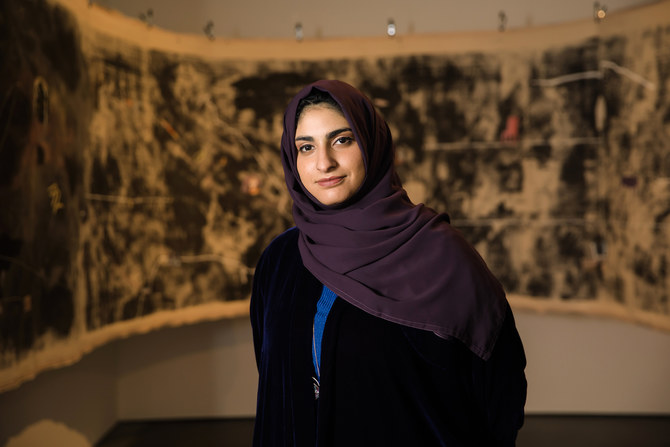

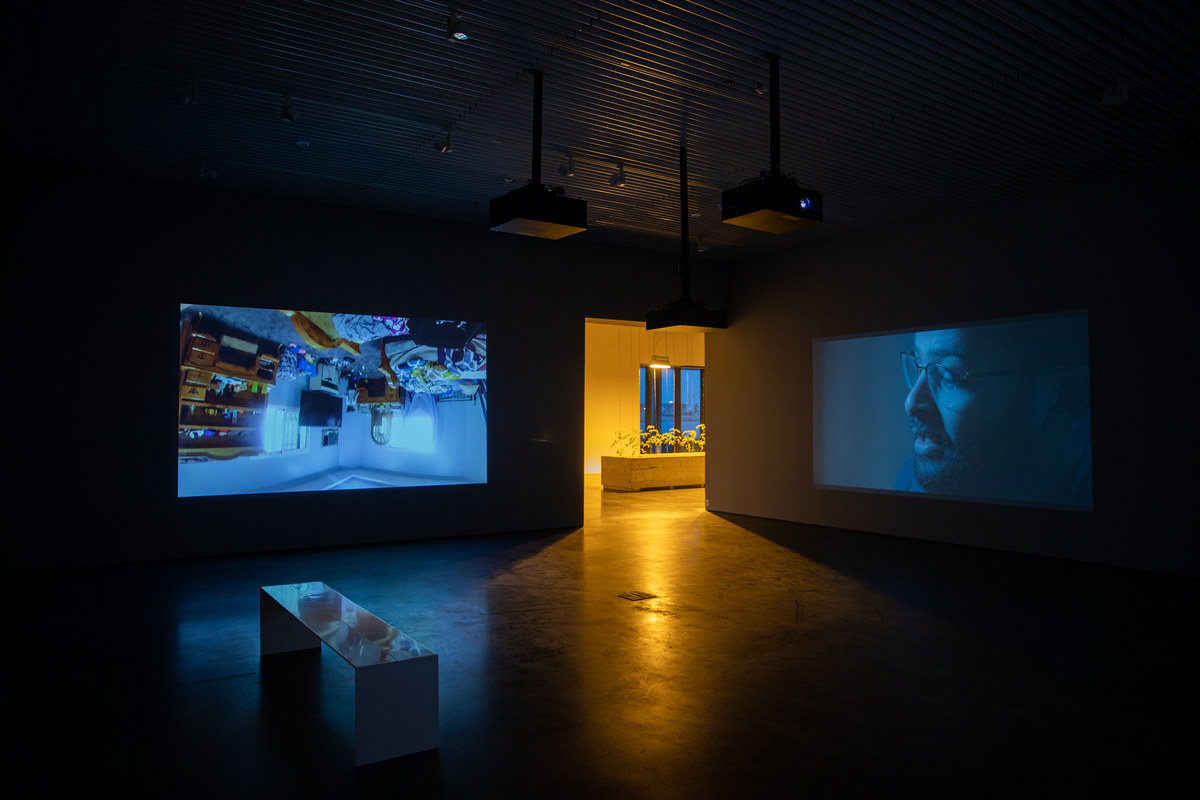
DUBAI: The sound of glass and hard metal emanates from a room in Dubai’s Jameel Arts Center. Something is being broken. Step inside the gallery and the noise is revealed to be coming from a video installation by Saudi artist Sarah Abu Abdallah called “Salad Zone,” in which two women in black abayas are repeatedly hitting a large television.
The work, a 20-minute single-channel video projection in color and sound — originally commissioned for “Rhizoma,” a group show that took place during the 55th Venice Biennale in 2013 — is both alarming and humorous. Abdallah herself is a protagonist in the film, and like her other multidisciplinary work, “Salad Zone” oscillates between the real, the poetic and the absurd.
Step inside the gallery and the noise is revealed to be coming from a video installation by Saudi artist Sarah Abu Abdallah called “Salad Zone.” (Supplied)
It was inspired by a story a friend told Abdallah about an argument that took place at her home. “My friend was so angry that she took a stick and started smashing the TV,” the artist explains. “I thought it was funny because the TV room seems to be the place where a lot of anger develops. It’s also the place in a home where people gather the most.”
The video is now part of “For the First Time in a Long Time,” the artist’s first solo exhibition at Dubai’s Jameel Arts Center, which brings together works she produced over the last six years using a variety of media, including painting, text, video and installation.
Each work offers an often-satirical meditation on what Abdallah — who has a BA in Fine Art from the University of Sharjah and an MA in Digital Media from the Rhode Island School of Design (RISD) — describes as “our media-saturated present.” Her work is influenced by the constant flow of online data and images, the pop-culture of the Gulf, and her own personal references.
In “Salad Zone” two women in black abayas are repeatedly hitting a large television. (Supplied)
“The House That Ate Them Whole,” a three-channel installation from 2018, also focuses on the rituals and residues of daily life as a way to open up a wider conversation on social codes that transcend public and private spaces.
“It’s a fictional story of a house that grew stagnant and bored and then ate its inhabitants,” explains Abdallah. “The story is told through witnesses. One person talks about a nightmare he had about an explosion that happened, while other scenes show people talking about the story in an investigative way, so that the story itself becomes almost real.”
The reportage in the video emulates current news channels to such an extent that it blurs the lines between what is fiction and truth; and so begs the question: Does the media show us what is real, or simply figments?

Abdallah herself is a protagonist in the film, and like her other multidisciplinary work, “Salad Zone” oscillates between the real, the poetic and the absurd. (Supplied)
Both “Salad Zone” and “The House That Ate Them Whole” also reflect on how notions of power permeate even the most mundane aspects of everyday life — from the way public roads are accessed and navigated to structural configurations of the private spaces that occupy one’s family home. In Abdallah’s art, these seemingly unimportant things are significant to how we think and feel.
Her work offers a dialogue that transcends public and private spaces and settles somehow in between — in a space where the unspoken social codes that are present in our daily lives can be discussed freely.
“Much of my work is generated through conversations with friends and collaborating with other artists,” she says, nodding to the idea that her art serves as a fictional extension of her real-life explorations.
Two new works, “Bad Hunches” and “Trees Speaking With Each Other” were specially commissioned for the show at Jameel Arts Center. The former is a large-scale undulating painting incorporating images and forms collected by Abdallah. It functions as a visual diary.
Her work offers a dialogue that transcends public and private spaces and settles somehow in between — in a space where the unspoken social codes that are present in our daily lives can be discussed freely. (Supplied)
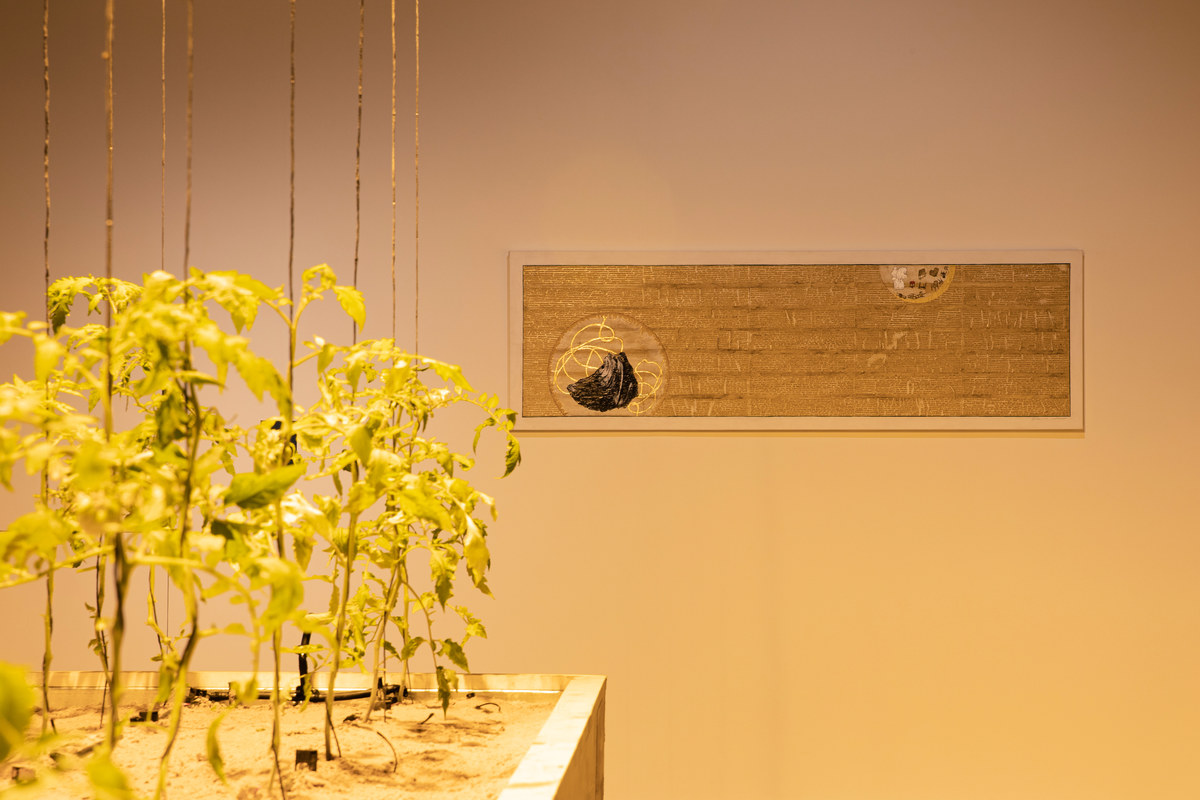
“It’s a bit of journal that is trying to link different moments in my life,” says Abdallah. “Here is my cat and there is a tomato that you will see in the next room.” And the title? “It refers to the anxiety we feel today,” she says.
The painting is scroll-like in form so that the viewer must spend time walking from one end to the other taking in the various figures, objects, thoughts and dreams that inhabit her mind and now her art.
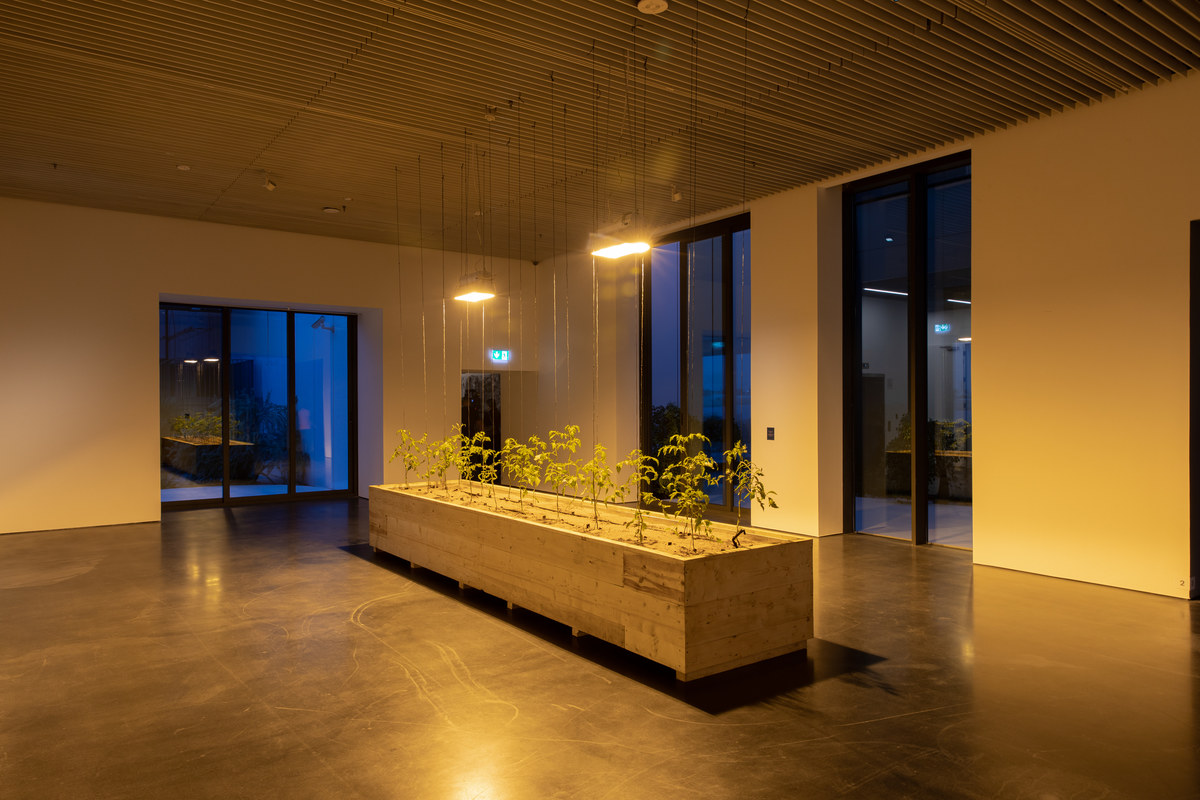
In “Trees Speaking With Each Other,” a large wooden planter box contains several living, heirloom tomatoes. But not just any tomatoes. The mundane installation serves as a monument to a type of tomato once grown in Saudi Arabia that has now disappeared due to land reforms and urbanization.
“It’s a work that speaks about the inability to recreate what has been lost,” says Abdallah. “I am from the Eastern Province (of Saudi Arabia) and, through urban development, farmlands have become compromised by the extraction of oil. These tomatoes are no longer available. They were grown by generations and generations of farmers. This piece is a gesture of nostalgia.”
In “For the First Time in a Long Time” — which runs until April 20 — the absurd, the powerful and the mundane are mixed with longing for what is no more. Abdallah preserves her memories not only of extinct tomatoes, but also of conversations with friends and her own explorations into the everyday wonders that make up daily life. In the end, her works are visual meanderings of the modern-day culture in the Gulf.


