

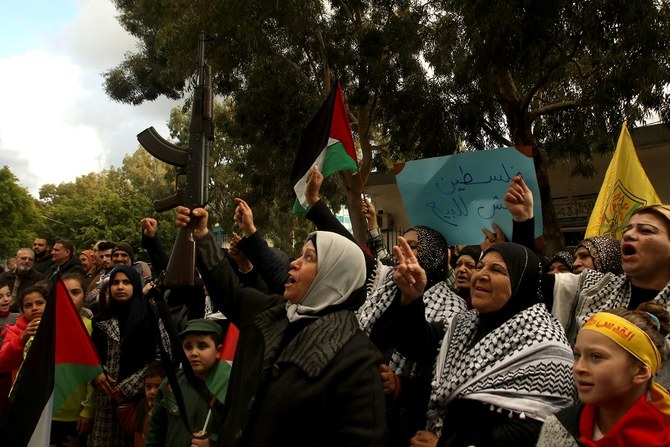

BEIRUT: Angry Palestinian refugees in Lebanon set fire to American and Israeli flags in response to US President Donald Trump’s Middle East peace offer, vowing the deal “will not pass.”
Refugees in Lebanese camps and towns took to the streets to voice their opposition to the so-called “deal of the century,” burning pictures of Trump and Israeli Prime Minister Benjamin Netanyahu, and calling on the Arab League to reject the offer.
The plan envisages a Palestinian state and the recognition of Israeli sovereignty over West Bank settlements.
The US leader said Jerusalem would remain Israel’s “undivided” capital, but the Palestinian capital would “include areas of East Jerusalem.”
Reacting to Tuesday’s announcement, Palestinian President Mahmoud Abbas said Jerusalem was “not for sale.”
“All our rights are not for sale and are not for bargain,” he added.
Lebanese President Michel Aoun called Abbas on Wednesday to affirm “Lebanon’s solidarity with the Palestinian people in facing the deal of the century,” according to his media office.
Aoun stressed “the importance of a unified Arab response,” saying Lebanon believes Palestinians have a right to an independent state with Jerusalem as its capital.
The Lebanese leader held talks with Foreign Minister Nassif Hitti ahead of a meeting of Arab foreign ministers in Cairo next Saturday.
“Any attempt to achieve a partial peace that does not guarantee the establishment of a Palestinian state with East Jerusalem as its capital will not succeed,” Hitti said.
“No one will give up their national identity in exchange for material temptations.”
Parliamentary Speaker Nabih Berri received a call from his Iranian counterpart Ali Larijani, who urged “Arab and Islamic peoples to reject the deal of the century.”
Berri said later that “Lebanon will not be a false witness at the new execution party for the Palestinian people.”
Palestinian rights will not be “bartered for money,” he added.
Prime Minister Hassan Diab tweeted: “Jerusalem will remain the compass and Palestine will remain the issue.”
Hezbollah also rejected the offer, describing it as “a very dangerous step that will have very bad repercussions for the future of the region and its peoples.”
The party warned that “the settlement project aims to create social, demographic and transitional tensions that serve only the interests of the enemy and its expansionist goals.”
Riad Tabbarah, former Lebanese ambassador to Washington, told Arab News the international community is unlikely to recognize the deal since the “disregard of the issue of refugees changes nothing on the ground.”
Speaking on the Arab League’s position, Tabbarah said: “I do not think any Arab country would dare take an anti-Palestinian stance. The presence of three Arab countries at the Trump and Netanyahu press conference does not necessarily mean they support the peace plan.”
Former Lebanese prime minister Salim Al-Hoss described the Trump deal as a “heinous crime that destroys the right of a people and abolishes an Arab homeland called Palestine.”
Another former leader, Fouad Siniora, said the deal ignored previous international agreements.
“It is a plan for the continuation of the Arab-Israeli conflict,” he added.


