Netanyahu to Putin: Trump’s Middle East peace plan a ‘new opportunity’

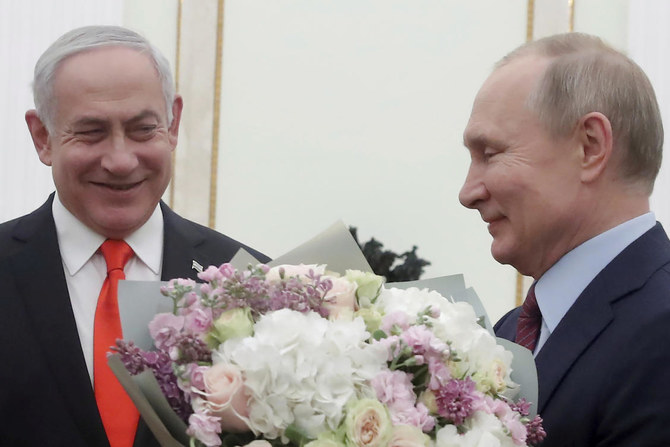
Russian President Vladimir Putin was the first leader that Israeli Prime Minister Benjamin Netanyahu met after US President Donald Trump’s announcement of the Middle East peace plan. (Reuters)
Short Url
Updated 30 January 2020
Follow

Netanyahu to Putin: Trump’s Middle East peace plan a ‘new opportunity’

  • Benjamin Netanyahu, facing graft charges, is contesting March elections and hoping the proposal will boost his re-election chances
  • US President Donald Trump’s plan angered Palestinians by proposing Israel retains control over Jerusalem

MOSCOW: Israeli Prime Minister Benjamin Netanyahu on Thursday hailed US President Donald Trump’s Middle East peace plan as a new opportunity after flying to Moscow to discuss it with President Vladimir Putin.
“I think there’s a new and perhaps unique opportunity here,” said the Israeli premier, who stood alongside Trump at the White House when the plan was announced Tuesday and called it a victory for Israel.
Trump’s plan angered Palestinians by proposing Israel retain control over Jerusalem as its “undivided capital” and giving the green light to annex Jewish settlements in the West Bank.
“I’d like to speak to you and hear your insights and see how we can combine all our forces for security and peace,” Netanyahu told Putin at the start of their Kremlin meeting.
“You’re actually the first leader I’m speaking with after my visit to Washington about President Trump’s Deal of the Century,” he added.
The Russian leader did not mention the peace plan in his public remarks.
Netanyahu, facing graft charges, is contesting March elections and hoping the proposal will boost his re-election chances.
The March 2 vote is Israel’s third in less than a year, with polls suggesting the prime minister’s rightwing Likud is again neck-and-neck with the centrist Blue and White party led by ex-military chief Benny Gantz.
Netanyahu was visiting Russia on the same day that it released a young US-Israeli woman jailed for drug trafficking over a small amount of cannabis found in her luggage as she transited a Moscow airport.
Her case caused an outcry in Israel and her release came after Netanyahu pleaded her case with Putin, who issued a pardon.


Israel’s Supreme Court suspends govt move to shut army radio

Updated 29 December 2025
Follow

Israel’s Supreme Court suspends govt move to shut army radio

  • Israel’s Supreme Court has issued an interim order suspending a government decision to shut down Galei Tsahal, the country’s decades-old and widely listened-to military radio station

JERUSALEM: Israel’s Supreme Court has issued an interim order suspending a government decision to shut down Galei Tsahal, the country’s decades-old and widely listened-to military radio station.
In a ruling issued late Sunday, Supreme Court President Isaac Amit said the suspension was partly because the government “did not provide a clear commitment not to take irreversible steps before the court reaches a final decision.”
He added that Attorney General Gali Baharav-Miara supported the suspension.
The cabinet last week approved the closure of Galei Tsahal, with the shutdown scheduled to take effect before March 1, 2026.
Founded in 1950, Galei Tsahal is widely known for its flagship news programs and has long been followed by both domestic and foreign correspondents.
A government audience survey ranks it as Israel’s third most listened-to radio station, with a market share of 17.7 percent.
Prime Minister Benjamin Netanyahu had urged ministers to back the closure, saying there had been repeated proposals over the years to remove the station from the military, abolish it or privatise it.
But Baharav-Miara, who also serves as the government’s legal adviser and is facing dismissal proceedings initiated by the premier, has warned that closing the station raised “concerns about possible political interference in public broadcasting.”
She added that it “poses questions regarding an infringement on freedom of expression and of the press.”
Defense Minister Israel Katz said last week that Galei Tsahal broadcasts “political and divisive content” that does not align with military values.
He said soldiers, civilians and bereaved families had complained that the station did not represent them and undermined morale and the war effort.
Katz also argued that a military-run radio station serving the general public is an anomaly in democratic countries.
Opposition leader Yair Lapid had condemned the closure decision, calling it part of the government’s effort to suppress freedom of expression ahead of elections.
Israel is due to hold parliamentary elections in 2026, and Netanyahu has said he will seek another term as prime minister.