ISLAMABAD: In November, during a huddle of parliamentarians from the ruling party, Pakistani Tehreek-e-Isaaf (PTI), a lawmaker launched an unexpected attack on the government’s flagship poverty reduction program.
He took aim directly at the soft-spoken Dr. Sania Nishtar, special assistant to Prime Minister Imran Khan on social protection and poverty alleviation, accusing her of rolling out initiatives benefiting the voters of his political opponents, Dr. Nishtar recalls, instead of his own. A few other voices chimed in.
There is “a small minority” within the cabinet, the special assistant conceded to Arab News this week, which is used to the old way of doing things-- politicizing social protection programs.
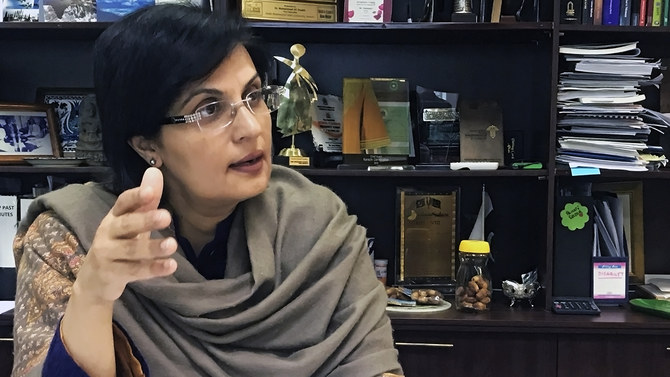
“Programs like these were in the past used for political purposes, for creating a vote bank,” she said, seated in her office in the capital, Islamabad.
“The prime minister is very clear that our program will run apolitically. And while I am here, it cannot be otherwise,” she said.
The South Asian country of 208 million people, has a huge poverty problem. According to its last national survey conducted in 2015-16, 38.4 percent of Pakistan’s population lives in multidimensional poverty. This means not only do they have low incomes, they do not have access to health, electricity, clean water and education, among other things. A majority of those who live in extreme poverty are in the country’s largest (area-wise) province, Balochistan, in southwestern Pakistan.
An updated poverty survey is expected to be completed this year.
In March last year, Pakistan’s newly elected government launched its largest and most ambitious poverty alleviation plan, the Ehsaas program. Ehsaas is an umbrella platform with over 134 pro-poor policy initiatives, aimed at widows, the homeless, orphans, laborers, students, farmers and the elderly.
It was a tough task. The doctor knew she was staking her legacy on a plan which would face resistance from political quarters. When the prime minister first approached her to join his cabinet, she said she hesitated, but agreed once she was promised complete freedom without political interference, to carry out her work.
“Prime Minister Imran Khan came across to me as someone who was genuinely interested in the problems of the poor. I am, to this day, never stopped from doing what is right. And if I did not have the prime minister’s complete support, I would not be sitting here today,” she said.
Since March, one after another, an initiative is rolled out every month in much-publicized ceremonies personally attended by Khan. Some ongoing projects include soup kitchens and shelter homes for the homeless and the Kifalat program, through which women, who do not have any other source of income, receive a small monthly stipend of Rs. 2,000 ($13).
Dr. Nishtar is powering through, while the pushback has only intensified.
Last month, the doctor announced the removal of over 800,000 people from the Benazir Income Support Program (BISP), a cash transfer plan launched in 2008 for women who do not have any source of income. The BISP now falls under Ehsaas.
The names excluded, Dr. Nishtar told reporters, were “undeserving” of the income support.
Upward of 140,000 of the claimants were government employees against whom disciplinary action would be taken, she said. Others listed on the BISP had homes and cars registered under their names while some had made foreign visits in the last few years.
Soon after, leader of major opposition party Pakistan People’s Party (PPP), Bilawal Bhutto-Zardari, called the exclusion of names an “economic attack on poor women.”
Recently, a member of the national assembly from the ruling party walked into the doctor’s office to complain about a woman employed at his home who was removed from the BISP only because she traveled to perform Umra.
“I asked him, does the woman live with you? He said yes. Do you provide her food and pay her medical bills? He said yes. I then asked him, don’t you think another woman who has nothing is more eligible for the program?” Dr. Nishtar said and added: “The BISP is for the poorest of the poor.”
Combined, the BISP and Khifalat aim to support seven million women in Pakistan. Ayesha Bano, who lives in the northwestern Khyber Pakhtunkhwa province, said she had been on the BISP for over a decade.
“Without it my household would be difficult to run,” she told Arab News.
Previously, parliamentarians were given thousands of BISP forms each, to fill out on behalf of women they thought were deserving. These forms were often misused. But that has now changed. The doctor and her team, through non-governmental organizations and analytical data, is identifying those who deserve the Rs. 5,000 quarterly as a stipend. Last week, Dr. Nishtar announced that quarterly figure would be increased to Rs. 6000 ($40).
She said that until now, she had only zeroed in on the federal and provincial governments, while other state departments still remained to be examined, to weed out officials exploiting the BISP.
“They [officials] are not giving me data because they know what I intend to do,” she said.
Political and bureaucratic challenges aside, there is one other problem – money. Social welfare programs like Ehsaas are expensive and require government revenue in order to bankroll them. In the last budget, the government allocated Rs. 80 billion to the initiative. This figure could be increased to Rs. 120 billion this year.
“Elaborate social welfare systems require the governments to collect a large proportion of their GDP’s in taxes,” explains Shahrukh Wani, a prominent Pakistani economist.
“Pakistan doesn’t collect enough (tax) to provide a basic level of service delivery, let alone enough under which it can provide comprehensive social protections. It is unlikely any such program can work in the absence of a large and extensive tax infrastructure.”
Dr. Nishtar agrees that Pakistanis out of the tax net have a connection with how the program is funded and its effectiveness.
“Social protection programs are largely funded through revenue,” she said. “The predictability of the budget has to be there.”


![]()
![]()

'Some in PM cabinet want to use Ehsaas for votes' says Pakistan poverty alleviation chief

Short Url
https://arab.news/m6p5r
'Some in PM cabinet want to use Ehsaas for votes' says Pakistan poverty alleviation chief
- Dr. Sania Nishtar says there are some in PM cabinet who want to use program for political gain
- National survey concluded 38.4 percent of Pakistanis live in multidimensional poverty
Latest updates


© 2026 SAUDI RESEARCH & PUBLISHING COMPANY, All Rights Reserved And subject to Terms of Use Agreement.