

Pakistan’s first female architect Yasmeen Lari wins Jane Drew Prize

Pakistan’s first female architect Yasmeen Lari is the winner of the Jane Drew Prize 2020. (Photo courtesy: Archnet)
Short Url
Updated 24 January 2020
Follow

Pakistan’s first female architect Yasmeen Lari wins Jane Drew Prize

  • Lari has designed some of Pakistan’s most iconic buildings
  • The prize promotes innovation, diversity and inclusiveness in architecture

ISLAMABAD: Yasmeen Lari, Pakistan’s first female architect, has won the prestigious Jane Drew Prize awarded by the Architects’ Journal.
“I am touched and humbled to be included among the galaxy of architects who have received this prize,” Lari told Architect’s Journal.
She was born in Dera Ghazi Khan to a family of a developer and was introduced to the building industry very early. She graduated from the School of Architecture at Oxford Brookes University.
In 1964, Lari established Lari Associates, Architects, Urban Designers, and has designed some of Pakistan’s most iconic buildings. She is perhaps best known for the Finance and Trade Center and Pakistan State Oil House, both being landmark buildings in Karachi.
She retired from architecture in 2000 to devote her time to writing, heritage-related work, and sustainable design – of which she is a pioneer in Pakistan.
In 2007, she began working with bamboo, an eco-friendly material, which used in projects for Pakistan’s vulnerable groups, such as communal kitchens for refugees in the Swat Valley and community centers to aid persons displaced by floods in Khyber Pakhtunkhwa and Sindh.
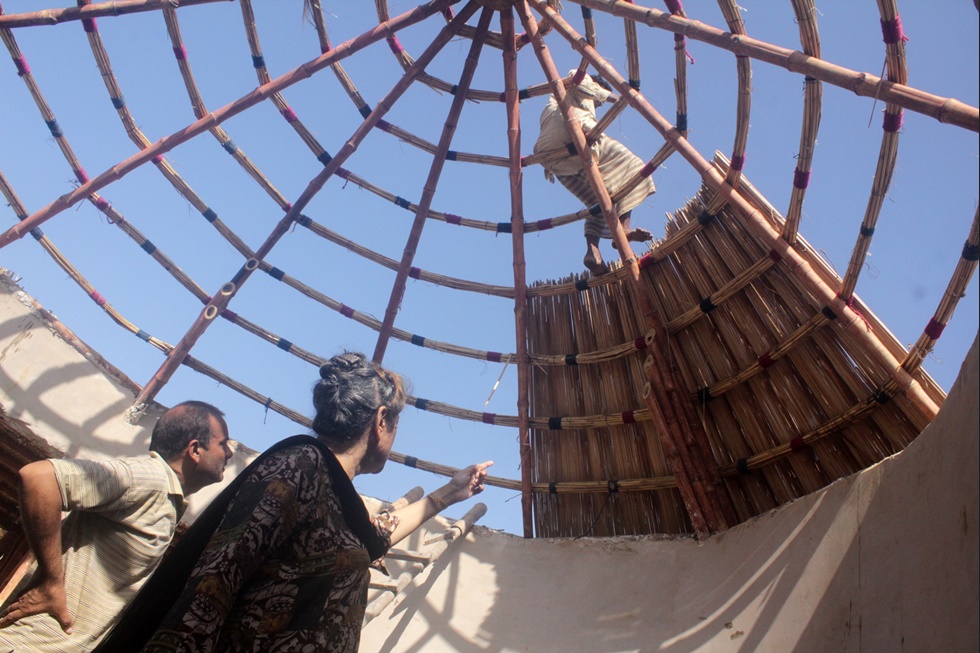


Yasmeen Lari visits the site of one of her bamboo shelter designs in Swat Valley, Pakistan, 2007. (Photo courtesy: Architects’ Digest)

In 2013, she helped design and construct shelters following devastating earthquakes in Balochistan.
In 2006, Lari was awarded Sitara-e-Imtiaz, one of the highest civil awards in Pakistan, for her services to the architectural profession and heritage conservation.
Previous Jane Drew Prize winners include Zaha Hadid, Odile Decq, Grafton Architects’ founders Yvonne Farrell and Shelley McNamara, and Eva Jiricna.
The prize was created to promote innovation, diversity and inclusiveness in architecture, is named after British architect and feminist Jane Drew, one of the founders of the modernist movement in Britain, whose work was guided by the principle that architecture should provide a space in which human beings can flourish.
Lari will be accepting the prize at Battersea Arts Center in London on March 6.


Pakistan bank enables Shariah-compliant digital payment facility for passengers at Islamabad airport

Updated 23 February 2026
Follow

Pakistan bank enables Shariah-compliant digital payment facility for passengers at Islamabad airport

  • Pakistan is a cash-dominated market where a significant portion of transactions in the informal sector are made without any taxes, officials say
  • The move comes amid Pakistan’s efforts to introduce a cashless model at airports under which only digital service providers can provide services

KARACHI: Aik, Pakistan’s first Islamic digital bank, has enabled fully digital payments at Islamabad International Airport to offer travelers and passengers secure, Shariah compliant digital transaction facility.

The development comes amid Pakistan’s efforts to introduce a cashless model at airports across the country, under which only digital service providers can provide services to customers.

Aik, a subsidiary of Bank Islami, said it has onboarded merchants across the Islamabad airport and integrated QR code deployments at key touchpoints to allow passengers and visitors to make secure, seamless, and Shariah-compliant digital transactions at all counters, retail outlets, and service points.

It said the implementation complies with the regulations and framework set by the State Bank of Pakistan (SBP) and is a working model for a large-scale adoption of cashless systems in public infrastructure.

“This deployment reflects our commitment to building practical digital infrastructure that improves everyday transactions,” Aik Chief Officer Ashfaque Ahmed said in a statement.

“By enabling a fully cashless environment at a major national gateway, we are supporting efficiency, transparency, and financial inclusion at scale. This is not only a project; it is a foundation for Pakistan’s cashless future.”

Pakistan is a cash-dominated market where a significant portion of transactions, particularly in the informal sector, are conducted in cash. Officials say many of these transactions are aimed at avoiding taxes.

In recent years, the SBP has taken steps to ensure a transition toward a more cashless economy so that transactions are more traceable, reducing chances of tax evasion and corruption.

By digitizing Islamabad airport, aik said it continues to invest in secure and accessible financial solutions that “expand digital participation and support national economic modernization.”