

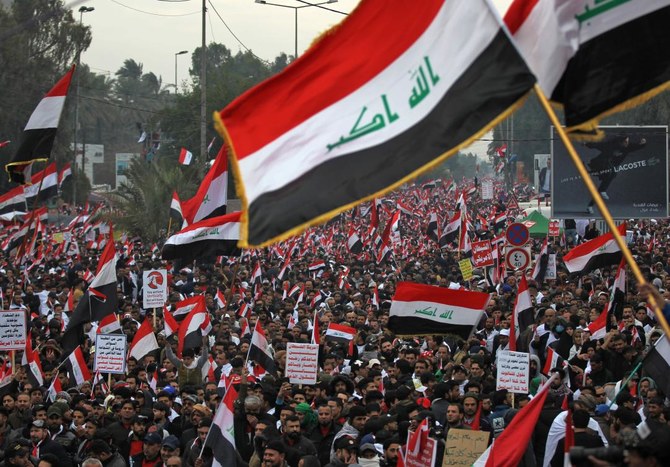

BAGHDAD: Thousands of supporters of populist Iraqi cleric Moqtada Sadr gathered in Baghdad on Friday for a rally to demand the ouster of US troops, putting the protest-hit capital on edge.
The march rattled the separate, months-old protest movement that has gripped the capital and the Shiite-majority south since October, demanding a government overhaul, early elections and more accountability.
In the early hours of Friday, thousands of men, women and children of all ages massed under grey skies in the Jadiriyah district of east Baghdad.
“Get out, get out, occupier!” some shouted, while others chanted, “Yes to sovereignty!“
A representative of Sadr took to the stage at the protest site and read out a statement by the influential Shiite cleric and populist politician.
It called for all foreign forces to leave Iraq, the cancelation of Iraq’s security agreements with the US, the closure of Iraqi airspace to American military and surveillance aircraft and for US President Donald Trump not to be “arrogant” when addressing Iraqi officials.
“If all this is implemented, we will deal with it as a non-occupying country — otherwise it will be considered a country hostile to Iraq,” the statement said.
Protesters then began peeling away from the square, tossing their signs in bins along the way, but thousands lingered in the rally camp.
The American military presence has been a hot-button issue in Iraq since a US drone strike killed Iranian general Qasem Soleimani and Iraqi paramilitary leader Abu
Mahdi Al-Muhandis outside Baghdad airport on January 3.
Two days later, parliament voted for all foreign troops, including some 5,200 US personnel, to leave the country.
The vote was non-binding and the US special envoy for the coalition against the Daesh group, James Jeffrey, said Thursday there was no “real engagement” between the two governments on the issue.
Joint US-Iraqi operations against IS have been on hold since the drone attack, which triggered retaliatory Iranian missile strikes against US troops in Iraq.
No Iraqi or US personnel were killed in Iran’s strike.
Long opposed to the US troop presence, Sadr seized on the public anger over the drone strike to call “a million-strong, peaceful, unified demonstration to condemn the American presence and its violations.”
Several pro-Iran factions from the Hashed Al-Shaabi paramilitary force, usually rivals of Sadr, backed his call and pledged to join.
But separate anti-government protesters, who have braved violence that has left 470 people dead since October, fear their cause could be eclipsed by Sadr’s powerplay.
“Sadr doesn’t represent us,” one teenager said defiantly late Thursday on a blocked-off thoroughfare in Baghdad.
To head off Friday’s gathering and ramp up pressure on authorities to enact reforms, young demonstrators blocked streets in Baghdad and across the south this week.
There had been worries that angry crowds might attack the presidential palace or the high-security Green Zone, home to the US embassy and other foreign missions.
The move would not be without precedent for Sadr, who urged followers to storm the Green Zone in 2016 in a challenge to the government over undelivered reforms.
But there were no attempts on Friday morning to storm government buildings.
Sadr, 46, battled US forces at the head of his Mehdi Army militia after the US-led invasion toppled Saddam Hussein in 2003.
He later branded himself a reformist and backed the recent anti-government protests when they erupted in October.
The cleric controls parliament’s largest bloc and his followers hold top ministerial positions.
Sadr is a notoriously fickle politician, known for switching alliances quickly.
His spokesman Saleh Al-Obeidy hinted that while others in Iraq unequivocally blamed either the US or Iran for instability, Sadr would choose a middle path.
“We believe that both are behind this ruin, and Sadr is trying to balance between the two,” he said.
Harith Hasan of the Carnegie Middle East Center said Sadr was trying to sustain his “multiple identities” by backing various protests.
“On the one hand, (he seeks to) position himself as the leader of a reform movement, as a populist, as anti-establishment,” Hasan told AFP.
“On the other hand, he also wants to sustain his image as the leader of the resistance to the ‘American occupation’,” partly to win favor with Iran.
Sadr may also have domestic motivations, Hasan said.
“This protest will show Sadr is still the one able to mobilize large groups of people in the streets — but it’s also possible he wants other groups to respond by giving him more space to choose the prime minister.”


