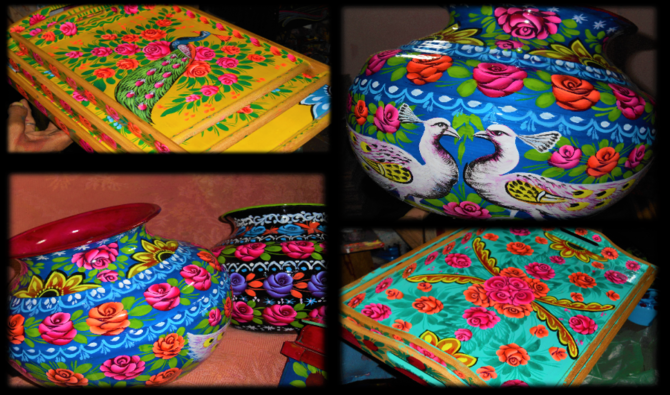
Commercial truck art enters Pakistani drawing rooms

Shahzad Hussain's truck art on everyday objects. (AN photo)
Short Url
Updated 25 January 2020
Follow

Commercial truck art enters Pakistani drawing rooms

  • Truck art is trending in interior design and gift industries
  • Its charm lies in imperfection, says artisan

KARACHI: In a small room of a building located in Saddar neighborhood in the heart of Karachi, Shahzad Hussain, 46, is making final touches to a brightly colored teapot, a wedding present painted with famous Pakistani truck art patterns.

“I have got an order to color 500 kettles from a family that is planning to present it as a wedding gift to their guests,” Shahzad told Arab News while his three assistants were busy painting other orders with vivid colors.

Pakistan’s famous truck art continues to flourish not only on freight vehicles, but also as unique ornaments that attract much recognition worldwide.

Lively hand-painted patterns – often inscribed with poetry verses – drawings of Pakistan’s native flora and fauna, or caricatures of popular personalities, have for decades caught attention, especially on the country’s roads.

“We paint truck art designs on a variety of products that are not limited to only truck models. People come up with different items such as trays, pots, key chains, shoes to give them different colors,” Hussain said. “In fact, we have over 200 items on our list that are painted with truck art.”
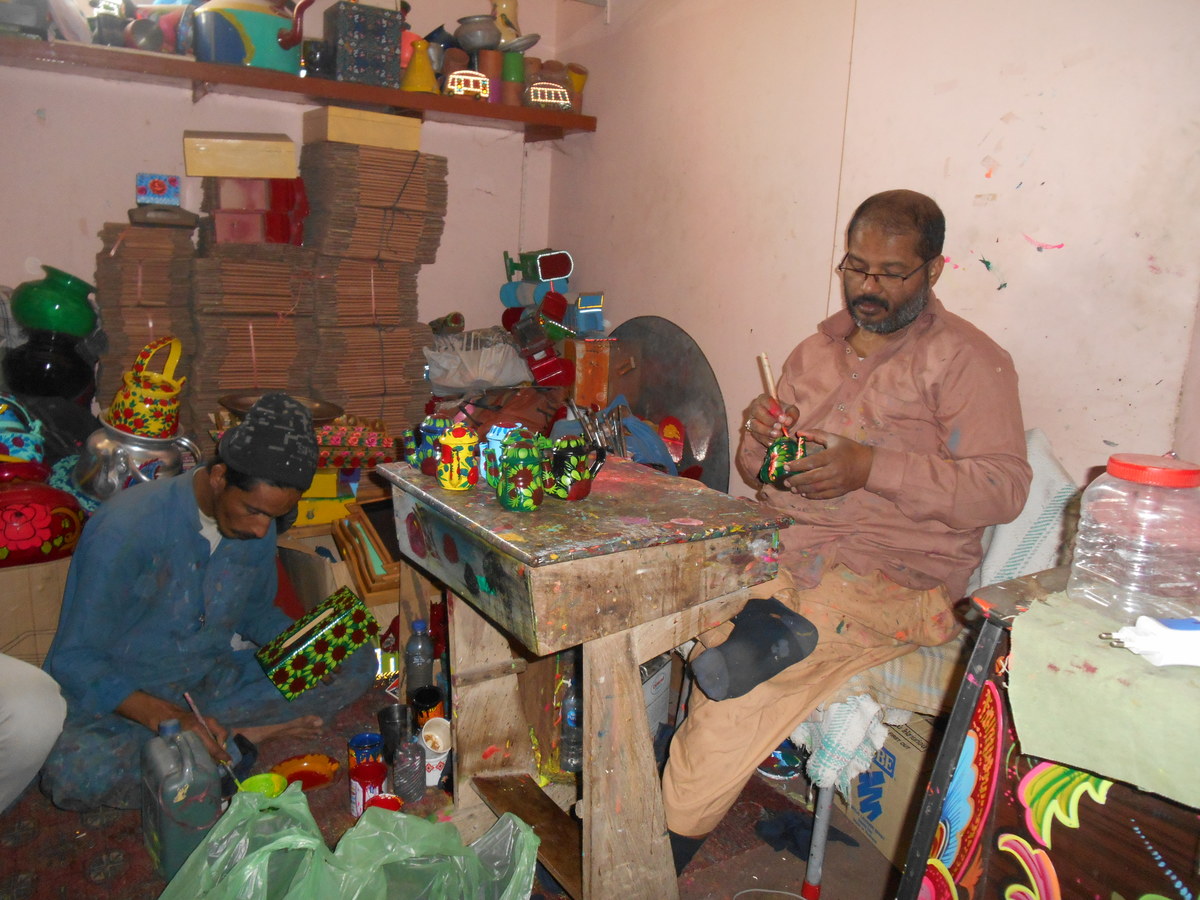


Truck artist Shahzad Hussain is painting a teapot with truck art ornaments at his shop in Saddar, Karachi on Jan. 22, 2020. (AN photo)

His customers are seasonal. In summers, he paints models of buses of all sizes, trucks and rickshaws, which are popular among foreign tourists. He also paints suitcases for between Rs1,500 and Rs10,000, wooden cases, lanterns, and photo frames.

The art is trending. In many Pakistani households, drawing rooms are considered incomplete without truck art-decorated objects.

Hussain’s works are also sold abroad, purchased mostly by handicraft sellers.

“We keep the aesthetic sense of customers in mind while painting. To survive in the business an artist must know the taste his clients,” the artisan argues and dismisses the impression that commercial artists are underpaid.

According to him, truck art should be promoted among the young and taught as a form of profession. “It takes at least five years to learn it. We need professional schools to promote the art,” he said, explaining that it must be handmade as machines, computers would lose its feel. It needs human imperfection.

“When you would try to make this work with all perfection, it will not look good,” he said.


Pakistan to sell excess gas in international markets from Jan.1— petroleum minister

Updated 24 min 6 sec ago
Follow

Pakistan to sell excess gas in international markets from Jan.1— petroleum minister

  • Pakistan was reportedly exploring ways to reduce $378 million in annual losses from supply glut caused by excess fuel imports 
  • Move to sell excess LNG in international markets will limit $3.56 billion losses caused since 2018-19, says petroleum minister

ISLAMABAD: Pakistan will sell its excess liquefied natural gas (LNG) in international markets from Jan. 1, Petroleum Minister Ali Pervaiz Malik said, revealing the move would limit losses caused from a years-long supply glut. 

Local and international media outlets had reported in July that Pakistan was exploring ways to sell excess LNG cargoes amid a gas supply glut that government officials said was costing domestic producers $378 million in annual losses. News reports had said Pakistan had at least three LNG cargoes in excess that it imported from Qatar and has no immediate use for.

Speaking to reporters during a press conference on Sunday, Malik said there was an excess of imported gas in Pakistan as the use of this fuel for power generation had reduced in the country during the past few months. He said Islamabad had been forced to sell the gas to local consumers, due to which the circular debt in the gas sector from 2018 till now had ballooned to around Rs1,000 billion [$3.56 billion]. 

“From Jan. 1 we will sell this excess fuel in international markets to reduce our burden and limit our losses of this Rs1,000 billion [$3.56 billion],” Malik said. 

He said this move would also allow Pakistan’s state-owned enterprises in the sector to operate on their full capacity and generate profits and employment. 

Malik also spoke of foreign oil companies that were ready to invest millions in the country in the near future. 

The minister cited the recent visit of Turkish energy minister to Pakistan which had resulted in the state-owned Turkish Petroleum signing deals to carry out onshore and offshore drilling activities in Pakistan. 

“Turkish Petroleum will also open its office in Islamabad, where 10 to 15 Turkish nationals will be working,” Malik said. 

He also said that a delegation of the State Oil Company of Azerbaijan Republic (SOCAR) visit Pakistan this week, adding that it was also expected to collaborate with local companies for oil and gas exploration.

The minister said SOCAR was also opening its office in Pakistan. 

“It will also invest millions of dollars in the construction of an oil pipeline from Machike to Thalian in collaboration with the PSO (Pakistan State Oil) and FWO (Frontier Works Organization),” Malik said.