

China’s zero-waste activists fight overconsumption

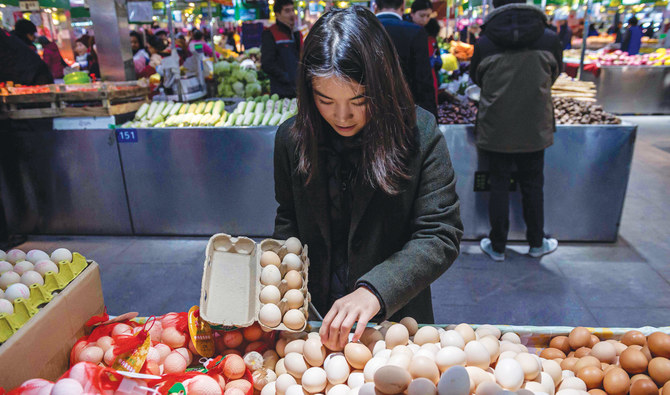
Carrie Yu, founder of zero-waste shop The Bulk House, places eggs into her personal re-usable egg carton. Increasing numbers of Chinese people are embracing a life of recycling and sustainability, as the country comes to terms with the scale of pollution caused by years of consumerism and growth. (AFP)
Short Url
Updated 22 January 2020
Follow

China’s zero-waste activists fight overconsumption

  • From central government to major corporations, pressure to produce re-usable goods and packaging is growing

BEIJING: Parcel piles at sorting centers and drivers speeding to deliver takeout are normal sights in urban China, where e-commerce and delivery apps thrive.

But the embrace of consumerism will generate as much as 500 million tons of waste annually by 2030, says the World Bank.

There are signs of a fightback — this week the government announced bans on plastic bags in cities and single-use straws from restaurants from this year.

The zero-waste movement is also grabbing public attention.

“Everything is wrapped with plastic, because it’s convenient, but the cost is tremendous,” said Carrie Yu, who committed to “zero-waste” living in 2016.

By recycling, repurposing and composting their garbage, Yu and her British partner Joe Harvey can fit three months of household waste into just two jars. Nearly every object in their apartment was selected with low environmental impact in mind.

A cardboard egg carton will be reused multiple times. Cloth make-up remover pads hang to dry after washing. Many of Yu’s clothes are second-hand or refashioned.

She buys unpackaged groceries, and makes sure to avoid restaurants that use disposable chopsticks.

GoZeroWaste, an organization set up by Beijing-based activist Elsa Tang, has members in 19 cities across China who meet to swap unwanted items and exchange tips.

“If we make more responsible choices, we’re being responsible for our lives, our health, and the environment,” Tang said.

For decades, Chinese people lived in a planned economy where everyday goods were rationed. Some aspects of zero-waste living, then, are familiar to older people.

It used to be common for merchants in the country to require packaging deposits for goods like yogurt, said Mao Da, an environmental history professor at Beijing Normal University.

“We used to think frugality was a glorious tradition,” Mao told AFP.

In the past, people would catch fish from the rivers and lakes near her village, but “you can see the pristine water right now just full of rubbish,” explained Yu, who grew up in rural Hubei province.

Growing incomes and the rise of delivery apps like Taobao have put impulse shopping and next-day delivery within  reach of millions.

Young people who moved away to cities “just bring so many things with packaging” whenever they return to visit, the 28-year-old said.

China produced 210 million tons of waste in 2017, according to World Bank data, lower than the US’s 258 million but expected to jump as incomes grow.

Efforts to tackle consumer waste are “slowly becoming mainstream” in China, Mao said.

Shanghai launched an ambitious garbage separation and recycling program in July, requiring residents to sort their own trash or risk fines. Beijing is set to follow.

In a document released Sunday, the government said production and sale of disposable polystyrene and plastic tableware would be banned by the end of the year.

The plan also outlaws single-use straws in the food and beverage industry this year, while disposable plastic should not be “actively provided” by hotels by 2022.

Corporations are also taking note. Chinese e-commerce giant Alibaba said last year it would make its annual Singles Day shopping festival “green” and set up 75,000 packaging recycling points in the country. Over 2.3 billion parcels were shipped in the aftermath of last year’s Singles Day.

But big corporations tend to prefer  promoting recycling to reducing consumption. “We must contain the total volume of the material being consumed,” Mao said.

Yu and Harvey are keen to encourage others to try their way of life and have launched The Bulk House, an online store that sells alternatives to single-use products including biodegradable tape and washable menstrual pads.

Yu, who made the change after a difficult move forced her to part with most of her belongings and confront her shopping habit, feels the “zero-waste” approach is good for people as well as the planet.

She explained: “I just feel so much lighter.”


Saudi stocks rebalance after Kingdom opens market to global investors

Updated 7 sec ago
Follow

Saudi stocks rebalance after Kingdom opens market to global investors

  • Foreign access reforms trigger short-term volatility while underlying market fundamentals hold

RIYADH: Saudi Arabia’s stock market experienced a volatile first week following a landmark decision to fully open the market to foreign investors—a move analysts view as essential to funding the Kingdom’s sweeping economic transformation plans.

The Tadawul All Share Index began the week with a sharp decline, falling 1.89 percent on Feb. 1, the same day new regulations eliminating key restrictions on international investment officially came into force. The index rebounded the following session and remained in positive territory for three consecutive days before slipping once more, ultimately ending the week down 1.34 percent.

Ownership data from Tadawul as of Feb. 1 indicated that foreign non-strategic investors reduced their holdings in nearly half of the companies listed on the TASI. An analysis conducted by Al-Eqtisadiah’s Financial Analysis Unit showed that foreign ownership declined in 120 firms, increased in 97 others, and remained unchanged across the remainder. Despite these shifts, the total number of shares held by foreign investors showed no overall change.

Speaking to Arab News, economist Talat Hafiz addressed the initial volatility in the TASI, explaining: “Stock markets in the Kingdom and globally naturally experience fluctuations driven by profit-taking and price corrections.”

He added that the index’s decline and subsequent recovery “appears to be primarily the result of technical and sentiment-related factors rather than a direct reaction to the opening of the market to foreign investors.”

Hafiz emphasized that this was particularly evident given that foreign participation in the Saudi market is not entirely new, having previously existed under alternative regulatory structures.

The market turbulence coincided with sweeping reforms enacted by the Capital Market Authority and announced in January. These measures included the removal of the restrictive Qualified Foreign Investor framework, which had imposed a $500 million minimum asset requirement, as well as the elimination of swap agreements. The reforms aim to attract billions of dollars in fresh investment while improving overall market liquidity.

Hafiz noted that an initial surge of foreign capital was widely expected to generate short-term volatility as portfolios were rebalanced and liquidity dynamics adjusted. However, the rapid recovery of the index suggests that the market’s underlying fundamentals remained strong and that investor confidence was not significantly undermined.

Earlier in January, experts had told Arab News that the reforms could unlock as much as $10 billion in new foreign inflows. Tony Hallside, CEO of STP Partners, described the move as a pivotal evolution, signaling that the Kingdom is committed to building the most accessible, liquid, and globally integrated financial markets in the region.

Hafiz reinforced this optimistic outlook, stating that broader market access is likely to yield positive effects by boosting liquidity, widening participation, and supporting overall market recovery—ultimately contributing to greater long-term stability once near-term adjustments ease.

He said: “TASI’s swift rebound reflects the market’s constructive response to increased openness and deeper investor participation.”

Hafiz said he does not believe the market opening is primarily intended to function as a conventional financing channel. Instead, he argued that its broader objective lies in the internationalization of the Saudi market, a goal underscored by its inclusion in major global indices.

He explained that attracting foreign capital should be understood less as a short-term funding solution and more as a structural reform aimed at strengthening market depth, efficiency, transparency, and global integration.

The Saudi economist added that while increased foreign participation can indirectly support Vision 2030 by enhancing liquidity and reducing the cost of capital, the opening of the market is “not designed as a direct mechanism to revive or fast-track projects that may have faced funding constraints.”

Rather, it creates a more resilient, globally connected financial ecosystem that can sustainably support long-term development ambitions, according to Hafiz.

As the market continues to stabilize, investors and observers are monitoring which sectors are expected to attract the largest share of investment in the coming weeks and months.

Hafiz told Arab News that foreign investment is expected to initially focus on companies operating in strategically significant, high-growth sectors such as healthcare, transportation, and technology, in addition to mining, energy, and telecommunications.

He added that experienced foreign investors are likely to gravitate toward firms demonstrating strong financial disclosure practices, sound corporate governance, adherence to environmental, social and governance standards, and a track record of consistent dividend payouts.