Court extends ex-PM Abbasi’s remand in Qatar LNG case
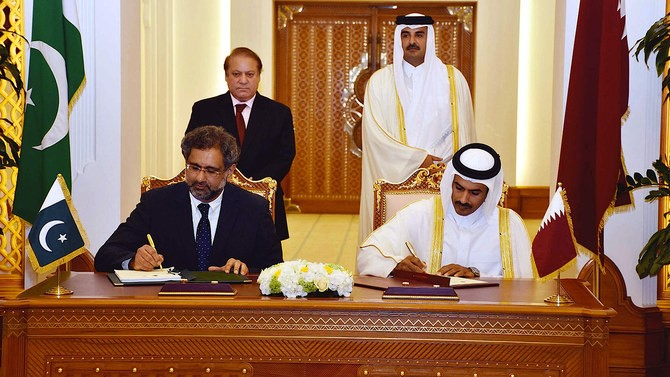
In this file photo, Shahid Khaqan Abbasi and then Qatargas chairman Saad Sherida Al-Kaabi are seen signing an agreement in Doha, Feb. 10, 2016. (PID photo)
Short Url
Updated 22 January 2020
Follow

Court extends ex-PM Abbasi’s remand in Qatar LNG case

  • Abbasi was present in court, another accused was declared an absconder
  • Last month anti-graft body filed a reference against 10 people, including Abbasi

ISLAMABAD: An accountability court in Islamabad on Tuesday extended the judicial remand of former prime minister Shahid Khaqan Abbasi until Feb. 4, in a case involving a multi-billion rupee contract for liquefied natural gas (LNG) imports from Qatar.

Abbasi was present at the court hearing during which another accused, former Pakistan State Oil (PSO) director Shahid Islam, was declared an absconder. Indictment proceedings in the case were adjourned until Feb. 4 due to Islam’s absence.

On Dec. 3, the National Accountability Bureau (NAB), Pakistan’s antigraft body, filed a reference against 10 accused, including Abbasi, former finance minister Miftah Ismail, and former PSO managing director Sheikh Imranul Haq.

According to NAB’s reference, Abbasi and others are accused of illegally awarding the LNG import contract to a private company on exorbitant rates. The company has received benefits of more than Rs21 billion between March 2015 and September 2019.

The reference said the national exchequer would suffer a loss of Rs47 billion by 2029 due to the contract.

Abbasi, vice president of the opposition Pakistan Muslim League-Nawaz (PML-N) party, was serving as a federal minister for petroleum in the cabinet of ex-premier Nawaz Sharif when he finalized the LNG import deal.

He served as prime minister following the resignation of Sharif in 2017.


Pakistani, Bangladeshi officials discuss trade, investment and aviation as ties thaw

Updated 28 December 2025
Follow

Pakistani, Bangladeshi officials discuss trade, investment and aviation as ties thaw

  • Pakistan and Bangladesh were once one nation, but they split in 1971 as a result of a bloody civil war
  • Ties between Pakistan, Bangladesh have warmed up since last year and both nations have resumed sea trade

ISLAMABAD: Pakistan's High Commissioner to Bangladesh Imran Haider on Sunday met Chief Adviser Muhammad Yunus in Dhaka, the latter's office said on, with the two figures discussing trade, investment and aviation.

Pakistan and Bangladesh were once one nation, but they split in 1971 as a result of a bloody civil war, which saw the part previously referred to as East Pakistan seceding to form the independent nation of Bangladesh.

Ties between Pakistan and Bangladesh have warmed up since former prime minister Sheikh Hasina’s ouster as a result of a student-led uprising in August 2024. Relations remain frosty between Dhaka and New Delhi over India’s decision to grant asylum to Hasina.

Pakistan has attempted to forge closer ties with Bangladesh in recent months and both South Asian nations last year began sea trade, followed by efforts to expand government-to-government commerce.

"During the meeting, both sides discussed ways to expand cooperation in trade, investment, and aviation as well as scaling up cultural, educational and medical exchanges to further strengthen bilateral relations between the two South Asian nations," Yunus's office said in a statement on X.

In 2023-24 Pakistan exported goods worth $661 million to Bangladesh, while its imports were only $57 million, according to the Trade Development Authority of Pakistan. In Aug. this year, the Pakistani and Bangladeshi commerce ministries signed a memorandum of understanding to establish a Joint Working Group on Trade, aiming to raise their bilateral trade volume to $1 billion in the financial year that began in July.

The Pakistani high commissioner noted that bilateral trade has recorded a 20 percent growth compared to last year, with business communities from both countries actively exploring new investment opportunities, according to the statement.

He highlighted a significant increase in cultural exchanges, adding that Bangladeshi students have shown strong interest in higher education opportunities in Pakistan, particularly in medical sciences, nanotechnology, and artificial intelligence. Haider also said that Dhaka-Karachi direct flights are expected to start in January.

"Chief Adviser Professor Muhammad Yunus welcomed the growing interactions between the two countries and emphasized the importance of increased visits as well as cultural, educational and people-to-people exchanges among SAARC (South Asian Association for Regional Cooperation) member states," the statement read.

"Professor Yunus also underscored the need to further boost Bangladesh–Pakistan trade and expressed hope that during Mr. Haider’s tenure, both countries would explore new avenues for investment and joint venture businesses."