LAHORE: Pakistan has allowed private companies to import 300,000 tons of wheat duty-free in an attempt to fill the worst shortage in the staple crop in years.
On Monday, the Economic Coordination Committee (ECC) agreed to import wheat amid soaring prices of the crop on the domestic market.
The first imports are expected to arrive by Feb. 15, said Imtiaz Ali Gopang, commissioner at the Ministry of National Food Security and Research.
“Companies will be allowed to buy from Ukraine, Kyrgyzstan and Kazakhstan,” he told Arab News.
In Pakistan, wheat is planted in November and harvested in March and April. From 2015 until last year, production was above-average, and in November 2018, according to Gopang, the government even planned to export 500,000 tons to neighboring Afghanistan.
Last year, however, the country missed its target of 25.5 million tons by 1.03 million tons, according to the ministry’s data. In April last year, a spell of heavy rains damaged wheat crops in Punjab, which contributes 70 percent of Pakistan’s wheat production.
“The weather damaged 10 to 15 percent of the crop in Punjab, creating a major shortage,” said Abdul Rouf Mukhtar, the chairman of the Punjab chapter of Pakistan Flour Mills Association.
In July, the government banned all exports of wheat and wheat flour. However, in October they were partially resumed, according to the Food and Agriculture Organization (FAO), following pressure from flour mill associations.
“We had suggested that exports should not be stopped. If there is a shortfall it should be filled by importing wheat,” Mukhtar told Arab News. “But when exports were banned, our market in Afghanistan was badly affected. Now, the country is buying mostly from Kazakhstan, rather than us.”
What furthered the crisis, as Federal Minister of National Food Security Khusro Bakhtiar told reporters on Sunday, was the Sindh province running late in wheat lifting for the central pool.
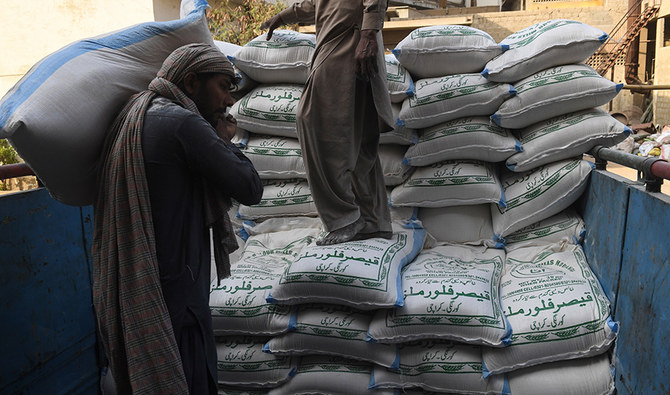
Consumers and small-scale flour mills have been worst affected. Last week, residents of Punjab, Sindh and Khyber Pakhtunkhwa complained that flour was either not available or its prices were exorbitant.
Muhammad Ismail Tariq, who runs a small chakki (millstone) in Lahore said he did not have wheat to grind the entire last week. He had to buy it for nearly double the price set by the government. “I have been in this business for a really long time,” he said, “I have never seen anything like this. The last time there was a wheat shortage was in 2013. Even that was not this bad. There seems to be no pre-planning this time.”
Rival political parties have also slammed the government for the surge in wheat prices. An opposition leader, Pakistan Muslim League-N (PML-N) president Shehbaz Sharif, who is currently in London, accused the government of “callouses” and “apathetic attitude” in a Twitter post on Saturday.
According to the government, hoarders are responsible for the current crisis. “They are using black money to buy flour and rice from the market and creating a shortage, to sell the items at higher prices,” Firdous Ashiq Awan, the prime minister’s special assistant, told reporters on Sunday.
Last year, 370 mills were shut down by the government, but only a few were charged with hoarding.
“Out of the 370 suspensions, 15, to date, have been shut down due to hoarding,” Punjab government spokeswoman Musarrat Jamshed said.
According to ECC’s Gopang, the major reason behind the crisis was mismanagement. There are also fears regarding the effects climate change will have on the country’s harvests in the coming years. “Right now, we are importing to mitigate and plan for any such crisis again in the future.”


![]()

Pakistan to buy 300,000 tons of wheat from Central Asia, Ukraine
Short Url
https://arab.news/52t6q
Pakistan to buy 300,000 tons of wheat from Central Asia, Ukraine
- First wheat imports will arrive by Feb. 15
- Consumers and small-scale flour mills have been worst affected by Pakistan’s wheat crisis
Latest updates


Recommended


© 2026 SAUDI RESEARCH & PUBLISHING COMPANY, All Rights Reserved And subject to Terms of Use Agreement.