

Alice Wells in Pakistan to discuss Afghan peace, regional security

Adviser to the Prime Minister on Commerce, Industries & Production and Investment Abdul Razak Dawood, 3rd left, is seen in a meeting with Alice Wells, 2nd right, Acting Assistant Secretary of State, Bureau of South & Central Asia Affairs alongwith Ambassador Paul Jones, right, in Islamabad on Jan. 20, 2020. (Supplied)
Short Url
Updated 20 January 2020
Follow

Alice Wells in Pakistan to discuss Afghan peace, regional security

  • The US deputy secretary of state for South and Central Asia visited Sri Lanka and India prior to her arrival
  • On Friday, FM Qureshi reminded Washington of Pakistan's help in Afghan peace process and asked for help in FATF issue

ISLAMABAD: Alice G. Wells, chief US diplomat for South Asian affairs, arrived in Islamabad on Sunday on a four-day visit centered on discussions regarding the peace process in Afghanistan, bilateral and regional issues, the US embassy in Islamabad said in a statement on Sunday.
Wells — US Deputy Assistant Secretary of State for South and Central Asian Affairs — was received at the airport by foreign office and US embassy officials. She has been on a tour of South Asia since Jan. 13 and has been to Sri Lanka and India prior to her arrival in Pakistan.
Wells’ visit to Islamabad comes immediately after Pakistan’s Foreign Minister Qureshi concluded his trip to the US where he interacted with senior United Nations and American officials in New York and Washington. 
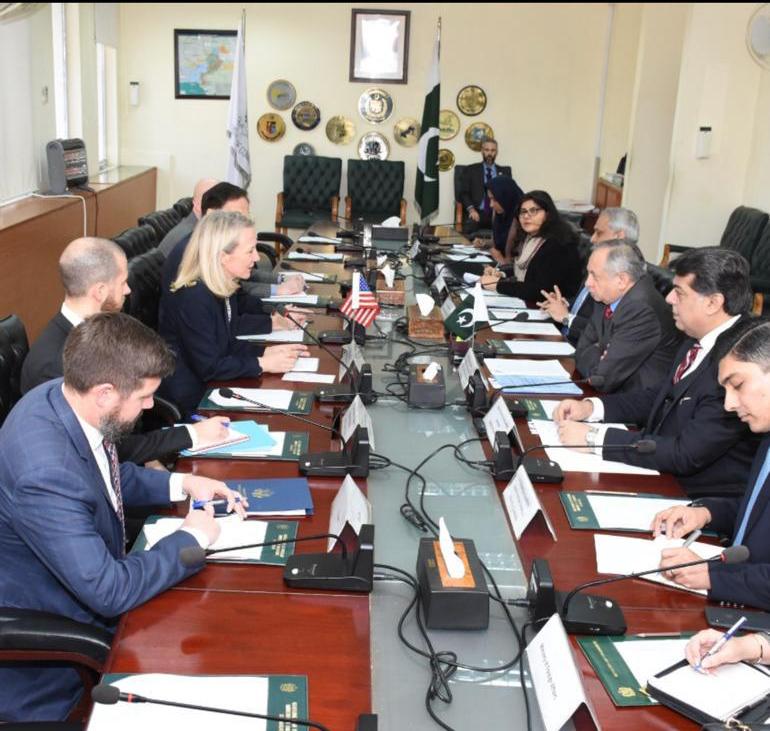


The U.S, Acting Assistant Secretary of State for South and Central Asian Affairs, Ms. Alice Wells met with Adviser to Prime Minister of Pakistan for Commerce, Textile, Industry & Production and Investment in Islamabad on January 20, 2020. (Photo Courtesy: Abdul Razak Dawood Twitter Account)

According to Amir Rana, director of prominent Islamabad-based think tank, Pakistan Institute of Peace Studies, the Afghan peace deal will be top of Wells’ agenda during her Pakistan tour.
Pakistan’s role in recent developments in the Middle East has positioned it as “an effective backdoor communication channel between Iran and the United States,” he added. 
In a news briefing in Washington on Friday, Qureshi strongly urged the US to help get Pakistan off the grey-list of global anti-money laundering watchdog, the Financial Action Task Force (FATF) at a decisive meeting in Beijing next month. A downgrade from the grey-list could result in crippling economic sanctions.
During the briefing, Qureshi said Pakistan had fulfilled its commitments to the US on facilitating the Afghanistan peace process, brought the Taliban to the negotiating table and assisted in releasing western hostages from insurgents — and had met FATF’s demands. 
The foreign minister reminded Washington: “Pakistan fulfilled your expectations. Now, we too had some expectations, what have you done (for us)?”— hinting Pakistan expected the US would help Islamabad in turn.
The US has consistently enlisted Pakistan’s help in facilitating rocky US-Taliban negotiations, which are reported to be inching near a peace deal this month.
“This is a sequel to Foreign Minister Qureshi’s visit, to coordinate the expected peace deal signing with the Taliban and potential US troops’ pullout from Afghanistan,” leading security analyst, Imtiaz Gul, told Arab News. 
Political expert Taimur Shamil told Arab News: “FATF is a tool to politically pressure Pakistan to do America’s bidding in Afghanistan. It... will likely continue till the Afghan issue is resolved.” 
Wells is expected to meet Prime Minister Imran Khan and army chief General Qamar Javed Bajwa during her visit, as well as foreign minister Qureshi.
Her last visit to Pakistan was in August last year.


Nearly 25% of Pakistan’s primary schools enrolling girls operate as single-teacher ones— report

Updated 13 sec ago
Follow

Nearly 25% of Pakistan’s primary schools enrolling girls operate as single-teacher ones— report

  • Pakistan needs over 115,000 more teachers in primary schools enrolling girls to meet global benchmark of one teacher per 30 students, says report
  • Sixty percent of Pakistani primary schools enrolling girls are overcrowded, while 32% lack clean drinking water or toilets, says Tabadlab report

ISLAMABAD: Nearly 25% of Pakistan’s primary schools that enrolls girls operate as single-teacher ones, a report by a leading think tank said this week, calling on the government to devolve teacher recruitment powers, upskill underutilized teachers and introduce reforms to hire and promote faculty members. 

Pakistan faces an acute education crisis which is reflected in the fact that it has the world’s second-highest number of out-of-school children, an estimated 22.8 million aged 5-16 who are not in educational institutions, according to UNICEF. 

While poverty remains the biggest factor keeping children out of classrooms, Pakistan’s education crisis is exacerbated by inadequate infrastructure and underqualified teachers, cultural barriers and the impacts of frequently occurring natural disasters. 

According to “The Missing Ustaani,” a report published by Islamabad-based think tank Tabadlab and supported by Malala Fund and the Pakistan Institute of Education (PIE), Pakistan needs over 115,000 more teachers in primary schools with girls’ enrolment to meet the basic international benchmark of ensuring one teacher per 30 children. Currently, the average Student-to-Teacher Ratio (STR) across Pakistan’s primary schools with girls’ enrolment is 39:1, it said. 

“Approximately 60% of these schools are overcrowded, necessitating the recruitment of over 115,000 additional teachers nationwide,” the report said on Monday. “Compounding this, nearly 25% of primary schools with girls’ enrolment operate as single-teacher schools, placing immense pressure on the quality of education.”

It said the situation is more dire in Pakistan’s poverty-stricken southwestern Balochistan province, where nearly 52% of the schools are single-teacher only ones while the percentage decreases slightly in the southern Sindh province to 51 percent. 

The report said while the STR improves to 25:1 at the middle school level, acute shortages of subject specialists emerge as the top-priority concern for quality education in these schools.

“Furthermore, around 32% of primary schools with girls’ enrolment and 18% of middle schools face ‘critical infrastructural shortages’— lacking clean drinking water or toilets in addition to high STRs— which significantly affects girls’ attendance and learning, particularly during adolescence,” the report said. 

The report cited a set of priority recommendations to address Pakistan’s systemic teacher deployment challenges and improve educational equity for girls. 

It urged the government to devolve recruitment authority to school or cluster levels to enable timely, context-specific hiring. It also called upon authorities to reform teacher transfer and promotion policies to introduce school-specific postings with minimum service terms. 

This, it said, would reduce arbitrary transfers and improving continuity in classrooms. The report advised authorities to upskill surplus or underutilized primary teachers to support instruction at the middle school level, helping address subject-specialist shortages.

“Together, these reforms offer a pathway toward a more equitable, efficient, and responsive teaching workforce— one capable of improving learning outcomes and ensuring that every girl in Pakistan has access to a qualified teacher,” the report said. 

To tackle Pakistan’s education crisis, Prime Minister Shehbaz Sharif declared an ‘education emeregency’ in September 2024, stressing the importance of education for all.