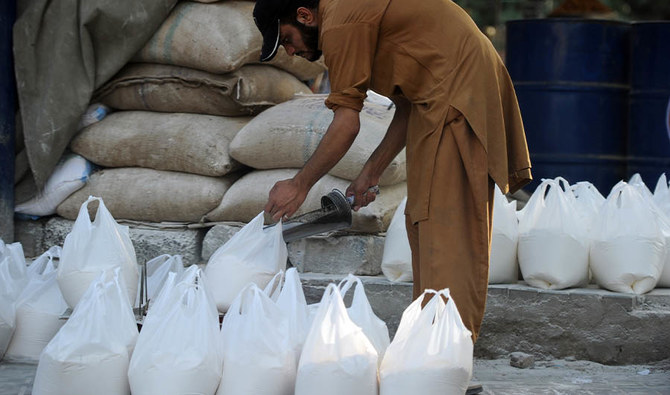
ISLAMABAD: Prime Minister Imran Khan has directed provincial chief secretaries to launch a “grand operation” against wheat hoarders and profiteers to bring down spiraling flour prices.
The PM’s directive comes days after the rate of wheat flour rose from Rs43 per kilogram to Rs75 per kilogram in different parts of the country, triggering sharp public criticism and outcry against the government.
“As per the prime minister’s instructions, we have been working closely with provincial administrations to resolve the crisis as quickly as possible,” Dr. Javed Humayun, senior joint-secretary at the Ministry of National Food Security and Research, told Arab News on Sunday.
He said the federal government had also started releasing additional wheat stocks to provinces to meet their demand. “Provincial governments have also been directed to launch a crackdown against hoarders and profiteers to overcome this artificial crisis,” he said.
The prime minister has also constituted a two-member committee comprising a senior party leader Jahangir Khan Tareen and Federal Minister for National Food Security Khusro Bakhtiar to take measures to control the commodity’s price.
The government’s chief spokesperson Firdous Ashiq Awan has called the crisis “negative propaganda” that was driven by media outlets.
“Action will be taken against those who sell a 20kg flour bag above the government’s rate of Rs805,” Awan said on Sunday while addressing a press conference. She added that the government had set up 368 sale points to provide flour at the officially prescribed rate.
“The government will take action against hoarders and profiteers,” she continued. “It is our responsibility to fulfill all basic needs of the people and we are trying our best to do it.”
On the other hand, the country’s major opposition parties have criticized the government for its “failure” to control food prices and losing its writ against the hoarding mafia.
“Only in December, prices of basic food items registered a sharp increase of 82 percent and this is a clear proof of the failure of this government,” Marriyum Aurangzeb, spokesperson of the Pakistan Muslim League-Nawaz (PML-N), said.
Bilawal Bhutto Zardari, chairperson of the Pakistan Peoples Party, accused the authorities of “intentionally” creating a wheat flour crisis in the country by allowing the export of 40,000 metric tons of wheat to Afghanistan.
“Flour prices have increased the second time in one week which proves that the government has no control over things,” he said. “Today the country is facing the worst kind of price hike after increase in power and gas tariffs and petroleum prices.”
Pakistan’s inflation rate was recorded at 12.63 percent in December, the highest in the last nine years.
Economists and food security experts believe the crisis was caused by the “mismanagement” of federal and provincial administrations and urged them to resolve it quickly to ensure food security in the country.
“If the crisis is not resolved soon, it will definitely add to food insecurity and undernourishment of a large population that has already limited economic access to quality diet,” Dr. Abid Qayyum Suleri, executive-director of the Sustainable Development Policy Institute (SDPI) in Islamabad, told Arab News.


Pakistan launches nationwide crackdown against hoarders to tackle wheat crisis
https://arab.news/4qqus
Pakistan launches nationwide crackdown against hoarders to tackle wheat crisis

- Sudden jump in wheat prices triggered sharp public criticism and outcry against the government
- The government will take action against hoarders and profiteers, PM’s aide says
Pakistan bank enables Shariah-compliant digital payment facility for passengers at Islamabad airport

Pakistan bank enables Shariah-compliant digital payment facility for passengers at Islamabad airport
- Pakistan is a cash-dominated market where a significant portion of transactions in the informal sector are made without any taxes, officials say
- The move comes amid Pakistan’s efforts to introduce a cashless model at airports under which only digital service providers can provide services
KARACHI: Aik, Pakistan’s first Islamic digital bank, has enabled fully digital payments at Islamabad International Airport to offer travelers and passengers secure, Shariah compliant digital transaction facility.
The development comes amid Pakistan’s efforts to introduce a cashless model at airports across the country, under which only digital service providers can provide services to customers.
Aik, a subsidiary of Bank Islami, said it has onboarded merchants across the Islamabad airport and integrated QR code deployments at key touchpoints to allow passengers and visitors to make secure, seamless, and Shariah-compliant digital transactions at all counters, retail outlets, and service points.
It said the implementation complies with the regulations and framework set by the State Bank of Pakistan (SBP) and is a working model for a large-scale adoption of cashless systems in public infrastructure.
“This deployment reflects our commitment to building practical digital infrastructure that improves everyday transactions,” Aik Chief Officer Ashfaque Ahmed said in a statement.
“By enabling a fully cashless environment at a major national gateway, we are supporting efficiency, transparency, and financial inclusion at scale. This is not only a project; it is a foundation for Pakistan’s cashless future.”
Pakistan is a cash-dominated market where a significant portion of transactions, particularly in the informal sector, are conducted in cash. Officials say many of these transactions are aimed at avoiding taxes.
In recent years, the SBP has taken steps to ensure a transition toward a more cashless economy so that transactions are more traceable, reducing chances of tax evasion and corruption.
By digitizing Islamabad airport, aik said it continues to invest in secure and accessible financial solutions that “expand digital participation and support national economic modernization.”


