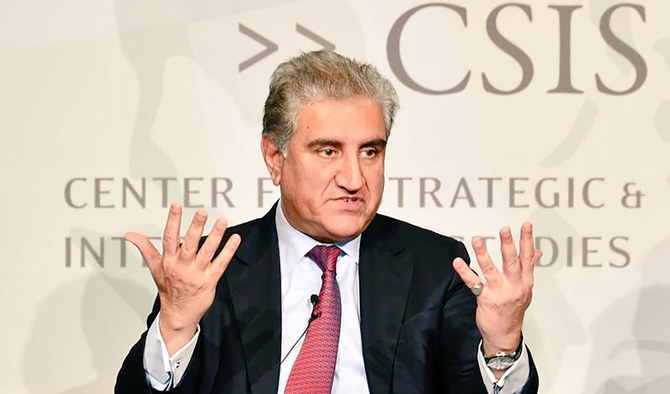
ISLAMABAD: Foreign Minister Shah Mahmood Qureshi expressed hope that 2020 could be “the year of peace in Afghanistan” and “no precipitate action” would disrupt it, the Foreign Office quoted him as saying at a Washington-based think tank on Thursday.
Qureshi also said he hoped that the withdrawal of foreign troops from Afghan territory would be “phased and orderly.”
“It is in no one’s interest to repeat the mistakes of the 1980s,” Qureshi said in a speech at Center for Strategic and International Studies (CSIS), referring to the abrupt US pullout from Afghanistan after Soviet withdrawal, according to the Foreign Office’s statement issued on Friday.
“We need to remember that peace in Afghanistan is ultimately a shared responsibility. Pakistan will and is playing its role, but it alone cannot do all that is needed,” he said, warning against “spoilers,” as “sadly, not every country in the broader region wants to see peace in Afghanistan,” he said.
The United States-backed proxy war against the Soviets in Afghanistan in the 1980s and its abrupt withdrawal of forces in 1989, have been linked to the rise of militancy in Pakistan and the whole region. In 2009, then US Secretary of State Hillary Clinton acknowledged that the US too had a part in creating the problem that plagues Pakistan today.
During his CSIS visit, Qureshi said that “for too long, the Pakistan-US relationship has remained hostage to the Afghan issue. We want this rather unhelpful framework to change.”
He also suggested that both the US and Pakistan need to “sharpen” their “focus and preparations for the post-conflict phase.”
Qureshi is currently in Washington for talks with the US officials.
In a meeting with members of the Senate Foreign Relations Committee, the foreign minister said that Pakistan was committed to the political reconciliation process in Afghanistan.
“The Committee members appreciated Pakistan’s role in the Afghan peace process and requested Pakistan’s continued support,” the foreign office said.
Qureshi also briefed the US Under Secretary of Defense John Rood about his recent visits to Saudi Arabia and Iran in Pakistan’s efforts to defuse ongoing tensions in the Middle East, following a US airstrike that killed the top Iranian commander Qassem Soleimani on Jan. 3.
Foreign relations analyst Rasul Bakhsh Rais told Arab News that US and its allies are trying to make sure that “state institutions, security arrangements and political order they have helped cultivate and build in Afghanistan must continue, while they withdraw their troops.”
“It would require the US to remain engaged in Afghanistan by supporting political stability, intra-Afghan reconciliation and post-conflict reconstruction,” Rais said.
Experts believe that US troop withdrawal from Afghanistan needs a basic expression of will for peace from the stakeholders.
Senior Pakistani diplomat Rustam Shah Mohmand said that the recent cease-fire announced by the Taliban was “not because of pressure from Pakistan.”
“This time when the talks resume, they would most likely lead to an agreement,” Mohmand told Arab News.
Foreign Office spokeswoman Farooqui said on Thursday that Pakistan welcomed the resumption of US-Taliban peace talks. “We hope that the talks would be concluded at the earliest leading the way to Intra-Afghan negotiations.”
“Under this umbrella, all efforts and negotiations whether it is cease-fire or any other aspect of the Peace Process is welcomed by Pakistan,” Farooqui said.


![]()

FM Qureshi hopes 2020 will be 'the year of peace in Afghanistan'
Short Url
https://arab.news/5bv72
FM Qureshi hopes 2020 will be 'the year of peace in Afghanistan'
- It is in no one’s interest to repeat the mistakes of the 1980s, says Qureshi
- Pakistani FM briefed US Under Secretary of Defense on Pakistan’s efforts to defuse ongoing tensions in the Middle East
Latest updates



Recommended


© 2026 SAUDI RESEARCH & PUBLISHING COMPANY, All Rights Reserved And subject to Terms of Use Agreement.