

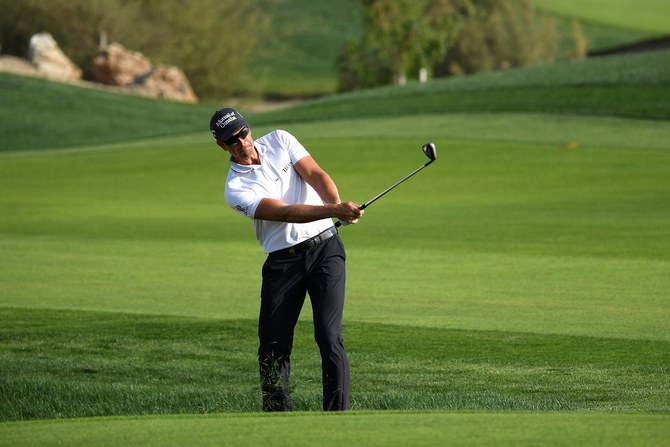
Swedish golfer Henrik Stenson eyes home advantage at upcoming Saudi International

Swedish golfer Henrik Stenson will be competing at the tournament that kicks off Jan. 30. (Supplied)
Short Url
Updated 15 January 2020
Follow

Swedish golfer Henrik Stenson eyes home advantage at upcoming Saudi International

  • The 43-year-old Swedish athlete said he is “ready to start 2020 strong” at the tournament to be held at the Royal Greens Golf and Country Club in King Abdullah Economic City
  • Stenson lauded the quality of the golf courses in the Kingdom, but said it was people’s hospitality that made the Middle East an ideal venue for the tournament

DUBAI: Middle East-based golfer Henrik Stenson is hoping for a home-court advantage as he returns to compete for the second time at the Saudi International golf tournament, which kicks off on Jan. 30.

The 43-year-old Swedish athlete said he is “ready to start 2020 strong” at the tournament to be held at the Royal Greens Golf and Country Club in King Abdullah Economic City.

Stenson, who was former world Number Two and currently the champion of the Hero World Challenge, was hoping for a big crowd at the Saudi tournament, while recognizing how the sport has been growing in the Kingdom.

“Having played in Saudi Arabia last year it will be exciting to see how the country has developed and how much the golf course has evolved over the last 12 months,” Stenson said.

Stenson lauded the quality of the golf courses in the Kingdom, but said it was people’s hospitality that made the Middle East an ideal venue for the tournament.

“The Middle East has been my home for a number of years and the way you are welcomed is second to none,” he emphasized.

Stenson will be joined by the world’s top golfers including number one ranked Brooks Koepka, as well as Phil Mickelson, Sergio Garcia and Dustin Johnson who claimed victory in last year’s Championship.

The four days of action on the course will also see globally recognized music acts perform, as well as a whole host of golf-related activities.


Why 2026 could be Saudi Arabia’s most important sporting year yet

Updated 01 January 2026
Follow

Why 2026 could be Saudi Arabia’s most important sporting year yet

RIYADH: As Saudi Arabia accelerates toward hosting some of the world’s biggest sporting events, the focus has shifted from spectacle to systems.

Under Vision 2030, building long-term capability in event-hosting has become as important as attracting the events themselves. And 2026 may be the year where that strategy is comprehensively tested more than ever.

The calendar alone hints at its significance. A mix of returning global fixtures and first-time arrivals will have Saudi Arabia host a near-continuous run of major events across multiple sports, creating an opportunity to refine and scale its hosting model.

The year begins with the Dakar Rally, which returns to Saudi Arabia for a seventh edition. More than 900 drivers will traverse over 7,000 km of desert terrain in one of the most logistically demanding events in world sport.

Shortly after, attention shifts to Al-Inma Stadium, with the Spanish Super Cup bringing Barcelona, Athletic Bilbao, Atletico Madrid and Real Madrid to Jeddah.

A new arrival will make its way to Saudi Arabia just a day prior: the AFC U-23 Asian Cup, a key tournament on the road to AFC Asian Cup 2027.

Sixteen nations will compete, offering a rehearsal not just for players, but also organizers and infrastructure ahead of the Kingdom’s first continental flagship event.

January 2026 also marks a milestone beyond the confines of traditional sport. The WWE Royal Rumble — part of the WWE’s “Big Four” Premium Live Events — will be staged outside of North America for the first time.

Riyadh is set to be the stage for the larger-than-life professional wrestling characters that have wowed Saudi fans on many an occasion in recent years.

The remainder of 2026 continues in similar fashion. Events confirmed include the Formula 1 Saudi Arabian Grand Prix, Formula E, AFC U-17 Asian Cup, eSports World Cup, WTA Finals, Gulf Cup and the Asian Indoor and Martial Arts Games.

These events form a calendar that includes elite competition, youth development, mass participation and digital sport.

What makes 2026 particularly important — despite the presence of much larger events in the following years, such as the AFC Asian Cup, the Asian Games and the FIFA World Cup — is not the scale of individual events, but the volume and variety.

These events will allow Saudi Arabia to deepen its operational expertise and test its ability to deliver consistently across a range of disciplines. This approach aligns with the Kingdom’s broader national objectives.

According to the Vision 2030 website, adult participation in physical activity for at least 150 minutes a week reached 59.1 percent in 2025, breaking past the 2027 target.

Also, children’s participation has risen to 19 percent, speeding past the 2029 goal by four years. Major events, in this context, are not endpoints, but catalysts for the rapid growth on show.

That is why tournaments such as the AFC U-23 Asian Cup and AFC U-17 Asian Cup sit alongside the global spectacles on the 2026 calendar.

More than just a way of bringing as many events as possible to the Kingdom, they represent pathways for athletes, fans, volunteers and organizers to engage with sport at every level, while contributing to Saudi Arabia’s growing identity as a capable and credible host.

By the time the Kingdom turns its full attention to the AFC Asian Cup 2027 — just over 12 months from now — much of the groundwork will have already been laid.

In that sense, it is clear to see that 2026 will not just be about headlines, but also building the Kingdom’s readiness for the sheer variety of events to come.