

Govt confirms release of 2,080 Pakistani prisoners from Saudi jails

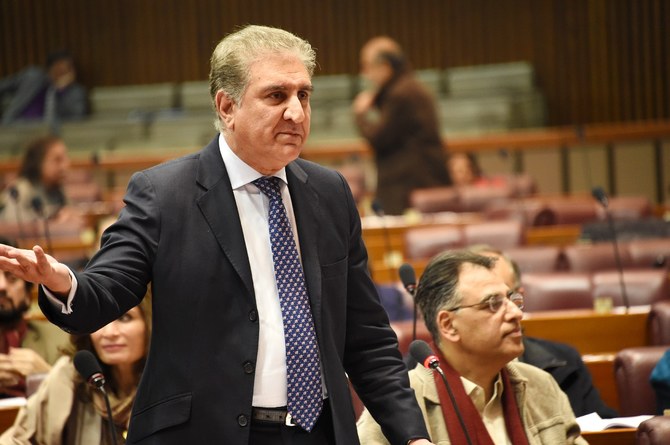
Pakistan’s Minister for Foreign Affairs Shah Mahmood Qureshi speaking at the National Assembly on 7th January, 2020. (Photo Courtesy: Foreign Office of Pakistan)
Short Url
Updated 16 January 2020
Follow

Govt confirms release of 2,080 Pakistani prisoners from Saudi jails

  • The Kingdom has so far released 2,080 Pakistani prisoners
  • Excellent bilateral relations between the two countries have helped the situation, says PM aide

ISLAMABAD: The government on Wednesday appreciated the Saudi authorities for releasing 2,080 Pakistani prisoners who were languishing in different jails in the Kingdom for crimes like forgery, theft, bribery and illegal bordering crossing.

Saudi Crown Prince Mohammed bin Salman ordered the release of about 2,100 Pakistani prisoners during a high-profile visit to Islamabad in February last year. Subsequently, the mutual cooperation between relevant authorities of both countries led to the release of Pakistani prisoners as promised by the crown prince, officials say.

“We have been getting excellent cooperation from the Saudi authorities and hope that our remaining prisoners will also be released soon,” Sayed Zulfiqar Abbas Bukhari, Special Assistant to Prime Minister Imran Khan on Overseas Pakistanis, told Arab News on Wednesday.

He said that Pakistan had managed to get a significant number of prisoners released from the Kingdom and this became “possible only due to the excellent bilateral relationship between both the brotherly countries.”

Bukhari said that a total of 3,284 Pakistani prisoners were in Saudi jailed – 1,859 of them were under the consular jurisdiction of the Pakistan Embassy in Riyadh and 1,425 under the Consulate General in Jeddah.

Official statistics show the government succeeded in getting 2,559 Pakistani prisoners freed out of a total of 6,880 imprisoned in Gulf countries, including 1,200 in the United Arab Emirates, 55 in Oman, 18 in Kuwait, 17 in Bahrain, 14 in Qatar and 10 in Iraq during the last year.

Most Pakistanis find themselves in detention in the Gulf for forgery, drug trafficking, illegal border crossing, theft, and bribery. A majority of those released had been sentenced to five or less than five years in prison.

Pakistan’s Minister for Foreign Affairs Shah Mahmood Qureshi on Tuesday informed the Senate that a total of 2,080 Pakistani prisoners jailed in Saudi Arabia had been released so far. He said that the number of Pakistani prisoners in Saudi jails kept changing due to the inflow and outflow of prisoners.

The minister said that the Pakistani mission in Saudi Arabia would periodically update the prisoner data after receiving information from the host government.

Qureshi informed the house that prisoners in Saudi Arabia were released upon completion of their sentences, as a result of royal clemency and normal pardon procedure in every Ramadan.

In cases where punitive measures include payment of fines/accidental diyats, many prisoners remain in custody due to non-payment of fines even after the completion of their sentences, he said.

The minister said the Pakistani mission in Saudi Arabia was taking different measures to ensure the release of prisoners, including the process of clemency requests with the Royal Court, visiting courts and meeting with the authorities to expedite delayed cases of release.

Bukhari, however, said that a “cogent mechanism” had been developed with the help of Saudi authorities to maintain a database of all Pakistani prisoners and convey all the latest updates to their families as well.

“Pakistanis in Saudi Arabia and other countries are our assets, and we are doing our best to take care of them,” Bukhari added.


IMF team expected in Islamabad today for loan reviews amid reform scrutiny

Updated 8 sec ago
Follow

IMF team expected in Islamabad today for loan reviews amid reform scrutiny

  • Talks to cover third review of $7 billion bailout and second climate resilience assessment
  • Analysts flag revenue shortfall and energy reforms as potential sticking points in negotiations

KARACHI: An International Monetary Fund (IMF) staff mission is expected to arrive in Islamabad today, Wednesday, to begin discussions on key program reviews that will determine Pakistan’s continued access to funding under its $7 billion bailout and a parallel climate resilience facility.

The visit, confirmed last week by IMF communications director Julie Kozack, will cover the third review under the Extended Fund Facility (EFF) and the second review under the Resilience and Sustainability Facility (RSF), which supports climate-vulnerable countries.

“We do have a staff team that is expected to visit Pakistan starting February 25th for discussions on the third review under the EFF and the second review under the RSF,” Kozack said at a regular press briefing last week.

The talks come at a sensitive moment for Islamabad, which has spent the past year implementing tax increases, subsidy rationalization and tight monetary policy to stabilize an economy that teetered on the brink of default in 2023.

IMF officials have credited those measures with producing measurable gains. Kozack said Pakistan’s policy efforts under the EFF had helped stabilize the economy and rebuild confidence, pointing to a primary fiscal surplus of 1.3 percent of GDP in the last fiscal year, contained inflation and the country’s first current account surplus in 14 years.

The review is expected to probe fiscal discipline and energy sector reforms, two areas that have historically complicated negotiations between Islamabad and the Fund.

Analysts told Arab News last week that while approval of the next tranche is likely, discussions might not be straightforward.

“This is expected to be a smooth sailing. However, questions might arise,” Shankar Talreja, head of research at Karachi-based Topline Securities Limited, said earlier.

He pointed to a revenue shortfall of Rs336 billion ($1.2 billion) against IMF targets and raised the possibility that the Fund may seek clarification over the government’s recent reduction in electricity tariffs for export-oriented industries, a move designed to support manufacturing but with fiscal implications.

A positive outcome of the review is vital for continued disbursements under the EFF and RSF programs. It will also be important to sustain investor confidence as the country seeks to consolidate its fragile economic recovery.

A successful staff-level review leads to a provisional agreement between the two sides, which then requires approval by the Fund’s Executive Board before the disbursement of the next tranche.